
Louis Pasteur · 1848
The Handedness of Molecules
A chemist of twenty-five looked into a microscope and found that molecules, like your hands, come in left and right — sorting crystals one by one with a pair of tweezers.
The walkthrough
Beat by beat
THE HOOK
0:20
01THE HOOK
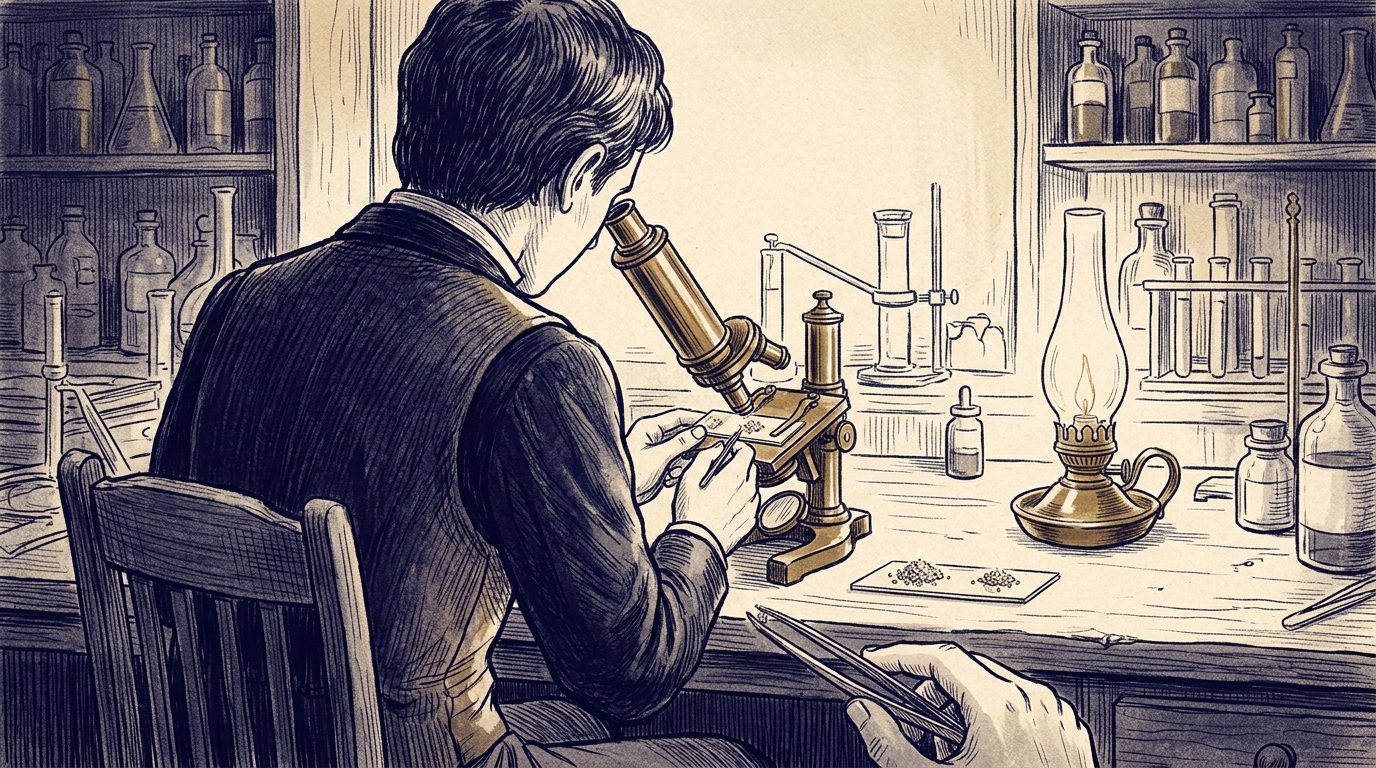
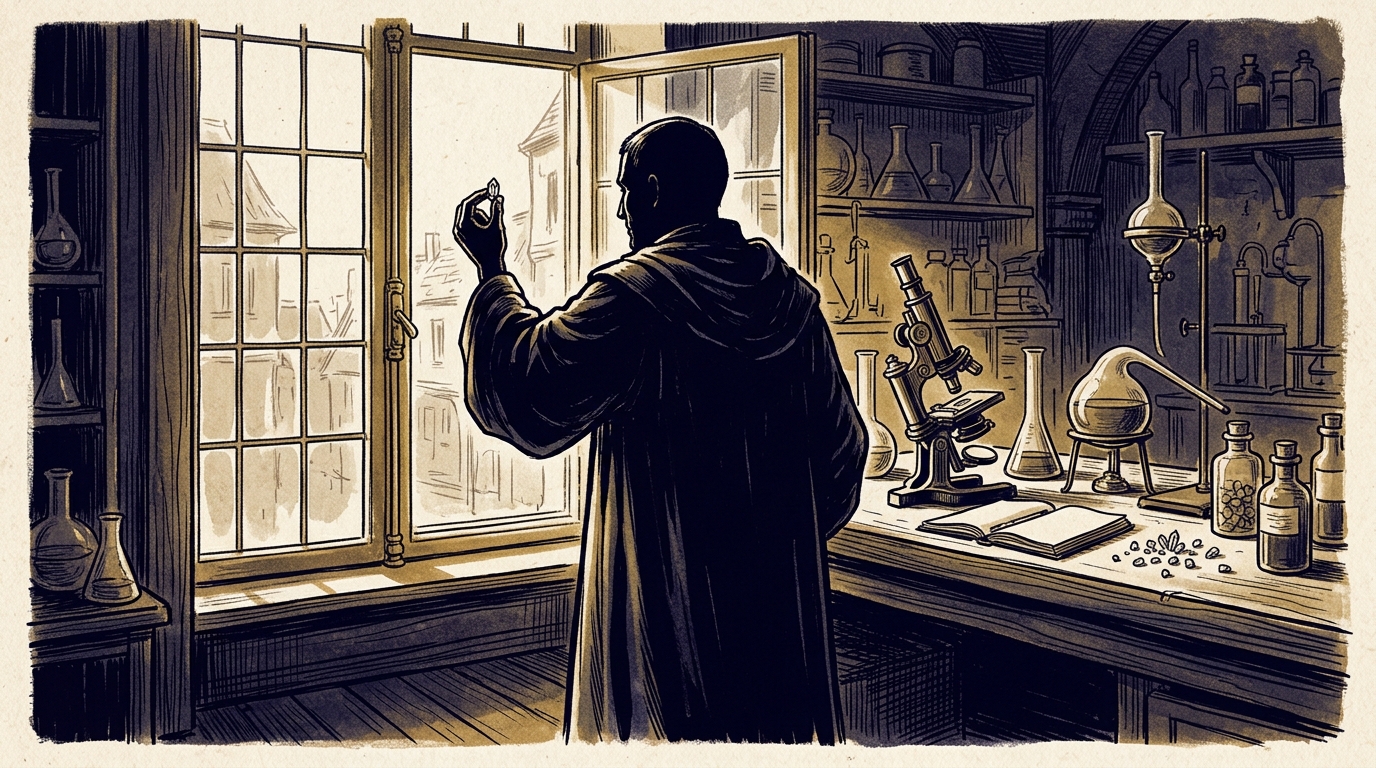
In 1848, a chemist of twenty-five looked into a microscope and discovered that molecules — like your hands — come in left and right `F1`. He proved it not with any grand apparatus, but with a pair of tweezers, sorting tiny crystals one by one `F1`.
02THE WORLD THEN
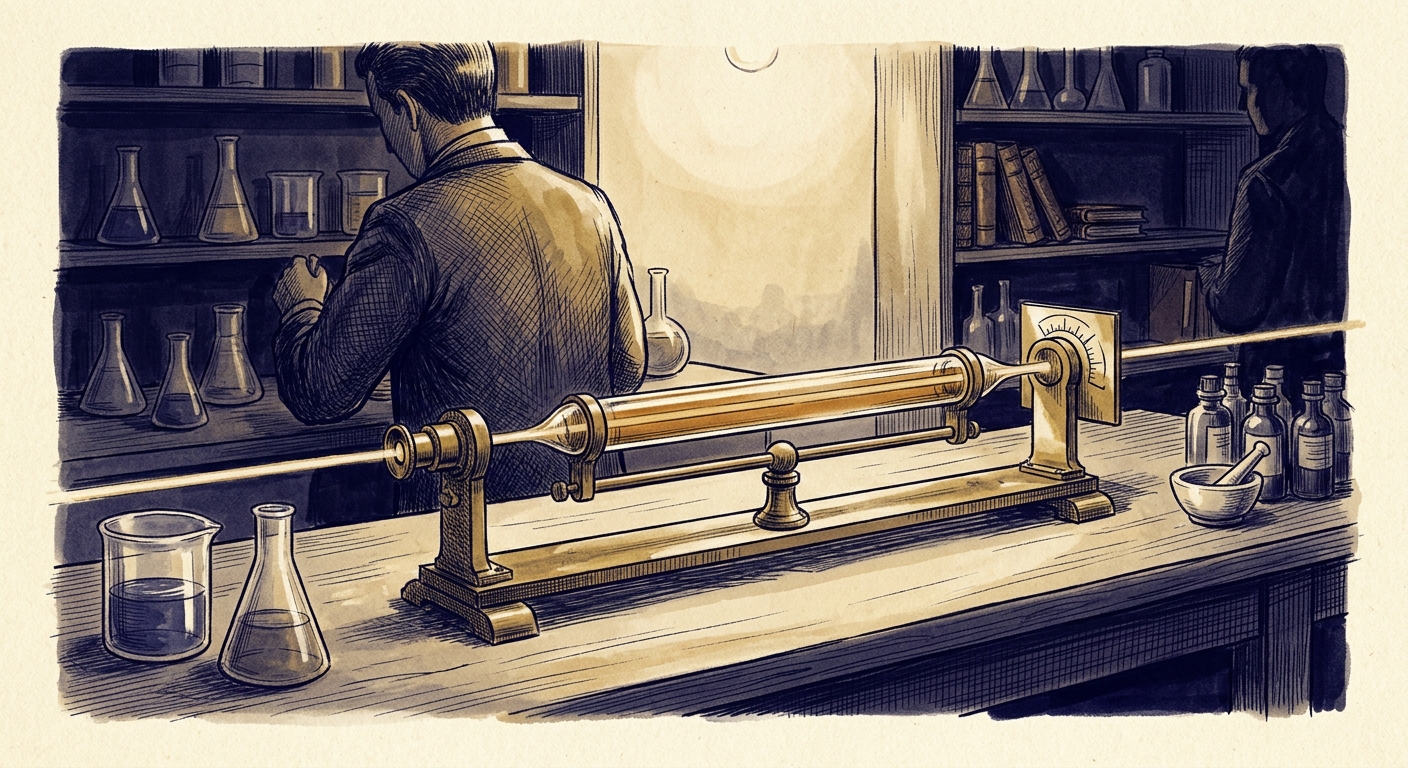
The clue came from wine. In the barrels, two acids form that had chemists baffled `F2`. Tartaric acid, and a rarer twin called racemic acid — and by every test, they were identical: the same atoms, the same formula, the same reactions `F2`. Yet shine a beam of polarized light through tartaric acid, and it twists the light's plane to one side. Through racemic acid — nothing at all `F3`. Two substances, the same in everything a chemist could measure — and yet one bent light and the other didn't `F3`.
03THE QUESTION
So here was the riddle. How can two substances made of exactly the same atoms differ in the way they touch light `F3`? Something about them had to differ — something no formula could capture `F8`.
04THE DESIGN ① under the microscope
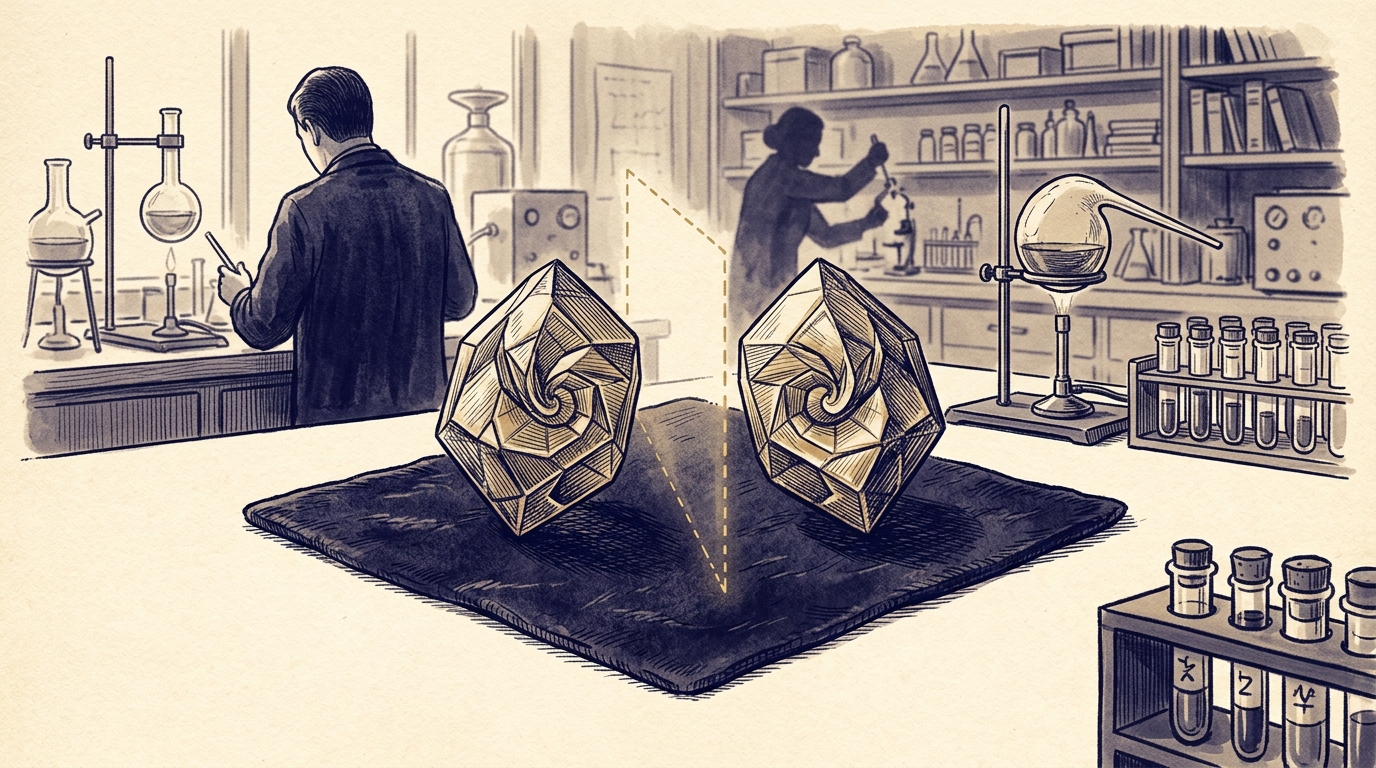
Pasteur crystallized a salt of the puzzling racemic acid, and put its crystals under the microscope `F4`. Each one carried a tiny slanted facet — an asymmetry `F4`. And the crystals came in two kinds: not different shapes, but mirror images of one another — a left-handed form and a right-handed form, like a scatter of tiny gloves `F4`.
05THE DESIGN ② the sort
So he did something almost absurdly patient. With a fine needle, under the lens, he sorted the crystals by hand — one at a time — into two piles: all the left-handed crystals here, all the right-handed there `F5`.
06THE RESULT
Then he dissolved each pile on its own, and sent polarized light through it `F6`. The right-handed crystals twisted the light to the right — exactly like natural tartaric acid. The left-handed crystals twisted it to the left, by precisely the same amount `F6`. Pour the two together, and their opposite twists cancel — which is why racemic acid, all along, had seemed to do nothing `F7`.
07THE MOLECULES
There was only one way to read this `F8`. The two acids are built from the very same atoms — but assembled into shapes that are mirror images, one the reflection of the other, and no more superimposable than your left hand on your right `F8`. The crystal's handedness was just the outward sign of a handedness in the molecule itself `F8`.
08WHAT WE LEARNED
Pasteur had found that molecules have a handedness — chirality — and with it, a whole new chemistry of shape `F8`. He couldn't yet say why; the picture of four bonds reaching out from a carbon atom, which explains it, was still twenty-six years away `F9`. But he had shown that a molecule's form — not only its ingredients — is part of what it is `F8`.
09WHY IT'S BEAUTIFUL
Its beauty is what he read, and how `F10`. With a microscope, a pair of tweezers, and a beam of light, Pasteur reached the three-dimensional shape of a molecule far too small to ever see `F10`. And he glimpsed something stranger still: that life itself keeps to one hand — the molecules of living things are almost all single-handed — a lopsidedness he suspected might be the very signature of life `F10`.
10SIGN-OFF
Two identical acids — told apart by a difference you could only hold in your hand. — Beautiful Experiments.
The write-up
In one line: In 1848 the 25-year-old Louis Pasteur showed that molecules come in left- and right-handed forms — not with any grand apparatus, but by crystallizing a salt of the optically "dead" racemic acid, noticing its crystals fell into two mirror-image shapes, sorting them by hand under a microscope into two piles, and finding that each pile rotated polarized light the opposite way, so that their 50/50 mixture cancels to nothing.
The world then
The clue came from wine. Two acids crystallize in the barrels — tartaric acid, and a rarer twin then called racemic (paratartaric) acid — and to every chemical test of the day they were the same substance: the same atoms, the same formula, the same reactions. But there was one place they parted. Jean-Baptiste Biot had shown in 1832 that dissolved tartaric acid rotates the plane of polarized light to one side; racemic acid, identical on paper, does nothing to the light at all. Chemistry had no language for a difference that composition could not name.
The question
How can two substances made of exactly the same atoms differ in the way they touch light? Something had to distinguish them — something no formula could capture. If it was not what they were made of, it had to be how they were put together.
The design
Pasteur crystallized a salt of the puzzling racemic acid and looked at its crystals under the microscope. Each one carried a small slanted facet — a built-in asymmetry (a hemihedral face). And the crystals were not all alike: they came in two kinds that were mirror images of one another, a left-handed form and a right-handed form, like a scatter of tiny gloves. So he did something almost absurdly patient. With a fine needle, under the lens, he sorted the crystals one at a time into two piles — every left-handed crystal here, every right-handed one there.
The result
He dissolved each pile on its own and read it in Biot's polarimeter. The right-handed crystals rotated the light to the right — exactly like natural tartaric acid. The left-handed crystals rotated it to the left, by the same amount. And when the two solutions were poured back together, their opposite rotations cancelled — which is precisely why racemic acid had always seemed optically dead. It was never one inert substance; it was a 50/50 mixture of two mirror-image acids whose twists erase each other.
What we learned, and why it's beautiful
There was only one way to read it. The two acids are built from the very same atoms, assembled into shapes that are mirror images — non-superimposable, like your left hand on your right. The crystal's handedness was just the outward sign of a handedness in the molecule itself. Pasteur had found chirality, and with it a chemistry of shape, not only of ingredients — the founding of stereochemistry. He could not yet say why molecules are handed; the picture of four bonds reaching out from a tetrahedral carbon that explains it was still twenty-six years away (van 't Hoff and Le Bel, 1874). The beauty is in what he read, and how: with a microscope, a pair of tweezers, and a beam of light, he reached the three-dimensional shape of a molecule far too small to ever see. And he glimpsed something stranger still — that the molecules of living things are almost all single-handed, a lopsidedness he suspected might be a signature of life itself.
Sources
Full claim-by-claim evidence is in references.md. Primary anchors:
- Pasteur, L. "Recherches sur les relations qui peuvent exister entre la forme cristalline, la composition chimique et le sens de la polarisation rotatoire." Annales de Chimie et de Physique 24, 442–459 (1848). — the manual separation of the tartrate enantiomers.
- Vantomme, G. & Crassous, J. "Pasteur and chirality" (review), Chirality 33 (2021). [PMC9291139] — a peer-reviewed history, including Pasteur's own 1848 words.
- Biot, J.-B. (1832) — the discovery that dissolved tartaric acid rotates the plane of polarized light.
- van 't Hoff, J. H. & Le Bel, J. A. (1874) — the tetrahedral carbon that explains molecular chirality.
- University of Illinois "Pasteur (1848)" X-ray crystallography exhibit; LibreTexts / OpenStax Organic Chemistry, "Pasteur's Discovery of Enantiomers." — accessible accounts of the separation and the optical result.
Accuracy notes:
- "Racemic acid" = the optically inactive (+)/(−) mixture — the substance later understood as equal parts of the two enantiomers, not meso-tartaric acid (a distinct, internally-compensated case the film does not raise).
- Pasteur was lucky, and knew it. The separable mirror-image (hemihedral) crystals form only from that particular sodium-ammonium salt of the acid, and only below about 26 °C. "Chance favors the prepared mind" — the observation was patient and fortunate both; the film frames it that way rather than as a guaranteed recipe.
- Shown vs. later explained. Pasteur inferred molecular handedness from the crystal handedness plus the optical result; he could not yet explain why molecules are chiral. The tetrahedral carbon that does was proposed by van 't Hoff and Le Bel in 1874, 26 years later.
- The "handedness of life" — that living matter is overwhelmingly single-handed — is Pasteur's later conjecture, suggested by this work but not proven by it.
- Optics kept qualitative. Only the direction of rotation (right vs. left), the equality of the two, and the cancellation of the mixture are stated — no specific rotation angles are presented as data. The on-screen crystals, polarimeter, and molecules are diagrams of the argument, not reproductions of Pasteur's figures.
The evidence
Every claim, sourced
Each [F#] you hear in the film links to the source it came from. Nothing gets narrated until every one is checked and signed off.
Sign-off
- Producer fact-check — the paradox (identical composition, different optical activity), the hemihedral two-form crystals, the manual sort, the equal-and-opposite rotations, the racemate cancellation, the enantiomer conclusion, and the 1848 citation are corroborated across the cited sources (Vantomme & Crassous with Pasteur's own words, the Illinois exhibit, LibreTexts, Wikipedia).
- ⚠️ Traps stated correctly in
script.md: (a) the salt was the sodium-ammonium racemate, and the separable hemihedry only appears below ~26 °C — Pasteur was lucky (kept as an honesty note in references, framed in-video as a patient, fortunate observation); (b) Pasteur inferred molecular shape from crystal shape and could not yet explain why — the tetrahedral carbon (van't Hoff/Le Bel, 1874) came later [F9]; (c) the handedness-of-life claim is Pasteur's later conjecture, not proven here [F10]; (d) "racemic acid" = the optically inactive (+)/(−) mixture (not meso-tartaric, a separate case not raised). - Numbers/optics kept robust: only the qualitative result is voiced (right vs left, "equal amounts," the mix cancels); no specific rotation angles put on screen as data.
- Chemist / historian sign-off (recommended before publish) — confirm the exact salt phrasing and the temperature/luck caveat against the 1848 paper and Vantomme & Crassous.
Gate OPEN → narration + render may proceed (prototype). Resolve the specialist box before public release.
- F1
In 1848 a 25-year-old Pasteur discovered that molecules come in left- and right-handed forms, by sorting tiny crystals by hand under a microscope — not with grand apparatus
The discovery + the manual crystal separation; Pasteur b. 1822 → age ~25 in 1848
- F2
From wine come two acids — tartaric acid and a twin, racemic (paratartaric) acid — with identical chemical composition and reactions (established by Gay-Lussac/Berzelius)
Same composition, different substances; "racemic" from racemus (grape)
- F3⚠ commonly confused
⚠️ The paradox: tartaric acid rotates the plane of polarized light (Biot, 1832), but racemic acid is optically inactive — two substances identical to every chemical test, yet different before polarized light
Tartaric = optically active; racemic = inactive; the discriminating property is optical, not chemical
- F4⚠ commonly confused
Pasteur crystallized a salt of racemic acid and saw under the microscope that its crystals bear a tiny asymmetric (hemihedral) facet, and come in two mirror-image forms. ⚠️ the salt was the sodium-ammonium tartrate/racemate; ⚠️ it only shows separable hemihedral crystals below ~26 °C — Pasteur was lucky in salt and temperature ("chance favors the prepared mind")
Hemihedral crystals in two enantiomorphous forms; the salt + the temperature caveat
- F5
He separated the crystals by hand (a fine needle/tweezers, under the lens) into two piles — left-hemihedral and right-hemihedral
The manual sort into two enantiomorphous piles
- F6
Dissolved separately and read in Biot's polarimeter, the right-hemihedral crystals rotate polarized light to the right (like natural tartaric acid) and the left-hemihedral rotate it to the left, by equal amounts — (Pasteur's own words, 1848)
The direct optical-rotation result, from the 1848 paper
- F7
So racemic acid is a 50/50 mixture of two mirror-image acids whose opposite rotations cancel — which is why it appeared optically inactive
The racemate = equal (+)/(−) mixture; net rotation zero
- F8
The two acids differ not in composition but in three-dimensional shape: their molecules are non-superimposable mirror images (enantiomers) — molecular handedness / chirality; the crystal's handedness reflects the molecule's
Molecular chirality established; enantiomers as non-superimposable mirror images
- F9⚠ commonly confused
It founded stereochemistry (a chemistry of shape); ⚠️ Pasteur could not yet explain WHY molecules are chiral — the tetrahedral carbon that does was proposed by van't Hoff & Le Bel in 1874, 26 years later
Founding of stereochemistry; the tetrahedral-carbon explanation came in 1874
- F10⚠ commonly confused
Why it's beautiful — with a microscope, tweezers and a light beam he read a molecule's 3-D shape without seeing it; and glimpsed that living things are almost all single-handed — a lopsidedness Pasteur suspected was a signature of life. ⚠️ the "handedness of life" is Pasteur's later thesis, not proven by this experiment alone
Reflection + the biological-homochirality thread (as Pasteur's conjecture)