
Brenner, Jacob & Meselson · 1961
The Message That Lives for Minutes
A gene never leaves the chromosome, yet the protein it codes for is built elsewhere. In 1961, three scientists caught the short-lived courier that carries the message between them — by weighing a cell's ribosomes. And the whole experiment nearly failed over a missing pinch of magnesium.
The walkthrough
Beat by beat
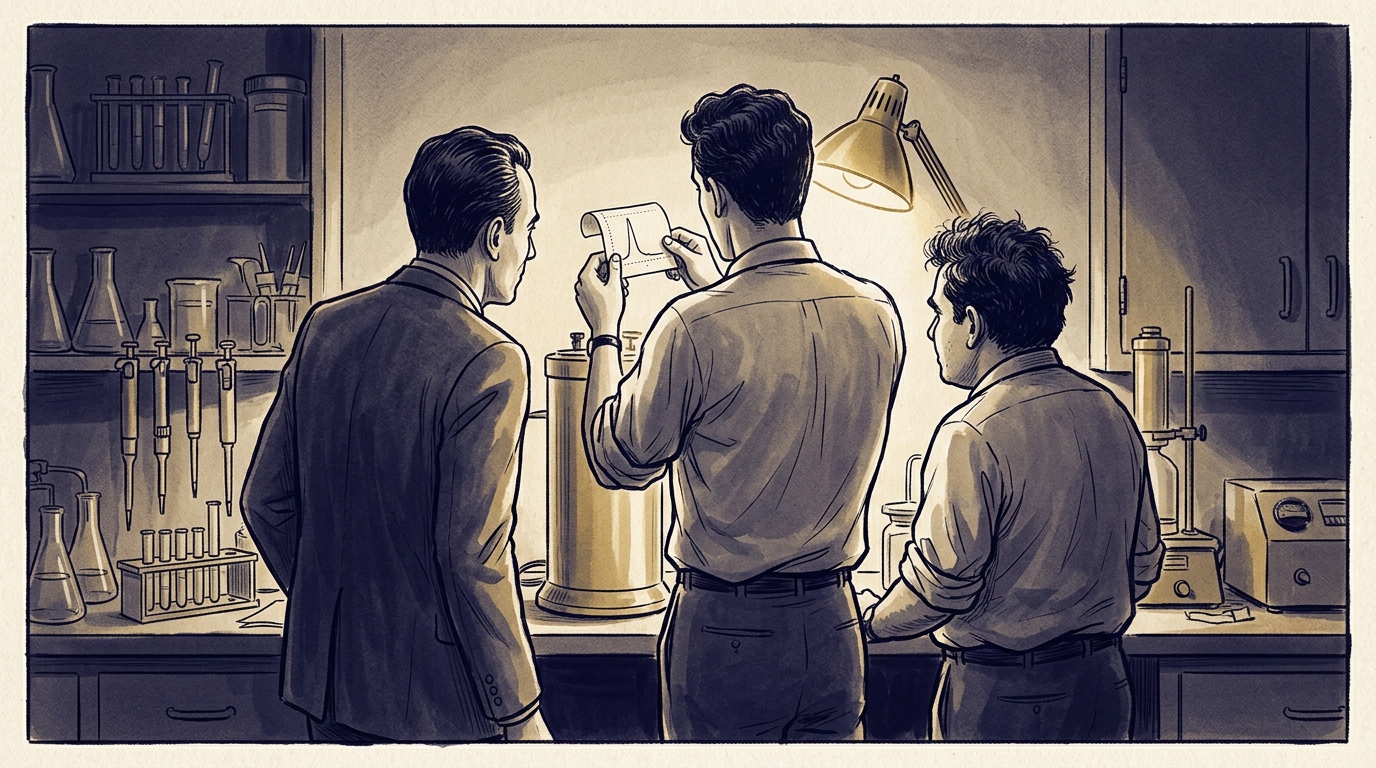
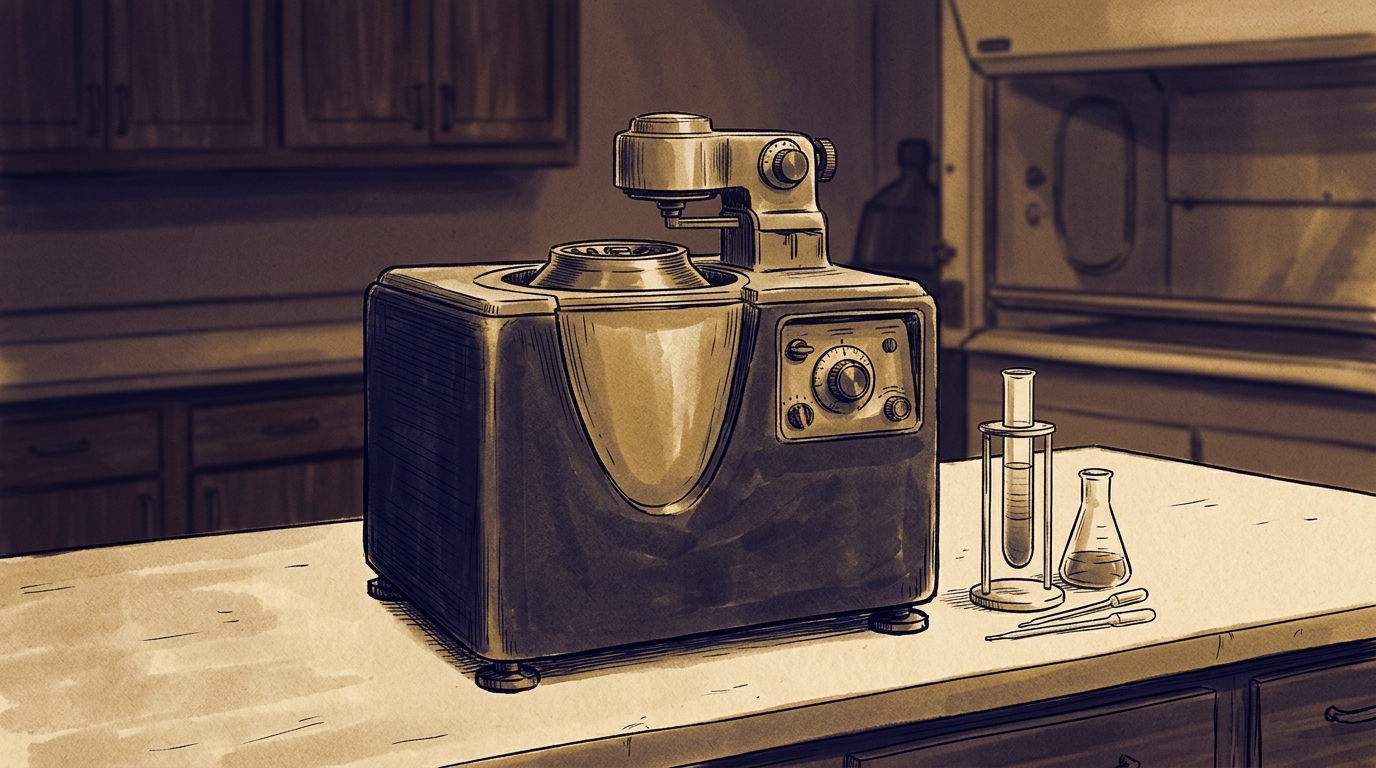
THE HOOK
0:20
01THE HOOK
The gene stays locked in the chromosome. The protein gets built somewhere else. So something has to carry the message between them `F1`. In 1961, three scientists caught that courier — by weighing it. A courier that lasts only minutes, then vanishes `F1`.
02THE WORLD THEN
By 1960, everyone knew where proteins were made. Little machines called ribosomes, thousands to a cell. But how they worked was a guess `F2`. The leading idea came from Francis Crick himself: each ribosome is a dedicated template — one ribosome, one protein `F2`. Its own RNA the gene's stamped copy. Make a new protein, and first you build a new ribosome to make it `F3`.
03THE CLUE
But there was a crack in that picture. Infect a bacterium with a virus, and within minutes it stops making its own proteins and starts making the virus's `F4`. Far too fast to build whole new factories. And years earlier, Volkin and Astrachan had seen something odd — right after infection, a burst of fresh RNA, short-lived, matching the virus's DNA, not the cell's `F5`. A message, maybe. No one could prove it.
04THE QUESTION
So Jacob and Monod made the bold guess: the gene doesn't build a new factory `F6`. It sends a short-lived message to the factories already there. Which posed a clean, testable question. After infection, does the virus build new ribosomes — or borrow the old ones? `F7` The two answers look identical down a microscope. You'd have to tell a brand-new machine from an old one reused.
05THE DESIGN ① the weight trick
And that is exactly what Meselson could do. Three years earlier he had weighed DNA. He grew it heavy, let it copy, and read the answer off a density gradient `F8`. Now he turned the same balance on the ribosome. Grow the bacteria for generations on heavy atoms — nitrogen-fifteen, carbon-thirteen — until every ribosome in the cell is dense `F9`. Then infect, and switch the food to ordinary light. From that moment, anything new is light `F9`. And tag the fresh RNA with radioactive phosphorus, so you can find it `F10`.
06THE DESIGN ② the two heights
Now the trap springs itself. Spin the mix in a cesium-salt gradient, and every particle sinks to its own weight `F8`. If the virus builds new ribosomes, the radioactive RNA rides down with them — light, high in the tube. But if it borrows the old ones, that same radioactivity clings to the heavy ribosomes, and sinks `F11`. One tube. Two possible heights. The whole answer is just: where does the red land?
07THE SNAG
But the first tubes were a mess. The radioactive RNA wouldn't stay put — it smeared, it drifted, it refused to band with the ribosomes at all `F12`. For weeks the experiment simply failed. Then one afternoon a colleague drove Brenner and Jacob out to the beach `F13`. And lying there in the sun, Brenner suddenly leapt up, shouting — the magnesium `F13`. The cesium was stripping the magnesium that holds a ribosome together. Starved of it, the machines fell apart and dropped their RNA `F14`. They raced back and flooded the gradient with magnesium `F14`.
08THE RESULT
This time the ribosomes held. And the counter told the story `F15`. The radioactive RNA — new, made only after infection — sat squarely on the heavy ribosomes. The old ones `F15`. No new factories had been built. The virus had sent its message to the machines already there `F16`.
09WHAT WE LEARNED
So the ribosome is not a template for one protein. It's a universal reading head — it will build whatever message is fed through it `F19`. And the message itself is a separate molecule: a working copy of the gene, made fresh, used, and destroyed within minutes `F17`. They named it messenger RNA `F18`. The missing middle of the central dogma — DNA, to RNA, to protein `F18`.
10WHY IT'S BEAUTIFUL
What makes it beautiful is the economy. A whole theory of the gene overturned — not by a new machine, but by where a spot of radioactivity came to rest `F19`. The same weight trick that had weighed DNA, borrowed and turned on the factory `F8`. And a month of dead ends undone by a single ion — the magnesium `F14`.
11SIGN-OFF
Sometimes the whole answer is hiding in a missing pinch of salt. — Beautiful Experiments.
The write-up
In one line: By making a cell's old ribosomes heavy and its new RNA radioactive, Brenner, Jacob and Meselson showed that a virus does not build new protein factories — it sends a short-lived message to the ones already there. That message is messenger RNA.
The world then
By 1960 the ribosome was known as the cell's protein factory, but no one knew how it worked. The sharpest guess belonged to Francis Crick: that each ribosome was a dedicated template — one ribosome for one protein, with the genetic specificity built into the ribosome's own RNA. In that picture, to make a new protein you had to build a new ribosome. Two loose threads nagged at it. Ribosomal RNA looked too uniform to be a library of diverse templates. And after Volkin and Astrachan infected E. coli with phage in 1956, a burst of short-lived RNA appeared whose base composition matched the phage's DNA, not the host's — an unexplained molecule nobody could yet place.
The question
Jacob and Monod proposed the alternative in 1961: the gene does not build a new factory, it dispatches an unstable "messenger" to the ribosomes already present. That turned a philosophy into a clean experiment. Infect a bacterium and it makes phage protein within minutes — far too fast to build a whole new set of ribosomes. So which is it: does the phage build new ribosomes, or borrow the old ones? Down a microscope the two look identical. The trick was to tell a brand-new machine from an old one reused.
The design
Matthew Meselson had already solved that class of problem. Three years earlier, with Franklin Stahl, he had weighed DNA — grown it dense on heavy isotopes, let it copy, and read the answer off a cesium-chloride density gradient. Here the same balance is turned on the ribosome. Grow E. coli for generations on heavy nitrogen-15 and carbon-13 so every existing ribosome is dense. Then infect with phage T4 and switch the cells to ordinary light medium, so anything made after infection is light — and label the new RNA with radioactive phosphorus-32. Spin in a CsCl gradient and every particle settles at its own weight. If the phage builds new ribosomes, the radioactive RNA rides high with the light ones; if it reuses the old ribosomes, the radioactivity sinks to the heavy band. One tube, two possible heights.
The magnesium. The first runs failed for weeks: the labelled RNA smeared through the gradient and refused to band with the ribosomes. The break came away from the bench — a colleague drove Brenner and Jacob to the beach, and lying in the sun Brenner suddenly leapt up shouting, "The magnesium!" The cesium salt had been stripping the magnesium ions that hold a ribosome's subunits together; starved of magnesium, the ribosomes fell apart and dropped their RNA. Flood the gradient with magnesium, and the machines held.
The result
With magnesium restored, the answer was unambiguous. The radioactive RNA — made only after infection — banded with the heavy, pre-existing ribosomes. No new ribosomes had been made. The phage had sent its message to the factories already in the cell.
What we learned, and why it's beautiful
The ribosome is not a template for one protein; it is a universal reading head that builds whatever message is threaded through it. The specificity lives in a separate molecule — a fresh working copy of the gene, used and destroyed within minutes: messenger RNA, the missing middle of the central dogma, DNA → RNA → protein. Its beauty is economy. A whole theory of the gene was overturned not by a new instrument but by where a spot of radioactivity came to rest — and a month of dead ends was undone by a single ion.
Sources
Full claim-by-claim evidence is in references.md. Primary anchors:
- Brenner S, Jacob F, Meselson M. "An unstable intermediate carrying information from genes to ribosomes for protein synthesis." Nature 190:576–581 (1961). — the experiment.
- Gros F, et al. "Unstable ribonucleic acid revealed by pulse labelling of Escherichia coli." Nature 190:581–585 (1961). — the back-to-back companion.
- Jacob F, Monod J. "Genetic regulatory mechanisms in the synthesis of proteins." J. Mol. Biol. 3:318–356 (1961). — the messenger hypothesis.
- Volkin E, Astrachan L. Virology 2:149–161 (1956). — the fast-turnover phage RNA (the clue).
- Jacob F, The Statue Within (1988). — the beach / magnesium account.
Accuracy note: The experiment used phage T4 (Volkin & Astrachan's 1956 clue used T2 — don't carry it forward). Volkin & Astrachan found an unexplained RNA in 1956; they did not "discover mRNA" — the messenger interpretation and proof are 1961. The Jacob–Monod paper is the theory; the Nature density-gradient paper is the experiment. The eureka is Brenner's, at an unnamed beach near Caltech, June 1960. mRNA's lifetime is kept qualitative ("within minutes"); no gradient density numbers are stated on screen.
The evidence
Every claim, sourced
Each [F#] you hear in the film links to the source it came from. Nothing gets narrated until every one is checked and signed off.
Sign-off
- PhD sign-off — facts above map to primary/authoritative sources; the ⚠️ traps (T4 not T2; Volkin–Astrachan ≠ mRNA discovery; theory-vs-experiment; eureka = Brenner) are stated correctly in
script.md. - Key numbers/dates verified: paper Nature 190:576–581 (13 May 1961); heavy = ¹⁵N + ¹³C; tracer = ³²P; phage = T4; eureka June 1960. mRNA half-life kept qualitative ("within minutes"); no density numbers on screen.
- "What was shown" vs "what was later confirmed" not overstated — the paper showed new phage RNA on old ribosomes (no new ribosomes); molecular mechanism of translation came later.
Gate OPEN → narration + render may proceed. (Runtime sign-off from the producer still pending — see `script.md` target.)
- F1
The gene stays in the chromosome; protein is built elsewhere; a short-lived intermediate carries the message — proven 1961 by Brenner, Jacob & Meselson.
The paper's title is the claim: "An unstable intermediate carrying information from genes to ribosomes for protein synthesis."
- F2
The leading pre-1961 idea (Crick, 1958) was "one gene–one ribosome–one protein": each ribosome a dedicated, stable template whose own RNA is the gene's copy.
Crick, "On Protein Synthesis," Symp. Soc. Exp. Biol. 12:138–163 (1958), articulated the ribosome-as-template hypothesis. ⚠️ It was a foil, not unchallenged dogma — Crick himself already doubted it (rRNA too uniform in base composition to be diverse templates).
- F3
Under that idea, making a new protein means first building a new ribosome to make it.
Logical content of the ribosome-as-template model (specificity resides in the ribosome ⇒ a new specificity requires a new ribosome).
- F4
Infect a bacterium with a phage and within minutes it stops making its own proteins and makes the phage's — too fast to build whole new factories.
T-even phage infection rapidly shuts off host synthesis and redirects the cell to phage products; the speed is the rationale for the experiment.
- F5
Volkin & Astrachan (1956): after phage infection a burst of new, short-lived RNA appears whose base composition matches the phage DNA, not the host's.
Volkin E, Astrachan L. "Phosphorus incorporation in E. coli RNA after infection with bacteriophage T2." Virology 2:149–161 (1956). ⚠️ They did not call it mRNA or claim the messenger role — that interpretation came later.
- F6
Jacob & Monod proposed the gene sends a short-lived "messenger" to pre-existing ribosomes rather than building new factories.
Jacob F, Monod J. "Genetic regulatory mechanisms in the synthesis of proteins." J. Mol. Biol. 3:318–356 (1961): "a short-lived intermediate, or messenger, which becomes associated with the ribosomes." ⚠️ A theory paper — not the CsCl experiment.
- F7
The clean, testable question: after infection, does the phage build new ribosomes, or send its message to the old ones?
The experiment's design distinguishes new-ribosome synthesis from reuse of pre-existing ribosomes.
- F8
The tool: Meselson's CsCl equilibrium density gradient — the same weight trick that had weighed DNA three years earlier — turned on the ribosome.
Meselson M, Stahl FW. "The replication of DNA in E. coli." PNAS 44:671 (1958); the CsCl density-gradient method (Meselson, Stahl & Vinograd) is Meselson's technique, reused here on ribosomes.
- F9
Bacteria grown for generations on heavy isotopes — nitrogen-15 (¹⁵NH₄Cl) and carbon-13 (¹³C-glucose) — so every pre-existing ribosome is dense; at infection, cells switch to ordinary light medium, so anything new is light.
Heavy media = ¹⁵NH₄Cl + ¹³C-glucose; shift to ¹⁴N/¹²C at infection is the density-labelling design.
- F10
Newly made RNA is tagged with radioactive phosphorus (³²P) so it can be located in the gradient.
³²P pulse labels RNA synthesized after infection.
- F11
The two-outcome logic: spin in CsCl; if the phage builds new ribosomes the radioactive RNA rides down light (high in the tube); if it borrows the old ones the radioactivity clings to the heavy ribosomes and sinks.
The density gradient reads out which ribosomes (heavy=old vs light=new) carry the labelled RNA.
- F12
The first experiments failed — the radioactive RNA would not stay bound to the ribosomes; it smeared and did not band.
Jacob's memoir account (via Norkin): weeks of failed runs before the fix.
- F13
Driven to the beach for a break, Brenner suddenly leapt up shouting "The magnesium! It's the magnesium!" (June 1960, at Caltech).
Jacob, The Statue Within (1988), quoted in Norkin: a colleague ("Hildegaard") drove Brenner & Jacob to the beach; Brenner "leaps up, yelling, 'The magnesium! It's the magnesium!'" ⚠️ The insight is attributed to Brenner specifically; keep the beach unnamed (accounts point to a marine-station beach near Caltech, not "Del Mar").
- F14
The cesium was stripping the magnesium that holds a ribosome together; starved of it, ribosomes fell apart and dropped their RNA. Flooding the gradient with magnesium fixed it.
Ribosomes require Mg²⁺ to keep the 70S particle (and its bound RNA) intact; raising Mg²⁺ in the gradient stabilised them and the label banded. "They... added plenty of magnesium."
- F15
With magnesium restored: the radioactive RNA — made only after infection — sat on the heavy (old) ribosomes.
The pulse-labelled phage RNA co-banded with pre-existing heavy ribosomes.
- F16
No new ribosomes were made after infection; the phage sent its message to the machines already there.
The result: phage RNA uses pre-existing ribosomes; ribosome is non-specialised.
- F17
The message is a separate molecule — a working copy of the gene, made fresh, used, and destroyed within minutes.
The paper shows the intermediate is unstable; the companion Gros et al. and later work put the half-life on the order of minutes. ⚠️ Narrate "within minutes"; the specific ~16-min figure is condition-dependent — keep qualitative on screen.
- F18
They named it messenger RNA — the missing middle of the central dogma, DNA → RNA → protein.
The term "messenger" is Jacob & Monod's (1961); the DNA→RNA→protein flow is Crick's central dogma (1958).
- F19
The interpretation: the ribosome is a universal reading head that will build whatever message is fed through it.
Non-specialised ribosome + separate messenger is the paper's conclusion.