
Matthew Meselson & Franklin Stahl · 1958
The Most Beautiful Experiment in Biology
How does a cell copy its DNA? Two young scientists settled biology's deepest question without ever watching it happen — by weighing molecules. It has been called the most beautiful experiment in biology.
The walkthrough
Beat by beat
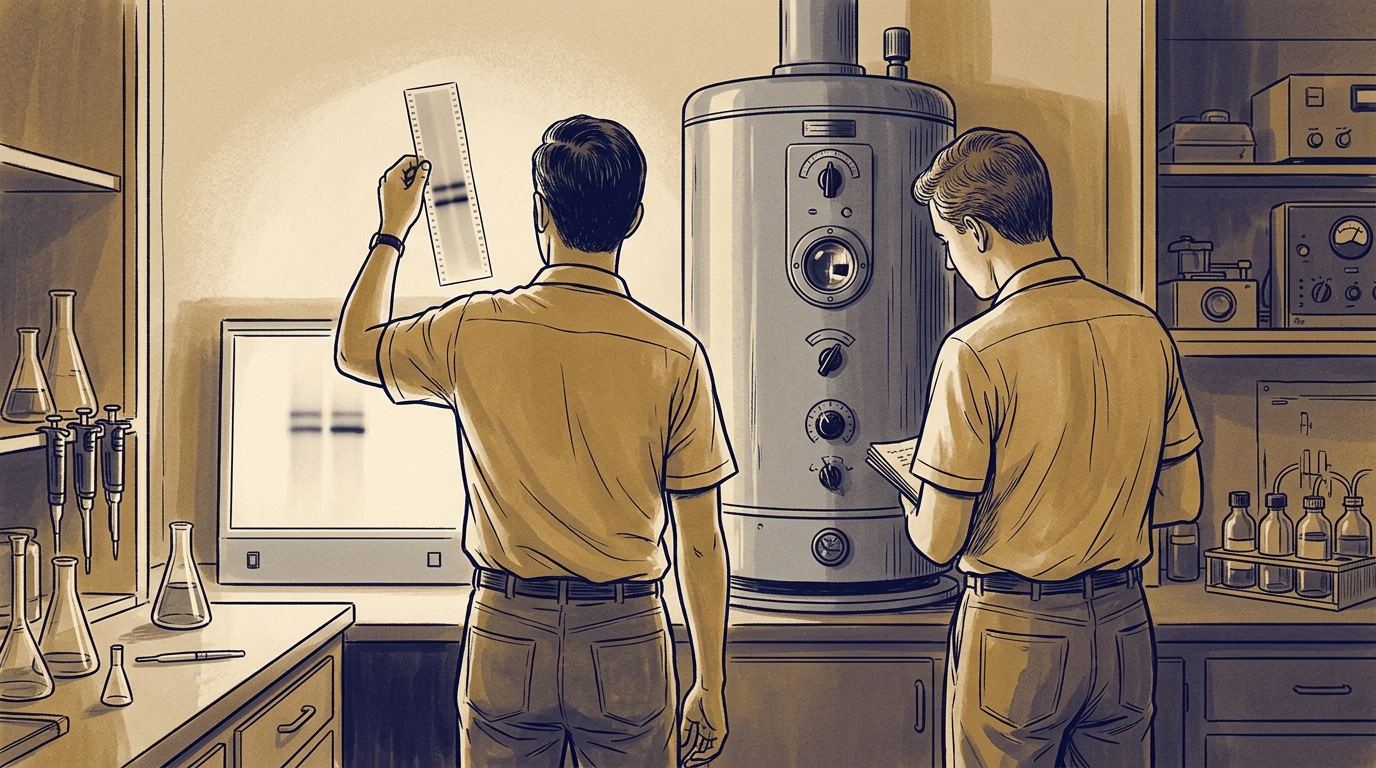
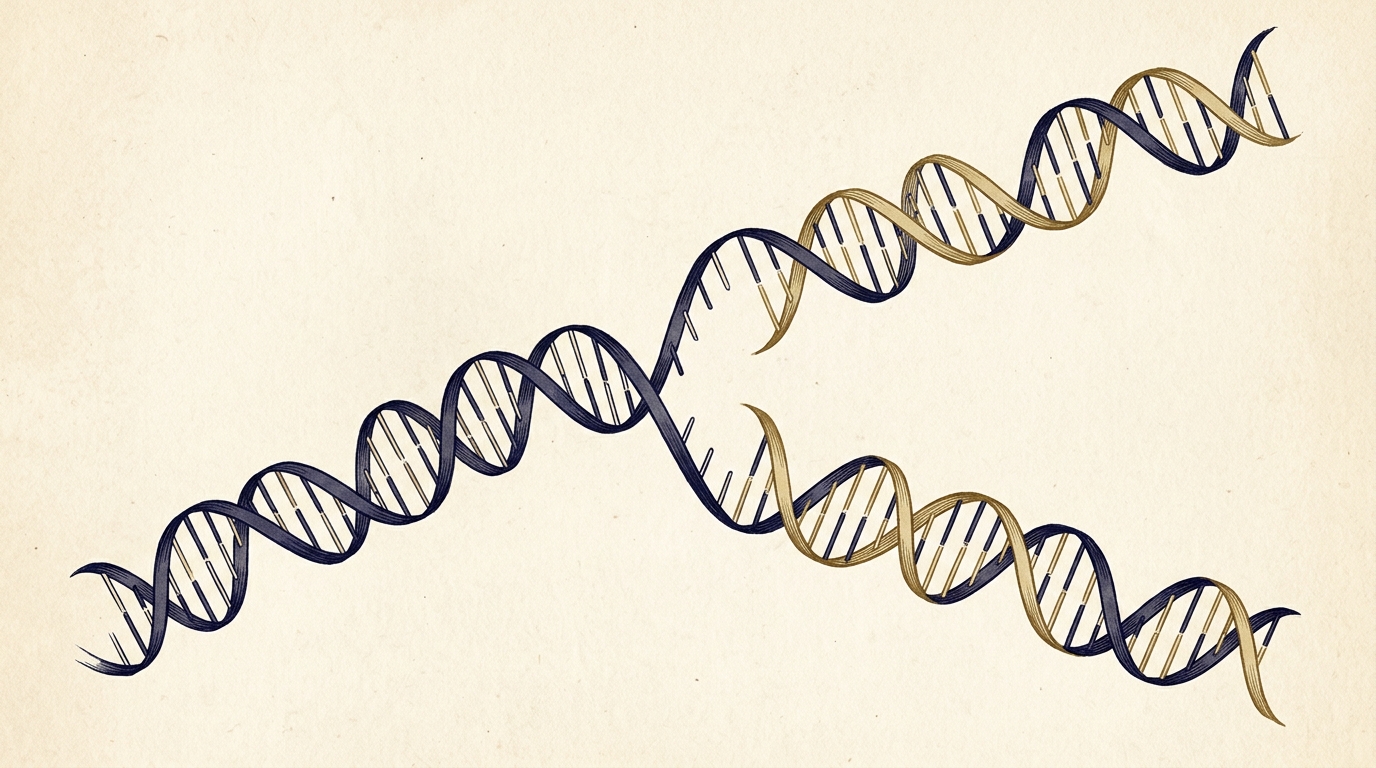
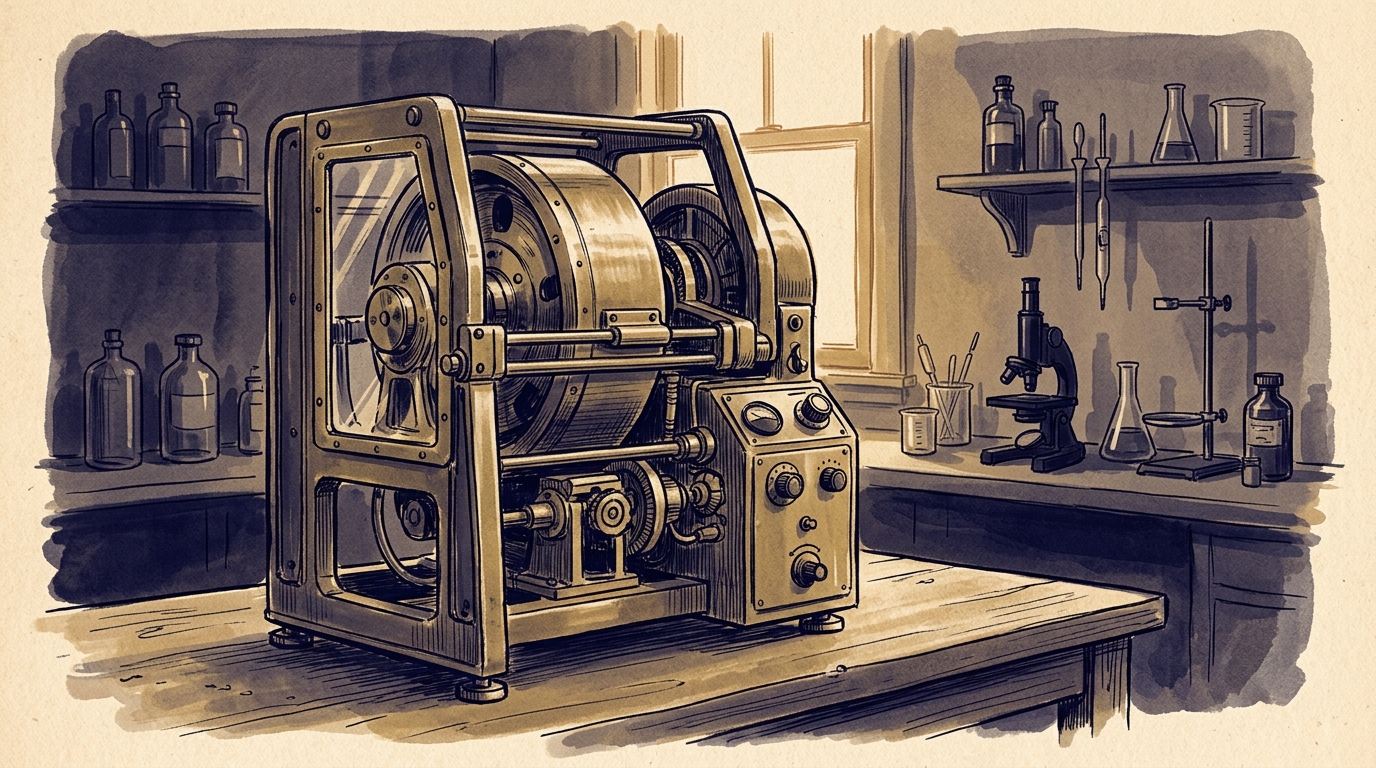
THE HOOK
0:20
01THE HOOK
In 1958, two young scientists settled one of biology's deepest questions — how a living thing copies its own DNA — without ever watching it happen `F1`. They answered it by weighing molecules. It has been called the most beautiful experiment in biology `F1`.
02THE WORLD THEN
Five years earlier, Watson and Crick had found the shape of DNA: the double helix — two strands twined together, each the mirror of the other `F2`. And they noticed something. If the strands came apart, each could template a new partner — one molecule becoming two faithful copies `F3`. A thrilling idea. But noticing a possibility is not proving it, and by 1958 no one had watched DNA copy, or knew what became of those two original strands `F3`.
03THE QUESTION
Three answers competed `F4`. Semiconservative: the helix unzips, and each copy keeps one old strand and one new. Conservative: the original helix stays whole, and a wholly new one is built alongside it. Dispersive: the old DNA is broken up and scattered, old and new interleaved along both copies `F4`. Three pictures of a single event — and to tell them apart was to learn how inheritance is passed on.
04THE DESIGN ① the weight trick
Matthew Meselson and Franklin Stahl saw that the three pictures disagree about one thing: where the old atoms end up. So they made old and new DNA weigh different amounts `F5`. They grew bacteria for generations on heavy nitrogen — nitrogen-fifteen — until every strand was dense `F5`. Then, in a single moment, they switched the cells to ordinary, light nitrogen-fourteen `F6`. From then on, every new strand was light, and every old strand stayed heavy `F6`.
05THE DESIGN ② weigh it
But how do you weigh something a hair heavier than its twin? With a method Meselson built with Jerome Vinograd: spin the DNA in a cesium-salt solution at tremendous speed `F7`. The spin packs the salt into a density gradient — light at the top, dense below — and every molecule drifts to the one layer that matches its own weight `F7`. Heavy DNA bands low, light DNA high, and half-heavy DNA settles exactly between. A photograph in ultraviolet light makes the bands appear `F8`.
06THE RESULT ① one generation
At the start, every molecule was heavy: one band, low in the tube `F9`. They let the cells divide just once in light nitrogen, and spun again. The heavy band was gone — replaced by a single band at the halfway mark, every molecule now exactly half-heavy `F9`. That picture killed the conservative model outright: had the old helix stayed whole, there would have been two bands — one heavy, one light. There was one, in the middle `F10`.
07THE RESULT ② two generations
But a single halfway band still fit two models — semiconservative and dispersive both predict it after one round `F10`. So they let the cells divide once more. After the second generation the band split: half still at the halfway mark, half now fully light `F11`. That removed the last rival. Had the old DNA been chopped and scattered, the band would have drifted lighter as one piece — never splitting cleanly into a hybrid and a light band `F11`.
08THE RESULT ③ the clincher
Every generation fit the same march: heavy, then all half-heavy, then half-heavy and light in equal measure `F12`. And for proof, they heated the halfway DNA until its two strands parted — and they came apart as one heavy strand and one light `F13`. The hybrid was exactly what semiconservative replication demanded: one old strand, paired with one new `F13`.
09WHAT WE LEARNED
That is semiconservative replication — and it is how almost all life copies its DNA `F14`. Each time a cell divides, the helix unzips and every strand builds a fresh partner, so each new molecule carries one strand made today and one inherited from the past `F14`. Watson and Crick's quiet guess had been exactly right `F3`.
10WHY IT'S BEAUTIFUL
Its beauty is its economy `F15`. Three sweeping ideas about the nature of inheritance, and one clean measurement told them apart — leaving nothing to argue `F1`. No tracer to interpret, no model to assume: only heavy against light, and bands in a tube you could photograph `F15`. It earned the name — the most beautiful experiment in biology `F1`.
11SIGN-OFF
Sometimes you don't need a sharper lens — only a cleverer question. — Beautiful Experiments.
The write-up
In one line: In 1958 Matthew Meselson and Franklin Stahl proved that DNA copies itself semiconservatively — each new double helix keeps one old strand and one new — by doing nothing more than making old DNA heavier than new DNA and spinning it until the two settled into separate bands.
The world then
Five years earlier, Watson and Crick had published the structure of DNA: a double helix of two complementary strands (1953). In a famous understatement they noted that the pairing "immediately suggests a possible copying mechanism" — unzip the helix, and each strand could template a new partner. But that was a suggestion. By 1958 no one had shown how the two original strands are actually parcelled out when DNA copies itself.
The question
There were three rival pictures. Semiconservative (Watson–Crick): each daughter helix keeps one old strand and one new. Conservative: the original helix stays intact and an entirely new one is built alongside it. Dispersive (Max Delbrück, 1954): the old DNA is broken up and scattered, old and new interleaved along both strands of both daughters. The three differ only in where the original atoms end up.
The design
Meselson and Stahl made "old" and "new" DNA weigh different amounts. They grew E. coli for many generations on a medium whose only nitrogen was the heavy stable isotope ¹⁵N, so every strand was slightly dense — a density label, not a radioactive one. Then they shifted the culture to ordinary light ¹⁴N: from that instant, every newly made strand was light while every old strand stayed heavy. To read the weights they used cesium-chloride density-gradient centrifugation — a method Meselson developed with Jerome Vinograd. Spun to equilibrium, the CsCl forms a density gradient, and each DNA molecule bands at the layer matching its own buoyant density: heavy low, light high, half-heavy exactly between. UV-absorption photography made the bands visible.
The result
At the start, all the DNA was heavy: one low band. After one generation in ¹⁴N, the heavy band was gone — replaced by a single band at intermediate density, every molecule now half-heavy. That alone killed the conservative model, which required two bands (one heavy, one light). But a single half-heavy band was equally consistent with semiconservative and dispersive — so they ran a second generation. After two generations the band split in two: half still half-heavy, half now fully light. That killed the dispersive model, which predicts a single band drifting steadily lighter, never splitting. Only semiconservative survived. As a clincher, heating the half-heavy DNA separated it into one heavy strand and one light strand — direct proof that the hybrid molecule is one old strand paired with one new.
What we learned, and why it's beautiful
DNA replication is semiconservative: every time a cell divides, the helix unzips and each strand templates a fresh partner, so each daughter molecule carries one strand inherited from the past and one made new — the mechanism Watson and Crick had only guessed at. The beauty is the economy. Three sweeping hypotheses about the nature of inheritance, decided by one clean measurement — no radioactive tracer to interpret, no model assumed, just heavy versus light and bands in a tube you could photograph. The historian Frederic L. Holmes built a whole book around the phrase John Cairns gave it: the most beautiful experiment in biology.
Sources
Full claim-by-claim evidence is in references.md. Primary anchors:
- Meselson, M. & Stahl, F. W. "The Replication of DNA in Escherichia coli." PNAS 44(7), 671–682 (1958).
- Meselson, M., Stahl, F. W. & Vinograd, J. "Equilibrium Sedimentation of Macromolecules in Density Gradients." PNAS 43(7), 581–588 (1957).
- Watson, J. D. & Crick, F. H. C. "Molecular Structure of Nucleic Acids." Nature 171, 737–738 (1953).
- Delbrück, M. "On the Replication of Desoxyribonucleic Acid (DNA)." PNAS 40(9), 783–788 (1954).
- Holmes, F. L. Meselson, Stahl, and the Replication of DNA: A History of "The Most Beautiful Experiment in Biology." Yale University Press (2001).
Accuracy notes: ¹⁵N is a non-radioactive density label (nitrogen, not carbon), distinct from the radioactive tracers of Hershey–Chase. The single half-heavy band after one generation rules out only the conservative model; the dispersive model is excluded only by the two-band result after the second generation. The experiment showed a conserved subunit that is single-stranded; identifying that subunit with the Watson–Crick polynucleotide chain rests on the structural model. "Most beautiful experiment in biology" is John Cairns's remark, popularised by Judson and Holmes — not the authors' own words.
The evidence
Every claim, sourced
Each [F#] you hear in the film links to the source it came from. Nothing gets narrated until every one is checked and signed off.
Sign-off
- Producer fact-check — the design (¹⁵N→¹⁴N density label, CsCl gradient banding), the three models and their predictions, the per-generation observations, and the dates/citation are corroborated across the cited sources (PNAS DOI, Embryo Project, mun.ca transcription, Wikipedia, the W&C and Delbrück originals).
- ⚠️ Traps stated correctly in
script.md: (a) ¹⁵N is a non-radioactive nitrogen density label, not carbon/radioactive [F5]; (b) gen 1 excludes only conservative and is consistent with both SC and dispersive — gen 2 excludes dispersive [F10,F11]; (c) "most beautiful experiment" is Cairns's attribution, not the paper [F1]; (d) the paper proves a conserved single-stranded subunit; strand-identity with the W–C chain rests on the model [F13,F14]; (e) the "copying mechanism" remark is W&C's suggestion (1953), not their proof [F3]. - Numbers in audio kept robust: only qualitative band patterns (one band / halfway / two bands) and the ½-heavy geometry are voiced; precise rpm/density figures are kept off the audio track.
- PhD sign-off (recommended before publish) — confirm the exact conclusion sentence and the apparatus figures (44,770 rpm, 20 h, ρ≈1.71 g/cm³) against the PNAS/PMC primary PDF.
Gate OPEN → narration + render may proceed (prototype). Resolve the final PhD box before public release.
- F1⚠ commonly confused
The experiment settled how DNA copies itself by weighing molecules — one clean measurement told three rival ideas apart; "the most beautiful experiment in biology." ⚠️ the phrase is John Cairns's remark, popularized by Judson & Holmes — not the authors' words or the paper's
Title of Holmes's history; Cairns attribution
- F2
1953: Watson & Crick found DNA's structure — the double helix, two strands, each the complement of the other
The structure paper
- F3⚠ commonly confused
They noticed a copying mechanism: if the strands separate, each can template a new partner → one molecule becomes two copies. By 1958 this was an unproven suggestion; ⚠️ the famous "it has not escaped our notice…" line is in the structure paper (171:737), and the copying scheme is spelled out in the follow-up (171:964) — the word "semiconservative" was coined later (Delbrück/Stent), not by W&C
The "copying mechanism" remark + the genetical-implications follow-up
- F4
Three rival models: semiconservative (W&C — 1 old + 1 new strand per daughter), conservative (parental duplex stays whole; a wholly new one is built), dispersive (old DNA broken & interleaved with new along both strands of both daughters). Dispersive = Max Delbrück, 1954
The three replication schemes; Delbrück's dispersive proposal
- F5⚠ commonly confused
They made old vs new DNA weigh differently: grew E. coli (strain B) for many generations with heavy nitrogen, ¹⁵N (as ¹⁵NH₄Cl, the sole N source) so every strand was denser. ⚠️ a stable-isotope density label — non-radioactive, nitrogen not carbon (≠ Hershey–Chase's radioactive ³²P/³⁵S)
¹⁵N heavy-isotope labelling of DNA
- F6
At one moment they shifted the culture to ordinary light ¹⁴N — thereafter every new strand is light, every old strand stays heavy
The ¹⁴N shift at t=0
- F7
DNA was weighed by CsCl density-gradient (isopycnic) equilibrium centrifugation — a method Meselson built with Jerome Vinograd (1957): spinning packs the salt into a density gradient, and each molecule bands at the layer matching its buoyant density — heavy low, light high, half-heavy between
The CsCl gradient technique (44,770 rpm, ~20 h, ρ≈1.71)
- F8
The bands were made visible by ultraviolet absorption photography (DNA absorbs ~260 nm)
UV-absorption detection of the bands
- F9
Gen 0: all DNA heavy → one low band. After one division in ¹⁴N → a single band at intermediate / half-heavy density (every molecule half ¹⁵N, half ¹⁴N)
The gen-0 and gen-1 observations
- F10⚠ commonly confused
The single half-heavy band excludes the conservative model (which predicts two bands at gen 1 — one heavy, one light). ⚠️ but a single intermediate band is consistent with BOTH semiconservative and dispersive — gen 1 alone does not decide between them
Conservative ruled out; SC vs dispersive still open after gen 1
- F11⚠ commonly confused
After two divisions → two bands of equal amount: half-heavy + fully light. ⚠️ this excludes dispersive (which predicts a single band drifting continuously lighter — to ~¾-light at gen 2 — never splitting) → only semiconservative survives
Dispersive ruled out at gen 2; semiconservative confirmed
- F12
The generations marched: heavy → all half-heavy → half-heavy + light in equal measure
The generational progression of bands
- F13⚠ commonly confused
Heating the half-heavy DNA split it into one heavy strand and one light strand — direct proof the hybrid duplex is one ¹⁵N (old) + one ¹⁴N (new) subunit. ⚠️ the paper proves a conserved subunit that is single-stranded; equating that subunit with the Watson–Crick chain leans on the structural model
The heat-denaturation sub-experiment
- F14
The conclusion: semiconservative replication — each daughter molecule keeps one old strand and one new — is how almost all life copies its DNA, confirming Watson & Crick's 1953 suggestion
The paper's central conclusion
- F15
Its economy: no radioactive tracer to interpret, no model assumed — just heavy vs light, bands in a tube you could photograph, deciding among three sweeping hypotheses
The elegance/economy framing