
Salvador Luria & Max Delbrück · 1943
The Signal Is the Scatter
Do mutations arise by blind chance, or in response to need? The answer was hiding in the scatter — an idea sparked at a faculty dance, watching a slot machine pay out a jackpot.
The walkthrough
Beat by beat
THE HOOK
0:24
01THE HOOK
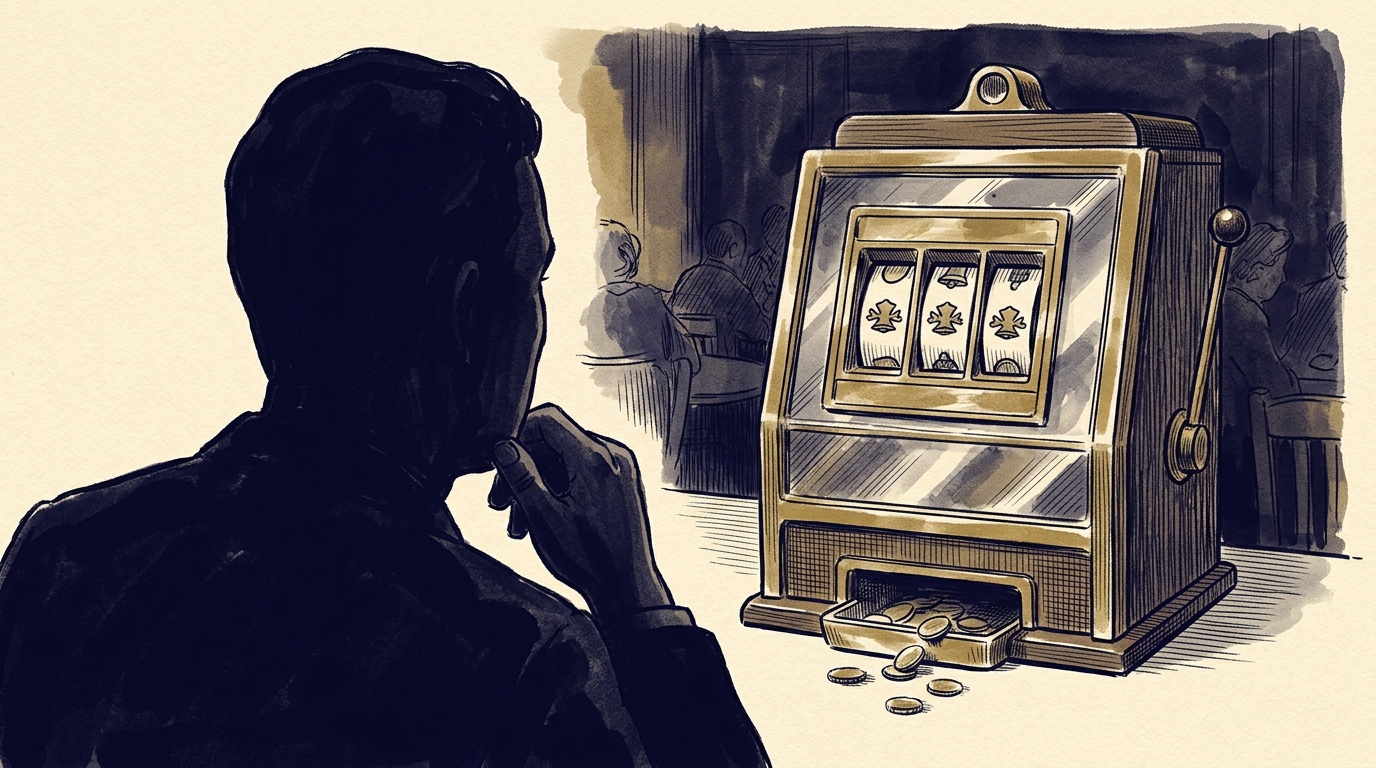
In 1943, two scientists — Salvador Luria and Max Delbrück — proved that living things mutate by blind chance, not in response to what they need, and they proved it without ever watching a single mutation happen `F1`. The idea came to Luria at a faculty dance, watching a slot machine pay out a jackpot `F1`.
02THE WORLD THEN
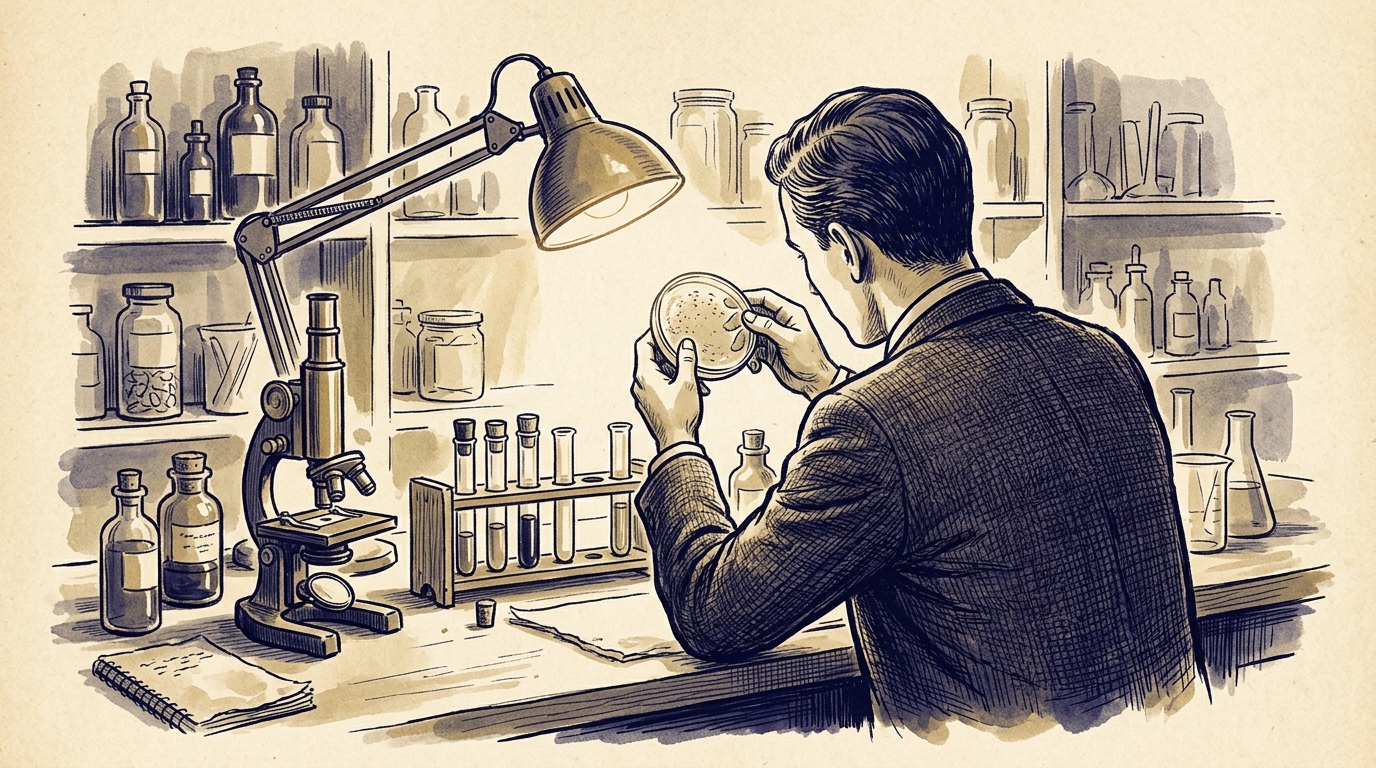
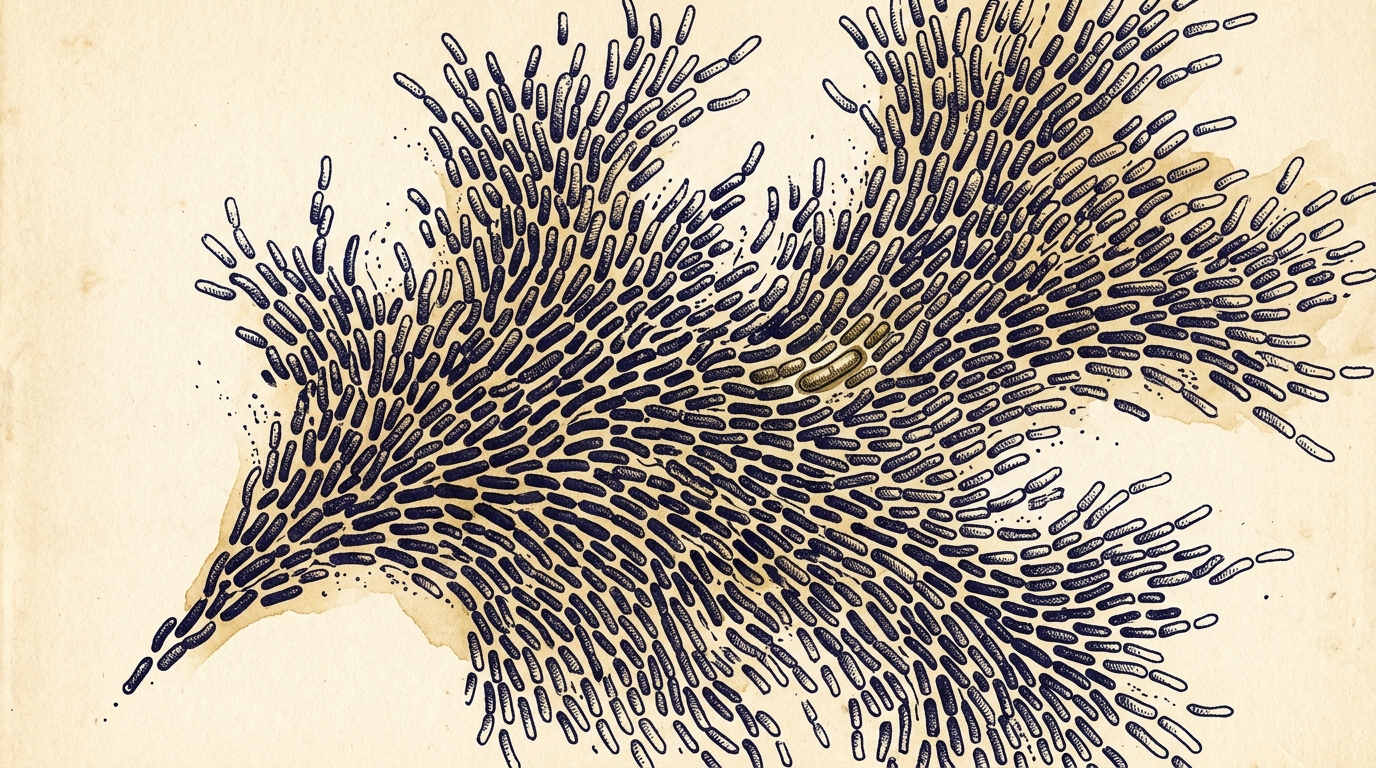
Here was the puzzle. Pour a deadly virus — a bacteriophage — onto a lawn of bacteria, and nearly all of them die `F2`. But a few survive, and their offspring are resistant forever `F2`. It looked as though the virus had taught the bacteria to resist — an adaptation, summoned by the threat itself `F2`. The rival idea was stranger: that the resistance was a random mutation, already present in a few cells before the virus ever arrived `F3`. And the trouble was — the survivors look identical either way `F3`.
03THE QUESTION
So which is it? Does the virus create the resistance — or merely reveal a mutation that was already there `F3`? You cannot tell from the survivors. And you cannot tell from their number — on average, both ideas predict the very same count `F4`.
04THE DESIGN ① watch the scatter
Luria's insight came from the slot machine: don't count the average — watch the scatter `F4`. Suppose the virus induces resistance. Then each cell, on meeting the virus, takes its own independent long shot `F5`. Grow many separate cultures, and each should turn up about the same small number of survivors — clustered tightly around the average, like coins from a fair game `F5`.
05THE DESIGN ② the jackpot
But suppose instead the resistance is a mutation that strikes at random as the culture grows — before any virus `F5`. Now timing is everything. A mutation late in the growth leaves only a few resistant cells. But a mutation early on gets copied, and copied, into an enormous resistant clone — a jackpot `F6`. So this picture predicts something wild: most cultures with a mere handful of survivors, and a rare few with hundreds `F6`.
06THE DESIGN ③ the fluctuation test
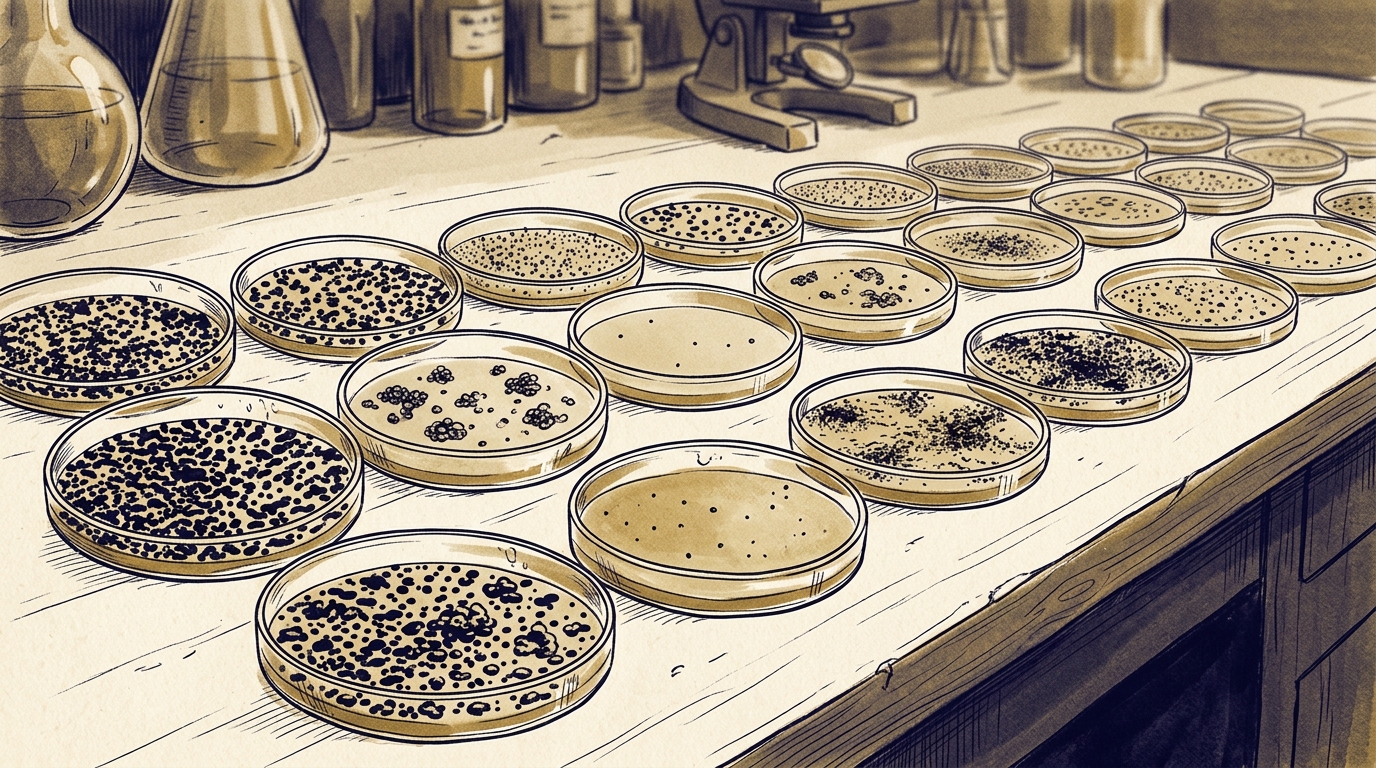
The test almost runs itself `F6`. Grow many tiny cultures side by side, each on its own, with no virus at all `F6`. Let them grow up. Then pour each whole culture onto a virus plate, and count the resistant colonies `F6`. Two pictures, two predictions: tight and even — or wildly uneven, with jackpots `F5`.
07THE RESULT
The cultures did not agree `F7`. Most gave a few resistant colonies — but some erupted into jackpots, hundreds strong `F7`. The scatter between the cultures was far larger than the average — far beyond the tight, even spread the "induced" idea demanded `F7`. The jackpots gave it away: the mutations had already been there, arising blindly as the cells divided, long before the virus arrived `F7`.
08WHAT WE LEARNED
Mutations happen on their own — at random, without purpose, and before any need for them `F8`. The virus doesn't teach resistance; it only exposes the mutants that chance had already made `F8`. Bacteria have genes, and they mutate like everything else — the result that founded bacterial genetics, and carried a Nobel Prize `F9`.
09WHY IT'S BEAUTIFUL
Its beauty is that it measured the invisible `F10`. No one saw a single mutation happen `F10`. Yet by reading pure chance — the shape of the scatter, not any one number — Luria and Delbrück caught the timing of unseen events, and turned a question that sounded like philosophy into a fact you could count `F10`.
10SIGN-OFF
Sometimes the signal isn't the number — it's how much the numbers disagree. — Beautiful Experiments.
The write-up
In one line: In 1943 Salvador Luria and Max Delbrück proved that bacteria mutate by blind chance — before they ever meet the threat, not in response to it — without watching a single mutation happen, by noticing that if mutations arise at random during growth the colony counts across parallel cultures must scatter wildly, and then finding exactly that scatter.
The world then
Pour a deadly bacteriophage onto a lawn of bacteria and nearly all of them die — but a few survive, and their offspring are resistant forever. It looked as though the virus had taught the bacteria to resist: an adaptation summoned by the threat itself. A stranger idea was on the table too — that resistance was a random mutation already present in a few cells before the virus ever arrived, and the virus merely exposed it. The trouble was that the survivors look identical either way. The phenotype alone could not decide between "induced adaptation" and "pre-existing mutation."
The question
Does the virus create the resistance, or merely reveal a mutation that was already there? You cannot tell from the survivors, and — this is the crux — you cannot tell from their number either. On average, both pictures predict the very same count of resistant cells. The two hypotheses agree on the mean. Where they disagree is on the variance: how much the counts jump around from one culture to the next.
The design
Luria's insight came, famously, at a faculty dance in February 1943, watching a slot machine pay out a jackpot: don't count the average — watch the scatter. The two hypotheses make opposite predictions about it.
- If the virus induces resistance, each cell takes its own independent long shot at the moment of exposure. Grow many separate cultures and each should turn up about the same small number of survivors — counts clustered tightly around the mean, a Poisson spread where the variance roughly equals the mean.
- If resistance is a spontaneous mutation that strikes at random as the culture grows — before any virus — then timing sets the count. A mutation late in growth leaves only a few resistant cells; a mutation early gets copied, and copied again, into an enormous resistant clone — a jackpot. The distribution is wildly skewed: most cultures with a handful of survivors, a rare few with hundreds.
The test almost runs itself. Grow many tiny cultures side by side, each on its own, with no virus at all. Let them grow up. Then pour each whole culture onto a virus plate and count the resistant colonies. Two pictures, two predictions: tight and even — or wildly uneven, with jackpots. This is the fluctuation test.
The result
The cultures did not agree. Most gave a few resistant colonies, but some erupted into jackpots hundreds strong. The scatter between cultures was far larger than the mean — far beyond the tight, even spread the "induced" idea demanded (for which variance would merely equal the mean). The jackpots gave it away: the mutations had already been there, arising blindly as the cells divided, long before the virus arrived. Crucially, this was a statistical inference from the shape of the fluctuation, not a direct sighting of a pre-existing mutant — that direct confirmation came later, from Newcombe's spreading experiment (1949) and the Lederbergs' replica plating (1952).
What we learned, and why it's beautiful
Mutations arise on their own — at random, without purpose, and before any need for them. The virus doesn't teach resistance; it only exposes the mutants that chance had already made. In one stroke the result showed that bacteria have genes and mutate like everything else, founding the field of bacterial genetics. The beauty is that it measured the invisible. No one saw a single mutation happen. Yet by reading pure chance — the shape of the scatter, not any one number — Luria and Delbrück caught the timing of unseen events, and turned a question that sounded like philosophy into a fact you could count.
Sources
Full claim-by-claim evidence is in references.md. Primary anchors:
- Luria, S. E. & Delbrück, M. "Mutations of Bacteria from Virus Sensitivity to Virus Resistance." Genetics 28(6), 491–511 (1943). — the fluctuation test.
- Newcombe, H. B. "Origin of Bacterial Variants." Nature 164, 150 (1949). — direct confirmation by spreading.
- Lederberg, J. & Lederberg, E. M. "Replica Plating and Indirect Selection of Bacterial Mutants." J. Bacteriol. 63(3), 399–406 (1952). — direct confirmation by replica plating.
- Luria, S. E. A Slot Machine, a Broken Test Tube: An Autobiography. Harper & Row (1984). — the slot-machine origin.
- The Nobel Prize in Physiology or Medicine 1969 (Delbrück, Hershey, Luria).
Accuracy notes: The two hypotheses predict the same mean number of resistant cells; only the variance/scatter across parallel cultures decides between them. For the "induced" (Poisson) null the benchmark is variance ≈ mean — the mutation signature is variance ≫ mean, with jackpots. The 1943 result is a statistical inference from that fluctuation, not a direct observation of pre-existing mutants; the direct sightings came from Newcombe (1949) and Lederberg replica plating (1952). Scope matters: this shows that phage-resistance mutations are random with respect to selection and pre-exist it — it is not a blanket disproof of all directed change. Host organism was E. coli strain B and the selective agent bacteriophage α (T1). Finally, the 1969 Nobel Prize went to Delbrück, Alfred Hershey and Luria "for their discoveries concerning the replication mechanism and the genetic structure of viruses" — the broader phage-genetics program, not the fluctuation test alone.
The evidence
Every claim, sourced
Each [F#] you hear in the film links to the source it came from. Nothing gets narrated until every one is checked and signed off.
Sign-off
- Producer fact-check — the design (parallel cultures, plate & count, the bulk-culture Poisson control), the variance-vs-mean logic, the jackpot mechanism, the result (variance ≫ mean), the strain/phage (E. coli B / phage α–T1), the 1969 Nobel, and the slot-machine anecdote are corroborated across the cited sources (PMC Historical Highlight of the 1943 paper, the Axioms and PMC reviews, the Nobel record, Luria's memoir).
- ⚠️ Traps stated correctly in
script.md: (a) both hypotheses give the same mean — only the variance/scatter decides [F4]; (b) Poisson variance ≈ mean; the mutation signature is variance ≫ mean + jackpots [F5,F7]; (c) it is a statistical inference, not a direct sighting of pre-existing mutants (Newcombe 1949 / Lederberg replica plating 1952 did that) [F7]; (d) scope kept honest — phage-resistance mutations are random & pre-existing, not a blanket disproof of all directed change [F8]; (e) the 1969 Nobel was shared with Hershey and cited for virus replication/genetic structure, not the fluctuation test alone [F9]. - Numbers kept robust in audio: only qualitative language voiced ("a handful," "hundreds," "variance far larger than the average"); no per-plate counts or rates put on screen as data.
- Geneticist / historian sign-off (recommended before publish) — confirm the exact conclusion phrasing and the E. coli B / phage α (T1) identification against the primary Genetics 1943 PDF.
Gate OPEN → narration + render may proceed (prototype). Resolve the specialist box before public release.
- F1
Luria & Delbrück (1943) showed bacteria mutate by blind chance, independent of need, without watching a mutation — a purely statistical proof; the idea came to Luria at a faculty dance watching a slot-machine jackpot (Feb 1943, Indiana University; his memoir A Slot Machine, a Broken Test Tube)
The fluctuation test + the slot-machine origin anecdote
- F2
A bacteriophage poured on a lawn of bacteria kills nearly all; rare survivors breed true resistant — which looked like an adaptation induced by the virus
Phage selection → heritable resistance; the "acquired immunity" reading
- F3⚠ commonly confused
The rival hypothesis: resistance is a random mutation already present before the virus arrives; ⚠️ the survivors are identical either way, so the phenotype alone cannot decide between "induced adaptation" and "pre-existing mutation"
The two competing hypotheses; indistinguishable by the survivors
- F4⚠ commonly confused
⚠️ The crux: the two hypotheses predict the same MEAN number of resistant cells but a different VARIANCE across parallel cultures — so the average can't decide; the scatter can
The variance, not the mean, is the discriminating statistic
- F5⚠ commonly confused
If resistance is induced by the virus, each cell's survival is an independent event at exposure → counts follow a Poisson distribution, clustered tightly around the mean. ⚠️ For a Poisson, variance ≈ mean (the benchmark for "no extra scatter")
The "induced" null → Poisson counts, variance ≈ mean
- F6
If resistance is a spontaneous mutation during growth, timing sets the count: a late mutation → few resistant cells; an early mutation → a large clonal "jackpot" → the distribution is skewed with rare huge values
Mutation-timing → clone size → jackpots; the Luria–Delbrück distribution
- F7⚠ commonly confused
Result: across many parallel cultures the counts fluctuated far more than Poisson (variance ≫ mean), with jackpots → resistance is a pre-existing spontaneous mutation, not induced by the virus. ⚠️ This is a statistical inference from the fluctuation — not a direct sighting of pre-existing mutants (that came later: Newcombe 1949; Lederberg replica plating 1952)
Observed variance ≫ mean + jackpots; the inference and its later direct confirmation
- F8⚠ commonly confused
Conclusion: mutations arise spontaneously, at random, and independent of selection — the virus reveals mutants, it does not create them. ⚠️ Careful scope: this shows phage-resistance mutations pre-exist and are random w.r.t. selection; it is not a blanket disproof of all directed change (and does not claim selection plays no role afterward)
The central conclusion, stated with scope
- F9⚠ commonly confused
It showed bacteria have genes and mutate like other organisms — founding bacterial genetics; ⚠️ Luria & Delbrück (with Alfred Hershey) shared the 1969 Nobel Prize in Physiology or Medicine "for their discoveries concerning the replication mechanism and the genetic structure of viruses" (not solely for the fluctuation test). Host = E. coli strain B; selective agent = bacteriophage α (T1)
Founding of bacterial genetics; the 1969 Nobel; strain/phage
- F10
Why it's beautiful — it measured the invisible (the timing of unseen mutations) by reading pure chance (the shape of the scatter, not any one number), turning a near-philosophical question into a counted fact. Editorial reflection
Channel reflection (economy/elegance), grounded in the above