
LIGO Collaboration · 2015
The Discovery of Gravitational Waves
A century after Einstein predicted them, two four-kilometre laser rulers felt spacetime itself quiver — by less than the width of a proton — as two black holes collided a billion light-years away.
The walkthrough
Beat by beat
THE HOOK
0:18
01THE HOOK
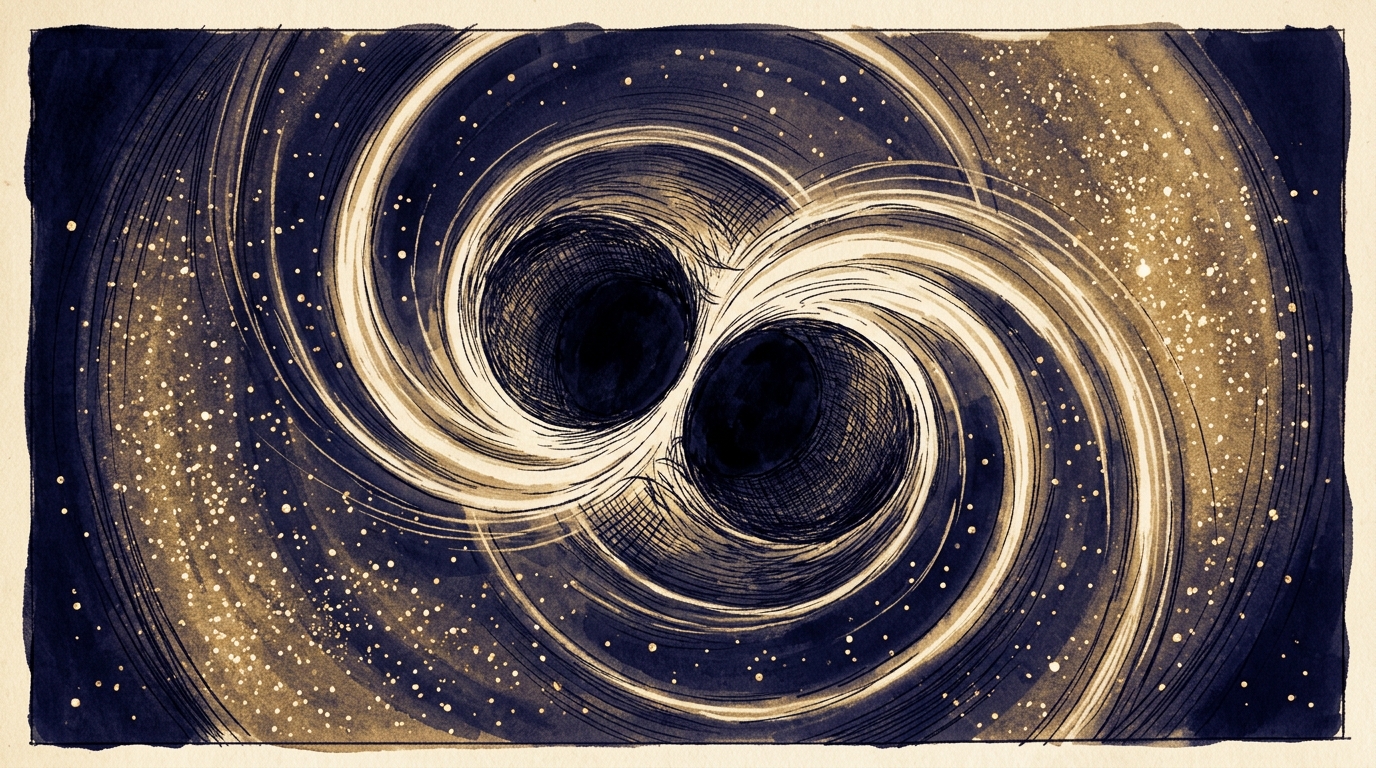
A century after Einstein predicted them, two four-kilometre laser rulers felt spacetime itself quiver — by less than the width of a proton — as two black holes collided more than a billion light-years away `F1`.
02THE WORLD THEN
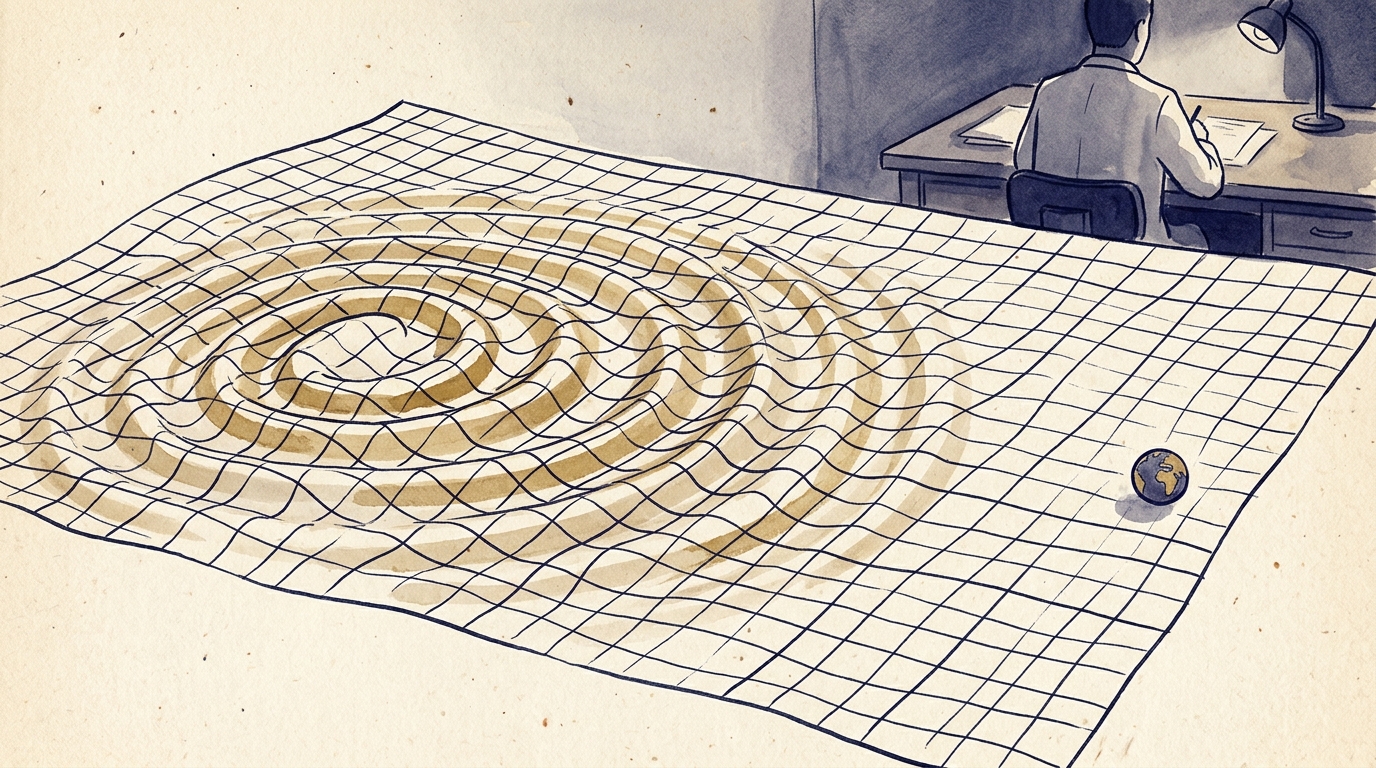
In 1915, Einstein recast gravity: not a force, but the bending of spacetime `F2`. A year later his equations predicted something stranger — that accelerating masses should send ripples of that curvature racing outward at the speed of light `F2`. But the effect was so faint that Einstein himself doubted it could ever be measured `F2`. For decades the only evidence was indirect: a pair of dead stars, found by Hulse and Taylor, whose orbit was shrinking at exactly the rate you'd expect if it were bleeding away energy as gravitational waves `F3`. To catch a wave directly, though, you would have to measure a change in length far smaller than an atomic nucleus, across kilometres of steel `F3`.
03THE QUESTION
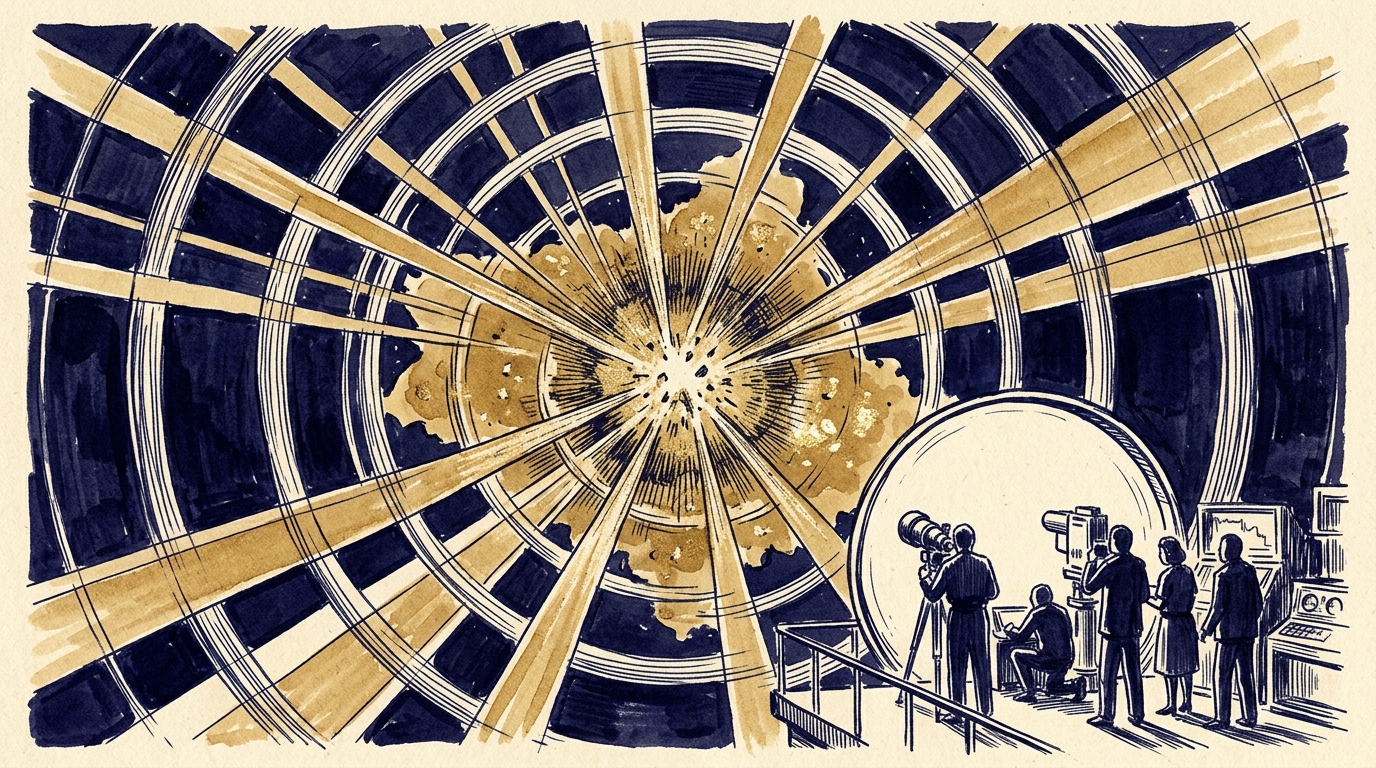
So here is the question. Could we actually feel spacetime stretch and squeeze as a wave rolled past — and by feeling it, listen directly to the most violent events in the universe, collisions that give off no light at all? `F4`
04THE DESIGN ① the L-shaped ruler
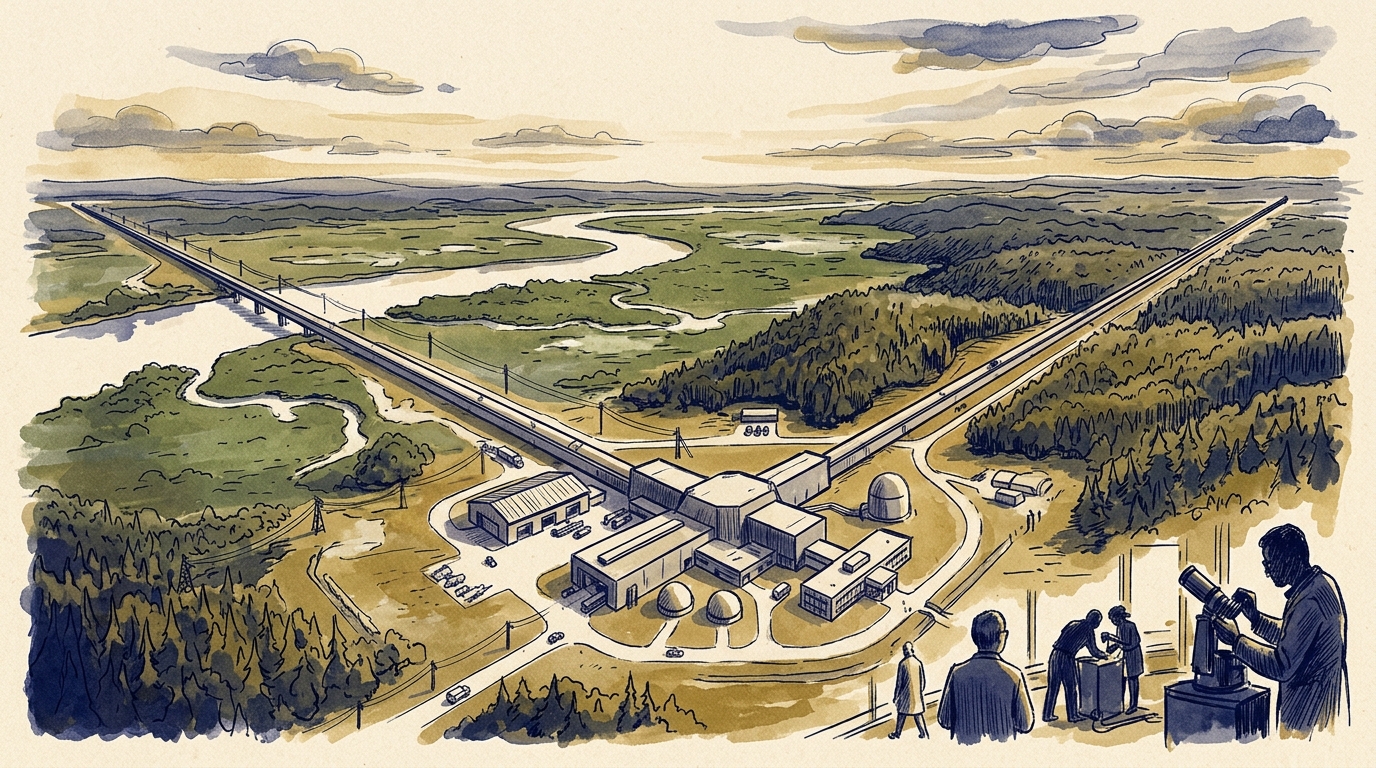
LIGO's answer is a giant letter L. One laser beam is split in two and sent down two four-kilometre arms set at a right angle, bounced off mirrors hung as ultra-quiet pendulums, then brought back together `F5`. And here's the trick: the two returning beams meet in opposition and cancel — with the arms matched, no light reaches the detector at all `F5`.
05THE DESIGN ② the wave brightens it
Now let a gravitational wave roll through. It doesn't push the mirrors — it stretches space itself along one arm while squeezing the other `F6`. For an instant the two arms no longer match. The light no longer cancels — and a flicker of brightness appears where there was darkness `F6`. A ripple in spacetime has become a signal you can read. That is the whole idea `F6`.
06THE DESIGN ③ how small is the wobble
And the wobble is small beyond imagining. The arms change by about one part in ten to the twenty-first `F7`. Over four kilometres, that is a shift far smaller than a single proton — a tiny fraction of its width `F7`. To measure that, LIGO had to hush every competing tremor: distant earthquakes, the heat in the mirrors, even the quantum jitter of the light itself `F7`.
07THE DESIGN ④ two detectors, no ghosts
But a single detector can be fooled — by a passing truck, a far-off quake, a stray footstep. So LIGO was built twice: one detector in Washington State, another three thousand kilometres away in Louisiana `F8`. A true wave from space passes through the whole Earth, so it reaches both sites almost at once — within the ten milliseconds it takes light to cross between them. A local jolt only ever shakes one detector, so any signal that shows up at just a single site is thrown out `F8`.
08THE RESULT
On the fourteenth of September, 2015, both detectors caught the same thing — a rising chirp, a tone sweeping up in pitch and then cutting off `F9`. And that shape is the whole story: the rising pitch is two black holes whirling faster and faster as they spiral inward, radiating gravitational waves; the sudden silence is the instant they merge into one `F9`. The signal earned its name from that very date: GW150914 — two black holes, each around thirty times the mass of the Sun, more than a billion light-years away `F9`. Laid against Einstein's equations, the waveform matched almost perfectly `F9`. The discovery was announced in February 2016 `F10`.
09WHAT WE LEARNED
A hundred-year-old prediction, confirmed — and, with it, a whole new way to see `F11`. Telescopes gather light; these detectors listen to the vibration of spacetime, catching objects that shine no light at all `F11`. Two years later, LIGO and its partner Virgo felt two neutron stars collide — and this time telescopes could look, too, at the very same event `F12`. In the glowing debris they watched the heaviest elements being born: shattered neutron-star matter, flung into space and forged into gold and platinum `F12`. Much of the gold that exists was made in collisions like this one `F12`.
10WHY IT'S BEAUTIFUL
What makes it beautiful is the refusal — to accept that a proton-scale measurement across kilometres was simply impossible, and the decades of stubborn craft it took to silence the world enough to build an ear for spacetime `F13`.
11SIGN-OFF
One century from a prediction to a tremor — and the universe was suddenly full of sound. — Beautiful Experiments.
The write-up
In one line: A century after Einstein predicted them, two four-kilometre laser interferometers measured spacetime itself flex by less than the width of a proton — hearing two black holes collide a billion light-years away.
The world then
General relativity (1915) recast gravity as the bending of spacetime, and in 1916 Einstein's equations predicted that accelerating masses should radiate ripples of that curvature at the speed of light. The effect is so faint that for decades its very reality was debated — Einstein himself, in 1936, briefly argued the waves didn't exist. The only evidence was indirect: the Hulse–Taylor binary pulsar, whose orbit was decaying at precisely the rate expected if it were losing energy to gravitational waves. Catching a wave directly would mean measuring a length change far smaller than an atomic nucleus, over kilometres.
The question
Could we actually feel spacetime stretch and squeeze as a wave rolls past — and so listen directly to the most violent events in the cosmos, collisions of black holes and neutron stars that emit no light at all?
The design
LIGO is a pair of giant Michelson interferometers (Hanford, WA and Livingston, LA), each with two 4-km arms at a right angle. A laser is split down the two arms, bounced off suspended-mirror test masses, and recombined; with the arms exactly equal, the returning light cancels and the output sits dark. A passing wave stretches one arm while shrinking the other, unbalancing them so the light no longer cancels and the output brightens — converting a ripple in spacetime into a readable signal. The strain to be caught is about 1 part in 10²¹: over 4 km, a shift of ~4×10⁻¹⁸ m — a tiny fraction of a proton's width — which demanded silencing seismic, thermal, and quantum noise. Two widely separated detectors provide the final check: a real wave crosses the Earth and hits both within the ~10 ms light needs to travel between them, where local noise can't.
The result
On 14 September 2015, both detectors recorded the same rising chirp — a tone sweeping up in frequency (≈35→250 Hz) and cutting off at merger. GW150914 was the coalescence of two black holes of ~36 and ~29 solar masses (source frame), more than a billion light-years away; the waveform matched general relativity's prediction. The discovery was announced on 11 February 2016, and the 2017 Nobel Prize in Physics went to Rainer Weiss, Barry Barish, and Kip Thorne.
What we learned, and why it's beautiful
Where telescopes gather light, gravitational-wave detectors listen to spacetime, reaching sources that emit no light. Two years later, GW170817 — two neutron stars, seen at once in gravitational waves and across the electromagnetic spectrum — launched multi-messenger astronomy and confirmed that such mergers forge heavy elements like gold. The beauty is in the refusal to accept that a proton-scale measurement across kilometres was impossible, and the decades of stubborn craft it took to build an ear for spacetime.
Sources
Full claim-by-claim evidence is in references.md. Primary anchors:
- B. P. Abbott et al. (LIGO Scientific Collaboration & Virgo Collaboration), "Observation of Gravitational Waves from a Binary Black Hole Merger," Phys. Rev. Lett. 116, 061102 (2016).
- Abbott et al., "Multi-messenger Observations of a Binary Neutron Star Merger," ApJL 848, L12 (2017).
- The Nobel Prize in Physics 2017 (Weiss, Barish, Thorne).
Accuracy note: the episode is careful on the traps that trip up popular retellings — LIGO's laser is 1064 nm infrared (no "green beam"); the ~36/29 M☉ are source-frame masses; the proton comparison is a derived displacement (~4×10⁻¹⁸ m, hundreds of times smaller than a proton — not "a thousandth"); and the gold-forging result is the later, separate GW170817 neutron-star event, not GW150914.
The evidence
Every claim, sourced
Each [F#] you hear in the film links to the source it came from. Nothing gets narrated until every one is checked and signed off.
Sign-off
- Producer fact-check — every headline number (strain 1.0×10⁻²¹; 4-km arms; 36 & 29 M☉ source-frame → ~30 each; 62 M☉ final, ~3 M☉ radiated; 410 Mpc / >1 billion ly; 35→250 Hz chirp; 09:50:45 UTC 14 Sep 2015; 6.9 ms L1→H1; announced 11 Feb 2016) verified against the primary PRL 116:061102 (abstract + Table I); Nobel split and GW170817 verified against the Nobel site and ApJL 848:L12.
- ⚠️ Traps stated correctly in
script.md: (a) laser is 1064 nm infrared, no colour claimed; (b) masses are source-frame (narrated as "around thirty"); (c) the proton comparison is a derived ΔL≈4×10⁻¹⁸ m ≈ hundreds of× smaller than a proton, not "a thousandth" and not "1/10,000"; (d) "cancels/dark" is idealised (homodyne readout near, not on, the null); (e) heavy-element forging is GW170817 (2017), a separate NS–NS event, not GW150914. - Numbers kept robust in audio: exact only where the paper is exact (10²¹ strain, 4 km, dates); masses/distance rounded ("around thirty," "more than a billion light-years"); proton ratio narrated qualitatively.
- "What was shown" vs "what was later confirmed" not overstated: GW150914 = direct BBH detection (2015); multi-messenger/gold = GW170817 (2017).
Gate OPEN → narration + render may proceed.
- F1
Two four-km laser interferometers measured spacetime strain < a proton's width as two black holes merged > a billion light-years away, a century after Einstein predicted such waves
The paper's result: peak strain 1.0×10⁻²¹ over 4-km arms; BBH merger at ~410 Mpc; Einstein's 1916 prediction
- F2⚠ commonly confused
1915 general relativity = gravity as curved spacetime; 1916 Einstein's equations predict gravitational waves — strain waves travelling at the speed of light; the amplitudes are so small that their reality was debated for decades (Einstein himself at one point argued against them) ⚠️ "doubt"
PRL intro: "In 1916 … Einstein predicted the existence of gravitational waves … transverse waves of spatial strain that travel at the speed of light … amplitudes would be remarkably small; … until the 1957 Chapel Hill conference there was significant debate about the physical reality" — plus the 1936 Einstein–Rosen "do they exist?" episode
- F3⚠ commonly confused
Before LIGO the only evidence was indirect: the Hulse–Taylor binary pulsar (PSR B1913+16), its orbit shrinking at just the rate expected if it radiated gravitational waves. A direct catch meant measuring a length change smaller than an atomic nucleus over kilometres ⚠️ decay shown by Taylor & Weisberg
PRL intro cites Hulse–Taylor discovery + energy-loss observations as demonstrating GW existence; orbital decay obs/GR = 0.997±0.002; Nobel 1993
- F4
The question: could we feel spacetime stretch and squeeze as a wave passes — and so listen to violent events that emit no light (black-hole, neutron-star mergers)?
GW detectors observe sources invisible to light; framing statement
- F5⚠ commonly confused
Design: a modified Michelson interferometer, two 4-km arms at a right angle; a laser is split, bounced off suspended-mirror test masses, and recombined; equal arms → the returning light cancels at the output (dark) ⚠️ homodyne readout, not a perfect null
PRL §detector: "a modified Michelson interferometer … each arm … L=4 km … mirrors, acting as test masses … signal extracted at the output port"
- F6⚠ commonly confused
A passing wave stretches one arm and shrinks the other (differential strain), unbalancing the arms so the light no longer cancels → the output brightens in proportion to the strain ⚠️ it oscillates (arms swap each half-cycle)
PRL: "ΔL(t)=ΔLx−ΔLy=h(t)L … alters the phase difference between the two light fields … transmitting an optical signal proportional to the strain"; Fig. 3 caption: "lengthening one 4-km arm and shortening the other"
- F7⚠ commonly confused
The strain is ~1 part in 10²¹; over 4 km that is a shift of ~4×10⁻¹⁸ m — a tiny fraction of a proton's width (hundreds of × smaller). Reaching it meant hushing seismic, thermal, and quantum noise ⚠️ proton ratio is derived (§traps)
PRL abstract: "peak gravitational-wave strain of 1.0×10⁻²¹"; ΔL=h·L=4×10⁻¹⁸ m; proton ≈1.7×10⁻¹⁵ m → ~1/400
- F8
Two detectors — Hanford, Washington and Livingston, Louisiana (~3000 km apart) — must both see a signal within the ~10 ms light-travel time to reject local noise. GW150914 hit Livingston ~7 ms before Hanford
PRL: "LIGO Hanford, WA, and Livingston, LA … within the 10-ms intersite propagation time"; "arrived first at L1 and 6.9₋₀.₄⁺⁰·⁵ ms later at H1"
- F9⚠ commonly confused
GW150914, detected 14 Sep 2015, was a rising chirp (sweeping up in frequency, then cutting off): two black holes ~30 M☉ each (source-frame 36 & 29) merging > a billion light-years away; the waveform matched general relativity ⚠️ source-frame masses; chirp 35→250 Hz
PRL abstract + Table I: "Sept 14, 2015 … sweeps upwards in frequency from 35 to 250 Hz … matches the waveform predicted by general relativity … 36₋₄⁺⁵ and 29₋₄⁺⁴ M☉ (source frame) … 410₋₁₈₀⁺¹⁶⁰ Mpc, z=0.09"
- F10
The discovery was announced 11 February 2016
PRL received 21 Jan 2016, published 11 Feb 2016; public announcement same day
- F11
The result confirmed a century-old prediction and opened a new astronomy: where telescopes gather light, these detectors listen to spacetime, reaching sources that emit no light
GW astronomy observes electromagnetically-dark sources; PRL framing
- F12⚠ commonly confused
Two years later (GW170817, 17 Aug 2017) LIGO + Virgo caught two neutron stars merging — seen simultaneously in gravitational waves and across the EM spectrum (a γ-ray burst + kilonova) — confirming such mergers forge heavy elements like gold (r-process) ⚠️ a later, separate NS–NS event
"Multi-messenger Observations of a Binary Neutron Star Merger," ApJL 848:L12 (2017); GRB 170817A + kilonova in NGC 4993; r-process signature
- F13
The triumph was the refusal to accept a proton-scale measurement across kilometres as impossible, and decades of noise-hunting craft; the 2017 Nobel Prize went to Weiss (½), Barish (¼), Thorne (¼) "for decisive contributions to the LIGO detector and the observation of gravitational waves"
Nobel Physics 2017 official citation & split