
Hershey & Chase · 1952
Everyone Bet on Protein
What is a gene actually made of? For decades the smart money was on protein. In 1952 a kitchen blender proved the smart money wrong.
The walkthrough
Beat by beat
THE HOOK
0:17
01THE HOOK
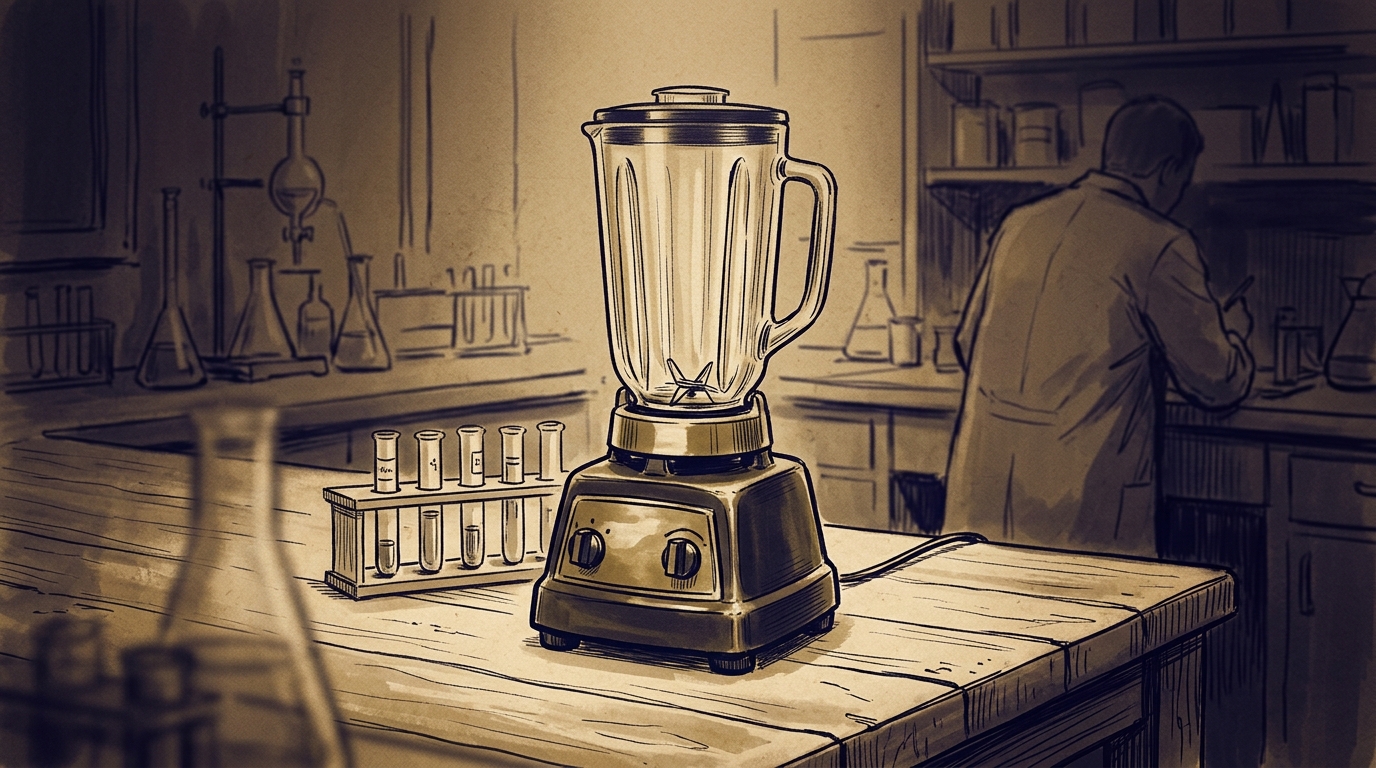
In nineteen fifty-two, one of biology's biggest questions — what a gene is actually made of — was answered with a kitchen blender `F1`. For decades the smart money had been on protein. The smart money was wrong `F1`.
02THE WORLD THEN
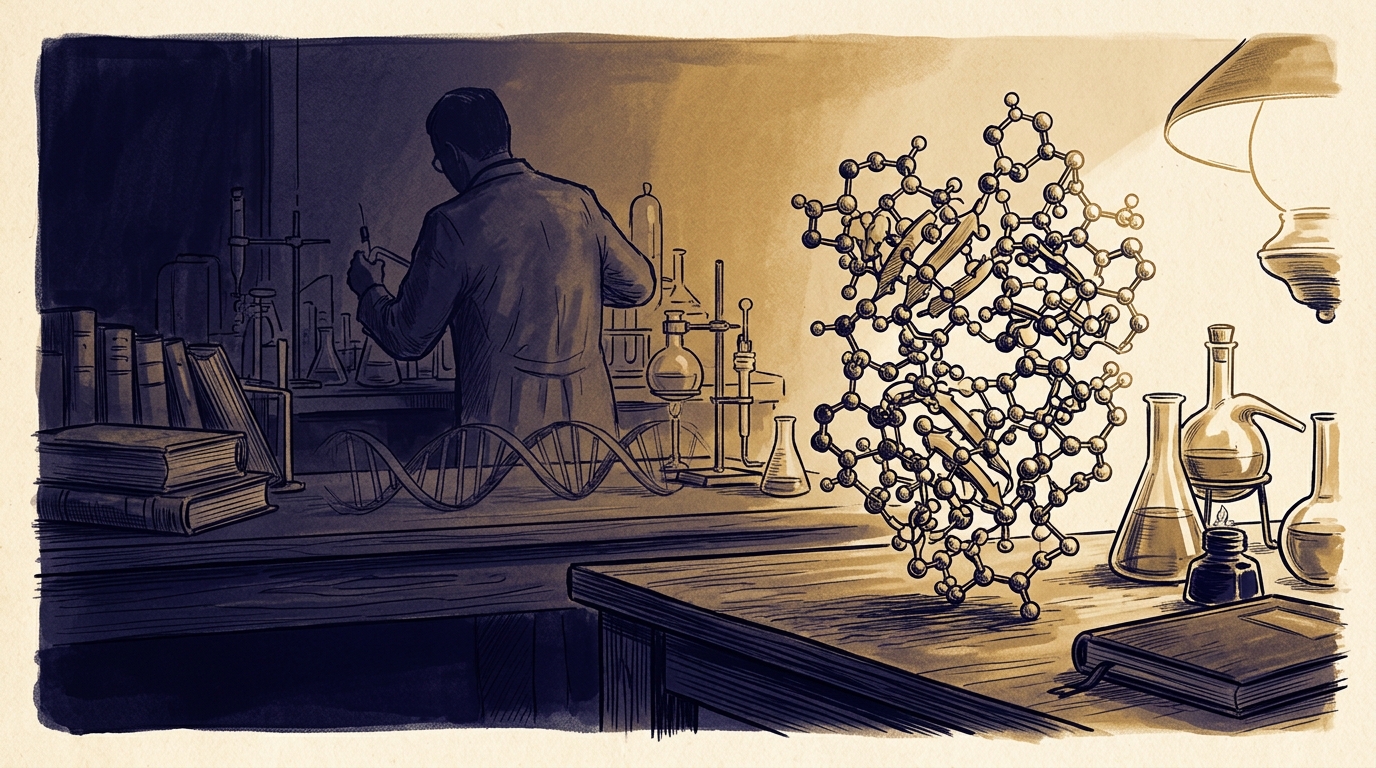
By the nineteen-fifties, biologists knew where genes lived: on the chromosomes, coiled inside every cell `F2`. And a chromosome was made of two kinds of molecule twisted together — protein, and DNA `F2`. One of them carried the instructions of life. The favourite, by far, was protein. Proteins are built from twenty different units, strung in any order — endless variety, enough to spell anything `F2`. DNA had only four units, thought to repeat in a dull, monotonous pattern — surely too simple to write a living thing `F2`.
03THE WORLD THEN ② the ignored clue
There had been a clue, and it had been ignored. Eight years earlier, in nineteen forty-four, Oswald Avery and his colleagues had purified the very substance that rewrites one strain of bacteria into another — and found it was DNA `F3`. But few were convinced. Perhaps a trace of protein, riding along in the DNA, was doing the real work `F3`. So the question stayed open: the gene — protein, or DNA? `F3`
04THE QUESTION
Two scientists at Cold Spring Harbor set out to settle it: Alfred Hershey and Martha Chase `F4`. Their tool was a virus — bacteriophage T2, which hunts the gut bacterium _E. coli_ `F4`. And a phage is almost nothing: a coat of protein wrapped around a thread of DNA `F4`. It lands on a cell, injects something inside, and minutes later the cell bursts open with a hundred new viruses `F4`. Whatever it injects to copy itself — that is the gene. Find what goes in, and you find the answer.
05THE DESIGN ① two colours of light
The phage has exactly two parts, so Hershey and Chase gave each part its own radioactive marker `F5`. The chemistry made it clean: protein contains sulfur but no phosphorus; DNA contains phosphorus but no sulfur `F5`. So they grew one batch of phage with radioactive sulfur — sulfur thirty-five — which stains only the protein coat, and another batch with radioactive phosphorus — phosphorus thirty-two — which stains only the DNA `F5`. Two parts, two labels. Now whatever entered a cell would announce itself.
06THE DESIGN ② the blender
They let the labelled phage settle onto the bacteria and inject `F6`. Then came the trick that named the experiment. They poured the mixture into a Waring blendor — an ordinary kitchen blender — and switched it on `F6`. The blades didn't harm the cells; they sheared the spent phage coats off the outside, snapping the empty shells free from the surface `F6`.
07THE DESIGN ③ sort it into two tubes
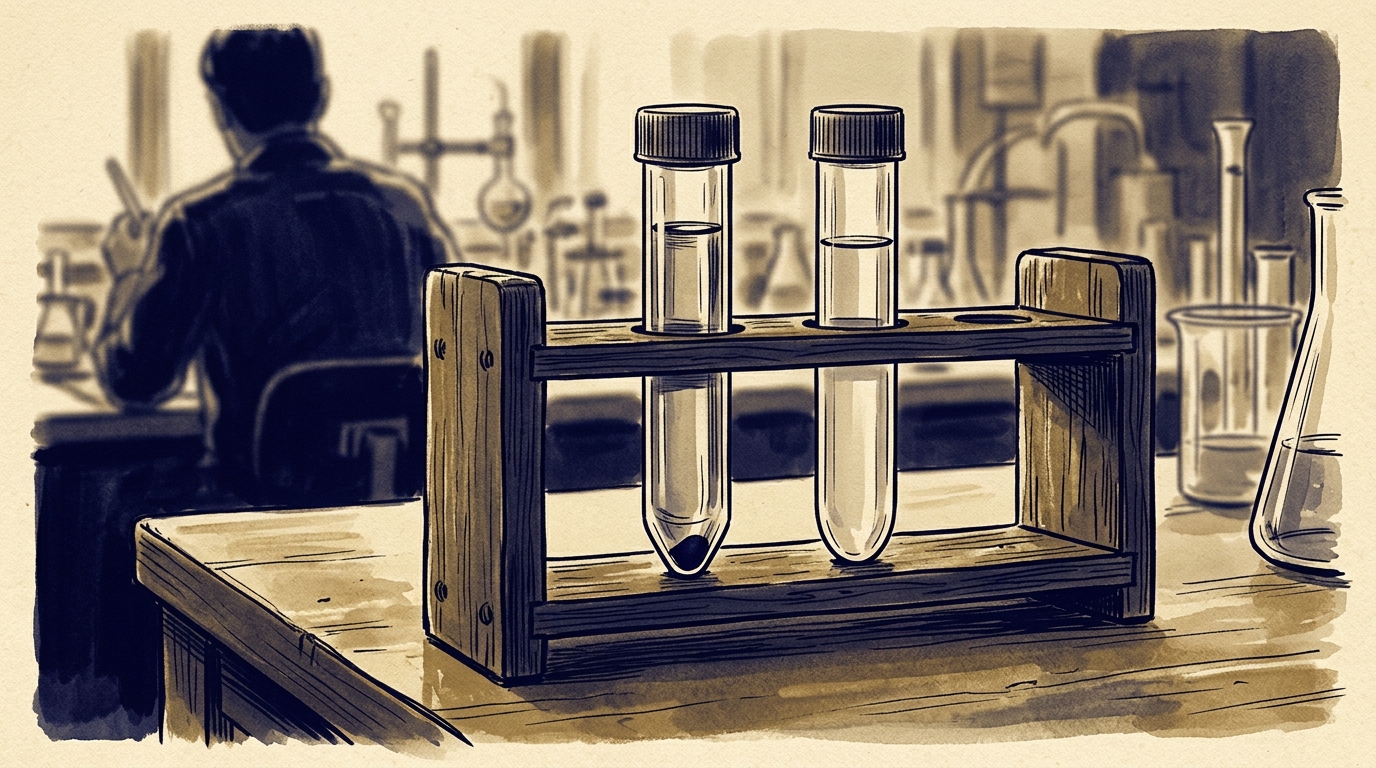
Then they spun the tubes in a centrifuge `F7`. The heavy, infected bacteria — and whatever was now inside them — sank to the bottom as a pellet `F7`. The light, empty phage coats stayed up in the liquid above `F7`. Inside the cell, or left at the door: the two parts of the phage were now in two different places. All that remained was to ask where each radioactive label had gone `F7`.
08THE RESULT
The answer was lopsided `F8`. The phosphorus — the DNA — was down in the pellet, inside the cells. The sulfur — the protein — was up in the liquid, left outside: the blender had knocked about three-quarters of it loose, while most of the phosphorus stayed with the cells `F8`. It was not perfectly clean — a little protein clung on, a little DNA washed away — but the trend was unmistakable `F8`. And the clincher: when those cells burst into a new generation, the young phage carried a third of the original DNA — and less than one percent of the original protein `F8`. The coat stayed at the door. The DNA went in, and was passed on.
09WHAT WE LEARNED
So the thing a phage injects to build its next generation is its DNA — not its protein `F9`. Hershey and Chase were careful about it. Their paper claimed only that the protein "probably has no function" inside the cell, and that the DNA "has some function" — and warned against reading any more into it `F9`. But it pointed, hard, in one direction — and it agreed with Avery `F9`. Coming from the influential phage group, in a single clean picture, it swung the field to DNA — part of the work that would later bring Hershey a share of the Nobel Prize `F10`.
10WHY IT'S BEAUTIFUL
Its beauty is its thrift `F11`. No new machine, no grand theory — a borrowed virus, two radioactive atoms, and an appliance you could buy in a shop `F11`. Hershey and Chase never tried to out-argue the people who loved protein. They arranged the world so the answer would sort itself into two tubes — one you keep, one you pour away. A question with two possible answers, built to answer itself.
11SIGN-OFF
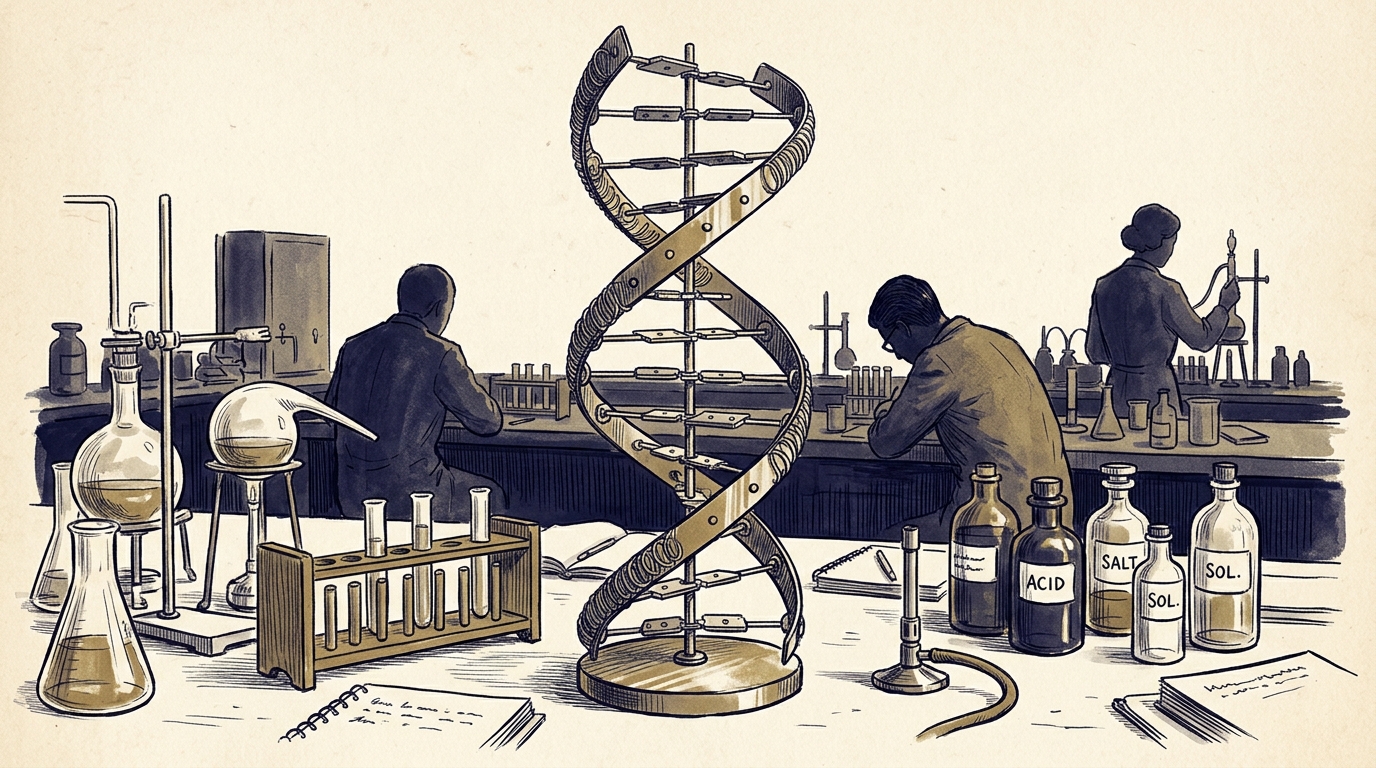
A year later, Watson and Crick drew the double helix — and the molecule everyone had underestimated became the most famous in biology `F12`. Sometimes the favourite is wrong — and it takes a blender to prove it. — Beautiful Experiments.
The write-up
In one line: In 1952 Alfred Hershey and Martha Chase labelled a virus's protein coat and its DNA with two different radioactive atoms, spun the infected bacteria in a kitchen blender, and showed that it is the DNA — not the protein everyone favoured — that a phage injects to build the next generation.
The world then
By the early 1950s biologists knew genes sat on the chromosomes, and that chromosomes were made of two kinds of molecule: protein and DNA. Which one carried the instructions? The overwhelming favourite was protein. Proteins are built from twenty different amino-acid "letters" in any order — apparently limitless variety — while DNA was thought (after Phoebus Levene's tetranucleotide hypothesis) to be a monotonous four-unit repeat, far too simple to spell out a living thing.
There had already been a clue to the contrary. In 1944 Oswald Avery, Colin MacLeod and Maclyn McCarty had shown that the pneumococcal "transforming principle" — the substance that rewrites one bacterial strain into another — was DNA. But many were unconvinced: perhaps a trace of protein contaminating the DNA prep was doing the real work. Eight years later, the question was still genuinely open.
The question
Alfred Hershey and Martha Chase, at Cold Spring Harbor, set out to settle it with an almost absurdly simple subject: a virus. Bacteriophage T2 — which infects the gut bacterium E. coli — is essentially only a protein coat wrapped around a thread of DNA. It lands on a cell, injects something that hijacks the cell into making ~100 new phages, and the empty coat is left behind. Whatever the phage injects to copy itself is the gene. Find what goes in, and you find the answer.
The design
Because the phage has exactly two parts — and because of a lucky chemical fact — the two could be tagged separately. Protein contains sulfur but no phosphorus; DNA contains phosphorus but no sulfur. So Hershey and Chase grew one batch of phage with radioactive sulfur-35 (³⁵S), which labels only the coat, and another with radioactive phosphorus-32 (³²P), which labels only the DNA.
They let the labelled phage attach to bacteria and inject. Then came the step that named the experiment: they whirled the mixture in a Waring blendor — an ordinary kitchen blender. The shear didn't harm the cells; it sheared the spent phage coats off the cell surface. A spin in a centrifuge then sorted the mixture: the heavy infected bacteria (and whatever was now inside them) packed into a pellet at the bottom, while the light, empty phage coats stayed up in the supernatant. All that remained was to ask where each radioactive label had gone.
The result
The split was lopsided. Blending released about 75% of the ³⁵S (protein) into the liquid, but only about 15% of the ³²P (DNA) — most of the DNA stayed with the cells. The protein coat had stayed at the door; the DNA had gone in. It was not perfectly clean — a quarter of the sulfur clung on, a little phosphorus washed off — but the trend was unmistakable. And the clincher came from the offspring: the next generation of phage carried "30 per cent or more" of the parental phosphorus (DNA) but "less than 1 per cent" of the parental sulfur (protein).
What we learned, and why it's beautiful
The thing a phage passes to its offspring is its DNA, not its protein. Notably, Hershey and Chase were cautious: their paper claimed only that the sulfur-containing protein "probably has no function in the growth of intracellular phage," that the DNA "has some function," and — in the last line of their conclusions — that "further chemical inferences should not be drawn from the experiments presented." It was strongly suggestive, not a claimed proof. But it pointed hard in one direction, it agreed with Avery, and, coming from the influential phage group, in one legible picture, it swung the consensus to DNA — a year before Watson and Crick drew the double helix (1953). Hershey later shared the 1969 Nobel Prize in Physiology or Medicine with Max Delbrück and Salvador Luria.
The beauty is the thrift: a borrowed virus, two radioactive atoms, and an off-the-shelf kitchen appliance, arranged so that a two-answer question would sort itself into two tubes — one you keep, one you pour away.
Sources
Full claim-by-claim evidence is in references.md. Primary anchors:
- Hershey, A. D. & Chase, M. "Independent Functions of Viral Protein and Nucleic Acid in Growth of Bacteriophage." Journal of General Physiology 36(1), 39–56 (1952). (PMC2147348)
- Avery, O. T., MacLeod, C. M. & McCarty, M. "Studies on the Chemical Nature of the Substance Inducing Transformation of Pneumococcal Types." Journal of Experimental Medicine 79(2), 137–158 (1944).
- Watson, J. D. & Crick, F. H. C. "Molecular Structure of Nucleic Acids." Nature 171, 737–738 (1953).
- The Nobel Prize in Physiology or Medicine 1969 (Delbrück, Hershey, Luria).
Accuracy notes: The isotopes are ³⁵S = protein, ³²P = DNA (never the reverse). The primary figures are 75% of sulfur / 15% of phosphorus released by blending — not the "~80% / ~20–35%" of some retellings. Hershey and Chase did not claim to have proved DNA is the genetic material; their stated conclusion was deliberately minimal. Priority belongs to Avery, MacLeod & McCarty (1944) — Hershey–Chase corroborated that result and tipped the consensus, partly through timing and the reach of the phage group. Martha Chase was a co-author and research assistant on the work; she was not a Nobel laureate.
The evidence
Every claim, sourced
Each [F#] you hear in the film links to the source it came from. Nothing gets narrated until every one is checked and signed off.
Sign-off
- Producer fact-check — the design (dual ³⁵S/³²P label by elemental specificity, Waring-blendor shear, pellet/supernatant split), the four headline numbers, and the dates/citations are taken from the PMC primary (PMC2147348) and corroborated by the Embryo Project monograph, Avery 1944 (JEM), the 1969 Nobel record, and Watson–Crick 1953.
- ⚠️ Traps stated correctly in
script.md: (a) isotopes not swapped — ³⁵S=protein, ³²P=DNA [F5]; (b) exact figures are 75% S released / 15% P released, voiced robustly as "≈¾ / most stayed" [F8]; (c) the paper's claim is cautious ("probably has no function" / "has some function" / "draw no further inferences") — no "proved DNA is the gene" is put in the authors' mouths [F9]; (d) Avery 1944 had priority; Hershey–Chase corroborated and tipped consensus [F3,F10]; (e) Chase was not a Nobel laureate [F10]; (f) M&C→Watson–Crick is timing/context, not a causal claim [F12]. - Numbers in audio kept robust: only the paper's own fractions (≈¾ of sulfur released; most phosphorus retained; ~⅓ parental P and <1% parental S in progeny) are voiced; unverified body-Methods rpm figures are kept off the audio track.
- PhD / domain sign-off — the four conclusion quotes + numbers confirmed against the PMC/JGP primary (PMC2147348); the ~5 min cut approved by the producer (2026-07-02).
Gate OPEN → narration + render may proceed. (Recommended before public release: a second domain read of the four verbatim conclusion quotes against the JGP PDF.)
- F1
1952: the question of what a gene is made of was decided by the "Waring blendor" experiment; the long-favoured candidate — protein — turned out to be wrong (the injected genetic material is DNA)
The paper + its popular name; the pre-1952 protein preference
- F2
Genes sit on chromosomes, which are protein + DNA; protein was the favoured genetic material (20 amino-acid "letters", limitless order) while DNA looked too simple — a monotonous 4-unit repeat (Levene's tetranucleotide hypothesis)
State of the art ~1944–52: protein favoured over "dull" DNA
- F3⚠ commonly confused
In 1944 Avery, MacLeod & McCarty showed the pneumococcal "transforming principle" is DNA — 8 years earlier — but it was doubted (feared to be a trace of contaminating protein), so the question stayed open. ⚠️ priority trap: Hershey–Chase is often mis-taught as the first/definitive proof; it corroborated Avery and won consensus partly by timing + the phage group's reach
Avery et al. 1944 identified DNA; contemporary skepticism
- F4
Alfred Hershey & Martha Chase, at Cold Spring Harbor, used bacteriophage T2 (infects E. coli); a phage is essentially only a protein coat around DNA, it injects material that makes the cell produce ~100 progeny — so what it injects is the gene
The subject system + its two-part composition (why the design works)
- F5⚠ commonly confused
Two radioactive labels, each specific by chemistry: protein contains sulfur, not phosphorus; DNA contains phosphorus, not sulfur → ³⁵S stains only the coat; ³²P stains only the DNA. ⚠️ do not swap the isotopes
Elemental basis of the dual label
- F6⚠ commonly confused
After adsorption/injection, the mixture was agitated in a Waring blendor (kitchen blender); the shear strips the spent phage coats off the cell surface without killing the cells. ⚠️ the paper spells it "blendor"; body-Methods rpm (~10,000 rpm, short bursts) is reported by secondary accounts but not verified from PMC text → kept off audio
Blendor-shear step
- F7
Centrifugation sorts the two fractions: heavy infected bacteria → pellet (carrying what got in); light empty coats → supernatant (what stayed out); then measure each label's location
Separation logic
- F8⚠ commonly confused
The result: blending released ~75% of the sulfur (protein) to the liquid but only ~15% of the phosphorus (DNA) (i.e. most DNA stayed with the cells); and the progeny carried "30 per cent or more" of parental ³²P but "less than 1 per cent" of parental ³⁵S. ⚠️ exact figures are 75% / 15% (not the "~80% / 20–35%" of some retellings); result is a strong trend, not perfectly clean
The four headline numbers (verbatim conclusions)
- F9⚠ commonly confused
⚠️ The overstatement trap: Hershey & Chase were deliberately cautious — the paper says the protein "probably has no function in the growth of intracellular phage" and the DNA "has some function," then "Further chemical inferences should not be drawn from the experiments presented." It was strongly suggestive, not a claimed proof; it agreed with Avery
The paper's own worded conclusion (conclusion 8)
- F10⚠ commonly confused
It shifted the consensus toward DNA as the genetic material (amplified by the influential phage group); Hershey shared the 1969 Nobel Prize in Physiology or Medicine with Max Delbrück and Salvador Luria "for discoveries concerning the replication mechanism and genetic structure of viruses." ⚠️ Martha Chase was not a laureate
Consensus shift + Nobel citation
- F11
The economy/elegance framing: a borrowed virus, two radioactive atoms, and an off-the-shelf kitchen blendor — a two-answer question engineered to sort itself into pellet vs supernatant
Elegance/economy (reflective; apparatus per F5–F8)
- F12⚠ commonly confused
~1 year later (April 1953) Watson & Crick published the DNA double helix; the once-underestimated molecule became central to biology. ⚠️ M&C→W&C is context/timing, not causation claimed
Watson–Crick date; sequencing of events