
Léon Foucault · 1851
The Earth's Rotation: Foucault's Pendulum
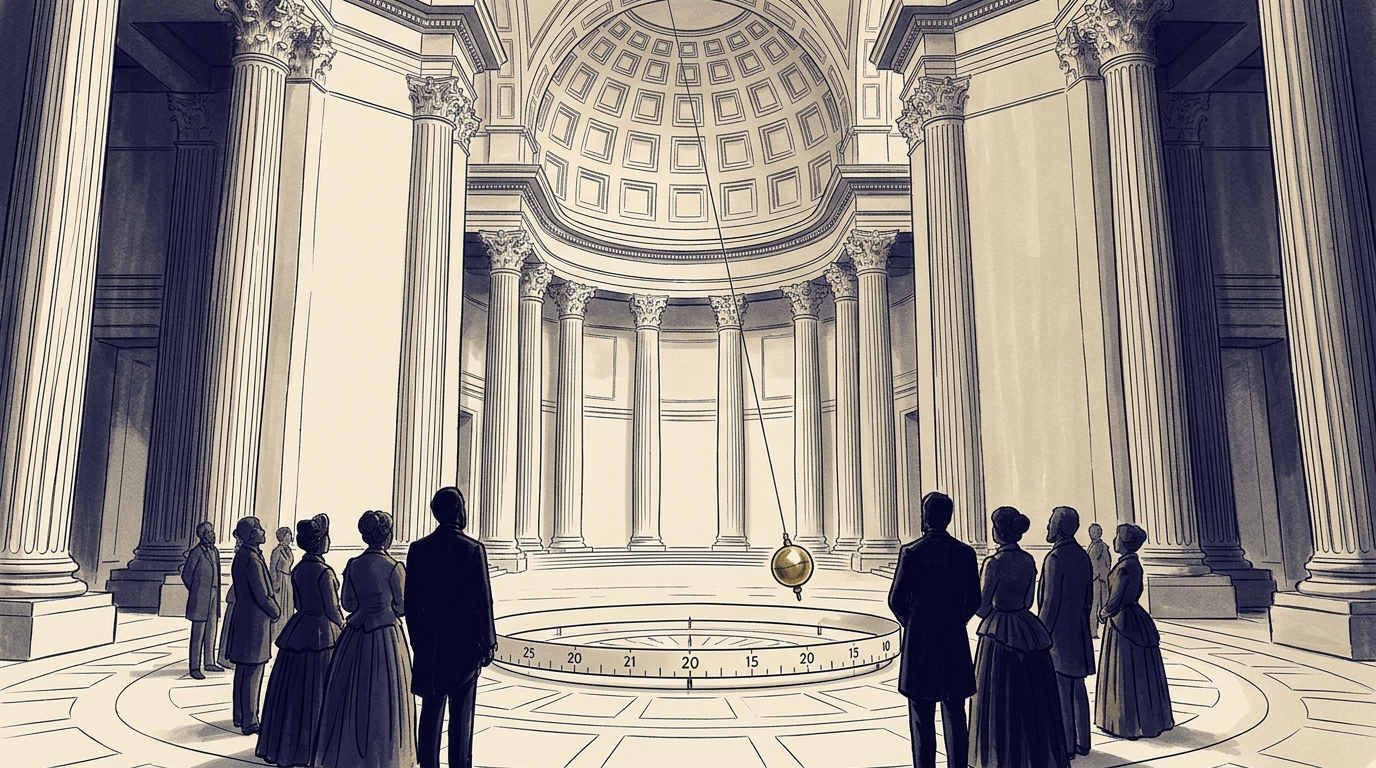
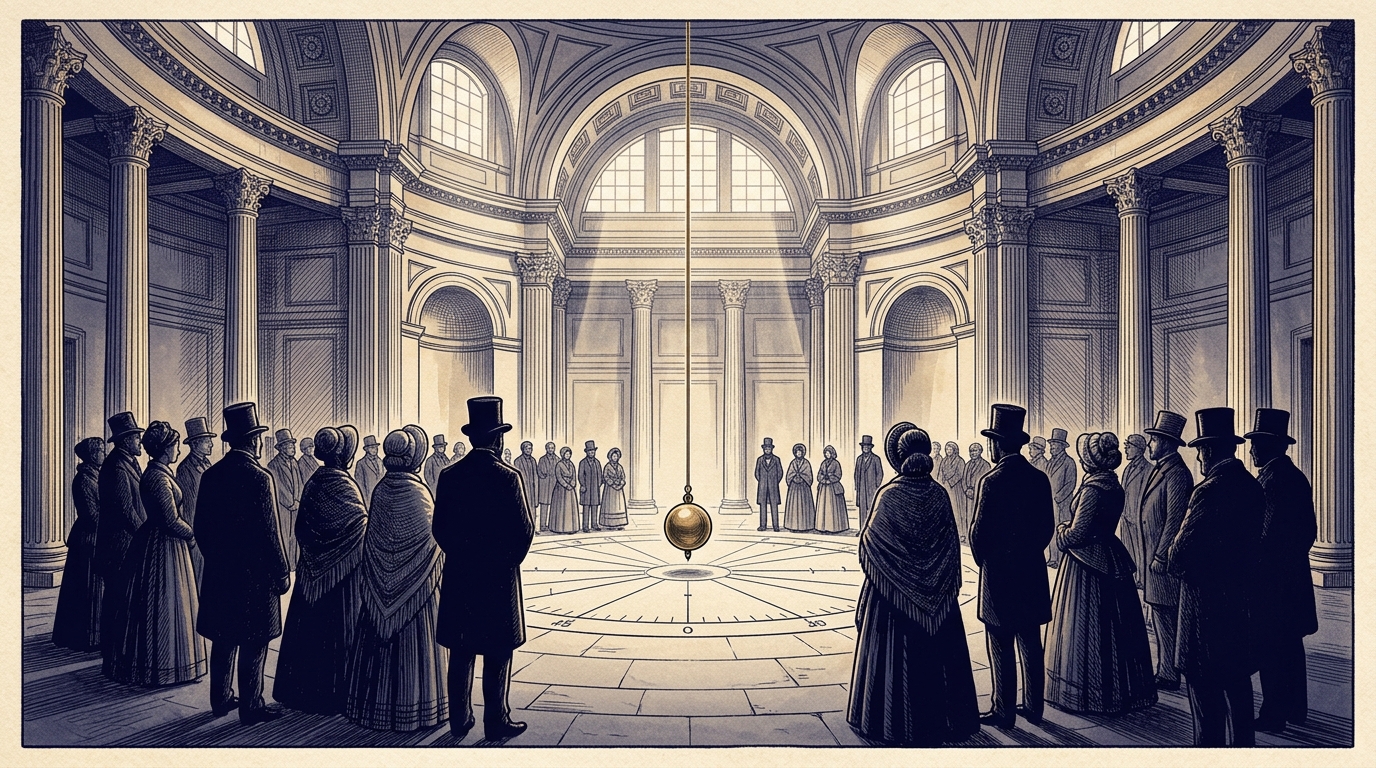
Beneath the dome of a Paris church in 1851, Léon Foucault hung a heavy bob on a 67-metre wire and set it swinging. No one touched it again — yet hour by hour its path turned across the floor. The crowd wasn't watching the pendulum. They were watching the Earth spin beneath it.
The walkthrough
Beat by beat
THE HOOK
0:20
01THE HOOK
In eighteen fifty-one, beneath the dome of a Paris church, Léon Foucault hung a heavy weight on a wire sixty-seven metres long — and set it swinging. No one touched it again. Yet hour by hour, its path turned across the floor. The crowd wasn't watching the pendulum. They were watching the Earth spin beneath it. `F1`
02THE WORLD THEN
By eighteen fifty-one, no scientist doubted that the Earth turned. Copernicus and Newton had settled that two centuries earlier, and the heavens agreed — the stars wheeled overhead, the planet bulged at its equator. But every proof was written in the sky. Down here on the ground, everything turns together with the Earth, so nothing gives the motion away. There was no simple experiment a person could stand beside and say: there — that is the Earth, turning. `F2`
03THE QUESTION
So Foucault asked an audacious question. Could you make the Earth's rotation visible right here — on the floor, in real time, with no reference to the sky at all? `F3`
04THE DESIGN ① the apparatus
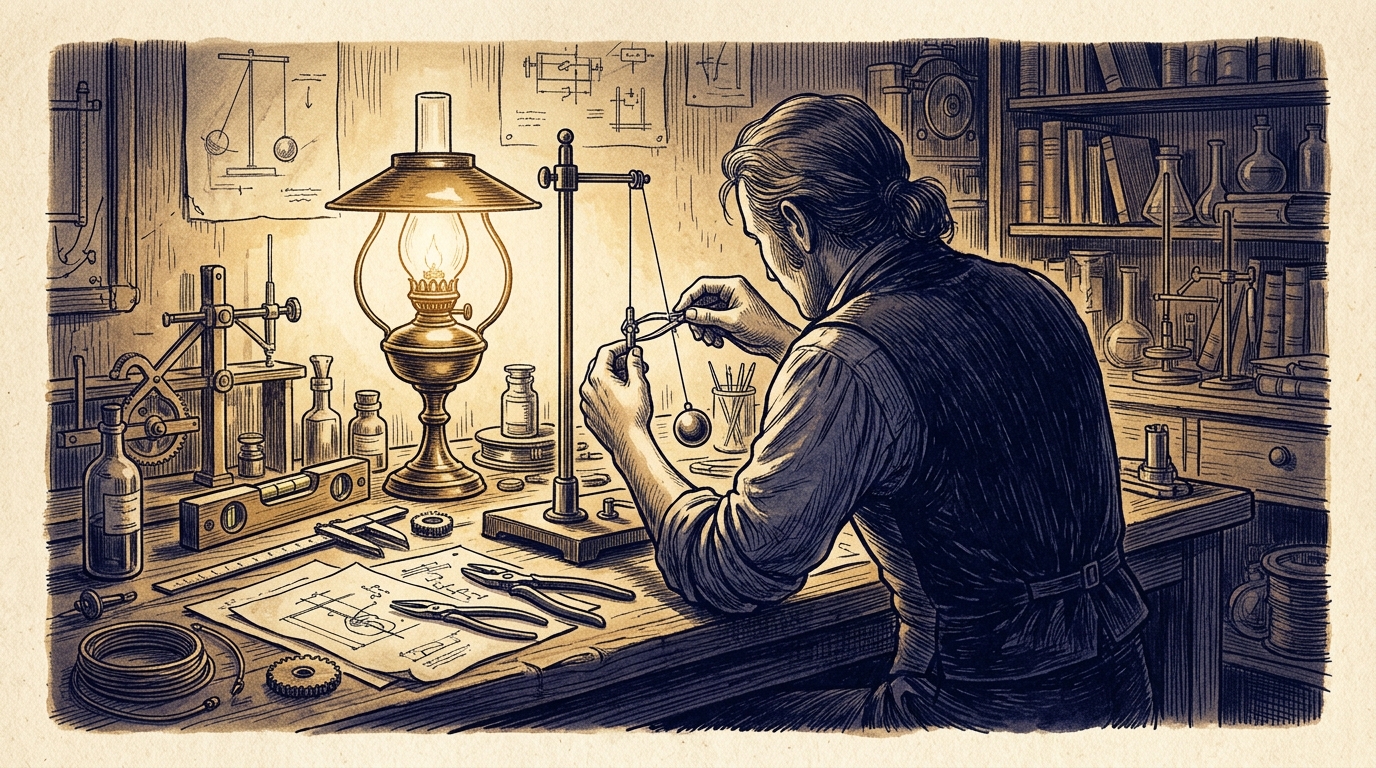
His answer was a pendulum. Hang a heavy bob on a very long wire, from a pivot so free it favours no direction of swing. Then start it perfectly — with no push to either side. Foucault drew the bob aside with a cord, tied it off, and burned the thread. The weight eased into a clean, flat swing, back and forth in a single vertical plane. At the Panthéon, that wire ran sixty-seven metres to a twenty-eight-kilogram brass bob. `F4`
05THE DESIGN ② why the plane holds
Now — why does that matter? Look at the only two forces on the bob: gravity, straight down, and the wire's pull, along the wire. Both of them lie inside the plane of the swing. Nothing pushes the bob sideways, out of that plane — so the swing has no way to steer itself. Left alone, the pendulum simply keeps its own plane, while the ground beneath it is quietly carried around by the turning Earth. `F5`
06THE DESIGN ③ the pole & the sine law
Here is the trick. Picture the pendulum at the North Pole. Its swing plane holds still against the stars — but the Earth turns underneath it, once a day. So to anyone standing on that floor, the swing line sweeps slowly all the way around the compass — a full circle in about a day. Move toward the equator, and less of that turning counts: only the share of the Earth's spin about your local straight up. That share is the sine of your latitude — and at the equator it falls to nothing, so the plane never drifts at all. `F6`
07THE RESULT
Paris sits at about forty-nine degrees north. The sine of that is roughly three-quarters — so there, the plane turns about eleven degrees every hour, completing a full circle in some thirty-two hours. Seen from above, the swing line creeps around, and a pointer on the bob knocks over a ring of markers, one by one. Untouched, the pendulum was drawing the rotation of the Earth on the floor. `F7`
08WHAT WE LEARNED
For the first time, the Earth's rotation was a local, mechanical fact — something you could watch with your own eyes, no telescope required. Crowds filled the Panthéon to see it. Within a year, Foucault built the gyroscope from the very same idea, and his pendulum became a lasting fixture of the science of rotating frames. `F8`
09WHY IT'S BEAUTIFUL
That is the beauty of it. Foucault took a planetary motion — invisible, abstract, argued only from the sky — and staged it so plainly that anyone with eyes could trust it. No mathematics to follow. Just a weight, a wire, and the patience to watch it turn.
10SIGN-OFF
One swinging weight, and the whole world could watch itself spin. — Beautiful Experiments.
The write-up
In one line: In 1851 Léon Foucault hung a 28 kg bob on a 67 m wire beneath the dome of the Paris Panthéon, and its slowly turning swing let a crowd watch the Earth rotate — the first simple, local, mechanical proof of a fact until then argued only from the sky.
The world then
By 1851 no scientist doubted the Earth turned — Copernicus and Newton had settled it, and astronomy agreed: the stars wheel overhead, the planet bulges at the equator, falling bodies drift faintly east. But every proof was celestial and indirect. On the ground, everything is carried around together with the Earth, so ordinary motion betrays nothing. There was no experiment a person could simply stand beside and watch the planet turn.
The question
Could the Earth's rotation be made visible here — on the floor, in real time, with no reference to the sky at all? Foucault's insight was that a freely swinging pendulum tends to keep its own plane of oscillation while the ground is carried around beneath it.
The design
A heavy bob on a long wire, hung from a universal pivot that favours no direction of swing. To start it without a sideways twist, Foucault drew the bob aside with a cord and burned the thread, releasing it cleanly into a flat swing in a single vertical plane. He built it up in stages — a 2 m wire in his cellar, 11 m at the Paris Observatory (presented to the Académie on 3 February 1851), then the famous 67 m wire and 28 kg brass-cased bob under the Panthéon dome on 26 March 1851.
The result
Why it works: the only forces on the bob — gravity and the wire's pull — both lie in the plane of the swing, so nothing steers it sideways. At the North Pole the plane holds fixed against the stars while the Earth turns beneath it, sweeping the swing line a full circle in about a day. Away from the pole only the component of Earth's spin about the local vertical counts — the sine of the latitude. Paris sits near 49°N (sin ≈ ¾), so the plane there rotates about 11° per hour, a full turn in roughly 32 hours, a pointer toppling a ring of floor markers one by one.
What we learned, and why it's beautiful
For the first time the Earth's rotation was a local, mechanical fact anyone could watch — no telescope, no celestial reckoning. The demonstration was a public sensation and remains a fixture of science museums worldwide. Within a year Foucault built and named the gyroscope from the same principle, and the pendulum became the canonical teaching case for rotating (non-inertial) reference frames and the Coriolis effect. Its beauty is theatrical: an invisible planetary motion, staged so plainly that anyone with eyes could trust it — a weight, a wire, and the patience to watch it turn.
Sources
Full claim-by-claim evidence is in references.md. Primary anchors:
- Léon Foucault, Démonstration physique du mouvement de rotation de la terre au moyen du pendule, Comptes Rendus de l'Académie des Sciences, 3 Feb 1851.
- W. Tobin et al., "Foucault and the rotation of the Earth," C. R. Physique 18 (2017) 520–525.
- Panthéon (official) · Britannica · MacTutor (Foucault biography).
Accuracy note: The clean "the swing plane stays fixed relative to the stars" is exact only at the poles; at other latitudes the plane also precesses in inertial space, and the observed floor-relative rate is Earth's rotation × sin(latitude). The pole period is one sidereal day (~23 h 56 min), rendered as "about a day." Paris figures (~11°/h, ~32 h) are honest rounded values; the bob is brass-cased and lead-filled, not solid brass.
The evidence
Every claim, sourced
Each [F#] you hear in the film links to the source it came from. Nothing gets narrated until every one is checked and signed off.
Sign-off
- PhD sign-off — facts above are correct; the ⚠️ traps are stated correctly in
script.md. (Physics/history-of-science review, 2026-07-06.) - Key numbers/dates verified against Foucault's 1851 note + authoritative sources (67 m, 28 kg, 26 Mar 1851; Paris ≈49°N, ~11°/h, ~32 h). Narration keeps them rounded ("about", "roughly", "some").
- "What is exactly true" vs. "a pole-only idealization" not overstated: the exact inertial-fixity claim is confined to the pole (seg-06); seg-05 claims only that the pendulum "keeps its own plane." Sidereal-vs-solar day handled by saying "about a day."
Gate OPEN → narration + render may proceed.
- F1
1851, beneath a Paris dome (the Panthéon), Foucault hung a bob on a 67 m wire and set it swinging; untouched, its path turned across the floor hour by hour — the Earth's rotation made watchable.
Panthéon public demonstration, 26 March 1851, wire ≈ 67 m; the swing plane visibly rotates relative to the floor with no external push.
- F2
By 1851 the Earth's rotation was universally accepted (Copernicus, Newton) and the sky agreed (wheeling stars, equatorial bulge) — but all the evidence was celestial/indirect; on the ground everything turns together, so there was no simple local mechanical demonstration a stationary observer could watch.
Framing confirmed: prior proofs were astronomical (apparent stellar motion, geoid oblateness, eastward deflection of falling bodies); Foucault's is described as the first hard proof of axial rotation legible to a mass audience in real time.
- F3
Foucault's question: could the Earth's rotation be made visible right here on the floor, in real time, with no reference to the sky?
His stated aim was a direct, local, purely mechanical demonstration of terrestrial rotation — the title of the 1851 note: "physical demonstration of the rotational movement of the Earth by means of the pendulum."
- F4
The design: a heavy bob on a long wire from a frictionless pivot with no preferred swing direction; started with no lateral push by drawing it aside with a cord and burning the thread; it settles into a swing in a single vertical plane. At the Panthéon: 67 m wire, 28 kg brass bob.
Universal (ball-and-socket) suspension so no azimuth is favoured; burn-release avoids the sideways jerk of cutting; Panthéon bob = hollow brass sphere (Ø 17 cm) lead-filled, ≈ 28 kg. ⚠️ "brass bob" is the canonical shorthand — the bob is brass-cased, lead-filled, not solid brass.
- F5⚠ commonly confused
The only forces on the bob — gravity (down) and wire tension (along the wire) — both lie in the plane of the swing, so nothing pushes it sideways; left alone the pendulum keeps its own plane while the ground is carried around beneath it. ⚠️
Correct as a tendency to maintain the plane. ⚠️ TRAP: absolute fixity relative to the stars is exact only at the poles; at other latitudes the plane also precesses in inertial space, and the floor-relative rate is Ω·sin φ (Coriolis). Script keeps the exact "fixed against the stars" claim only for the pole in seg-06; seg-05 says only that it "keeps its own plane."
- F6⚠ commonly confused
At the North Pole the swing plane holds still against the stars while the Earth turns under it → a full circle in about a day; toward the equator less counts — only the share of Earth's spin about the local vertical, which is the sine of the latitude — and at the equator it is zero. ⚠️
Precession rate (relative to floor) = Ω·sin φ, Ω = 360°/sidereal day ≈ 15.04°/h. Pole (φ=90°): one sidereal day, 23 h 56 min. Equator (φ=0°): no precession. ⚠️ TRAP: the pole period is one sidereal day (~23 h 56 min), not 24 h solar — "about a day" is used loosely; never "exactly 24 h."
- F7⚠ commonly confused
Paris ≈ 49°N; sin ≈ ¾; the plane turns ≈ 11° per hour, a full circle in ≈ 32 hours; a pointer on the bob topples a ring of markers one by one. ⚠️
φ ≈ 48.87°N, sin ≈ 0.7536; rate ≈ 15.04 × 0.7536 ≈ 11.3°/h (Foucault predicted 11.25°/h); period ≈ 360/11.3 ≈ 31.8 h (~32 h). Sand-tray pegs knocked over successively. ⚠️ Use rounded 11°/h and ~32 h; never "33 hours" (a secondary-source error) and not "exactly 32."
- F8
First time the Earth's rotation was a local, watchable, mechanical fact; crowds filled the Panthéon; within a year (1852) Foucault built and named the gyroscope from the same principle; the demo grounds the science of rotating frames / the Coriolis effect.
Gyroscope coined & demonstrated 1852 as a second rotation proof; the pendulum is the canonical teaching case for non-inertial frames. Foucault (1819–1868): trained in medicine, turned to experimental physics + photography, later measured the speed of light by rotating mirror (1862, c ≈ 298,000 km/s), and gave his name to eddy ("Foucault") currents.