
Hippolyte Fizeau · 1849
Measuring the Speed of Light
In 1849 everyone assumed light was far too fast to ever catch on the ground. Hippolyte Fizeau aimed a beam through the teeth of a spinning wheel to a mirror eight kilometres away — and by spinning the wheel until a tooth swallowed the returning flash, he clocked the speed of light on Earth for the first time.
The walkthrough
Beat by beat
THE HOOK
0:27
01THE HOOK
Light is the fastest thing there is. Too fast, everyone assumed, to ever catch on the ground. Then, in eighteen forty-nine, a Frenchman aimed a beam across Paris. Through the teeth of a spinning wheel, out to a distant mirror, and back. And he clocked it. The first time the speed of light was measured here, on Earth. More than three hundred thousand kilometres. Every second. `F1`
02THE WORLD THEN
By then, no one doubted light was fast. And finite. Two centuries earlier, Ole Rømer had caught it lagging. Jupiter's moons ran early or late as the Earth swung near or far. Light took time to cross the gap. But every measurement lived in the sky. Moons. Eclipses. The wheeling stars. Down on the ground, light seemed to arrive the instant it left. It crosses a kilometre in a few millionths of a second. Faster than any shutter could open. To catch it here, you had to slice time into millionths. `F2`
03THE QUESTION
So Fizeau asked a bold question. Could you measure the speed of light entirely on Earth, over a stretch of countryside you could pace out yourself, with no appeal to the heavens at all? `F3`
04THE DESIGN ① the light path
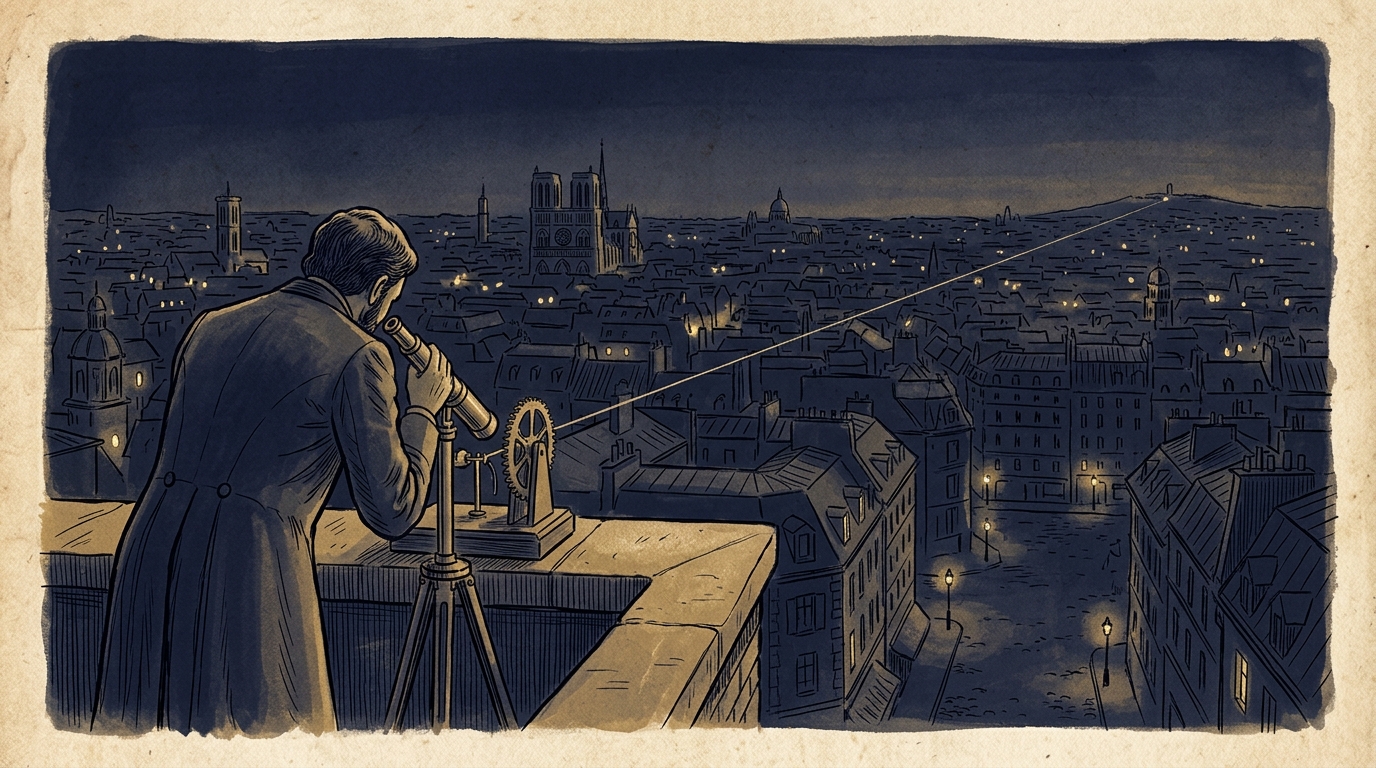
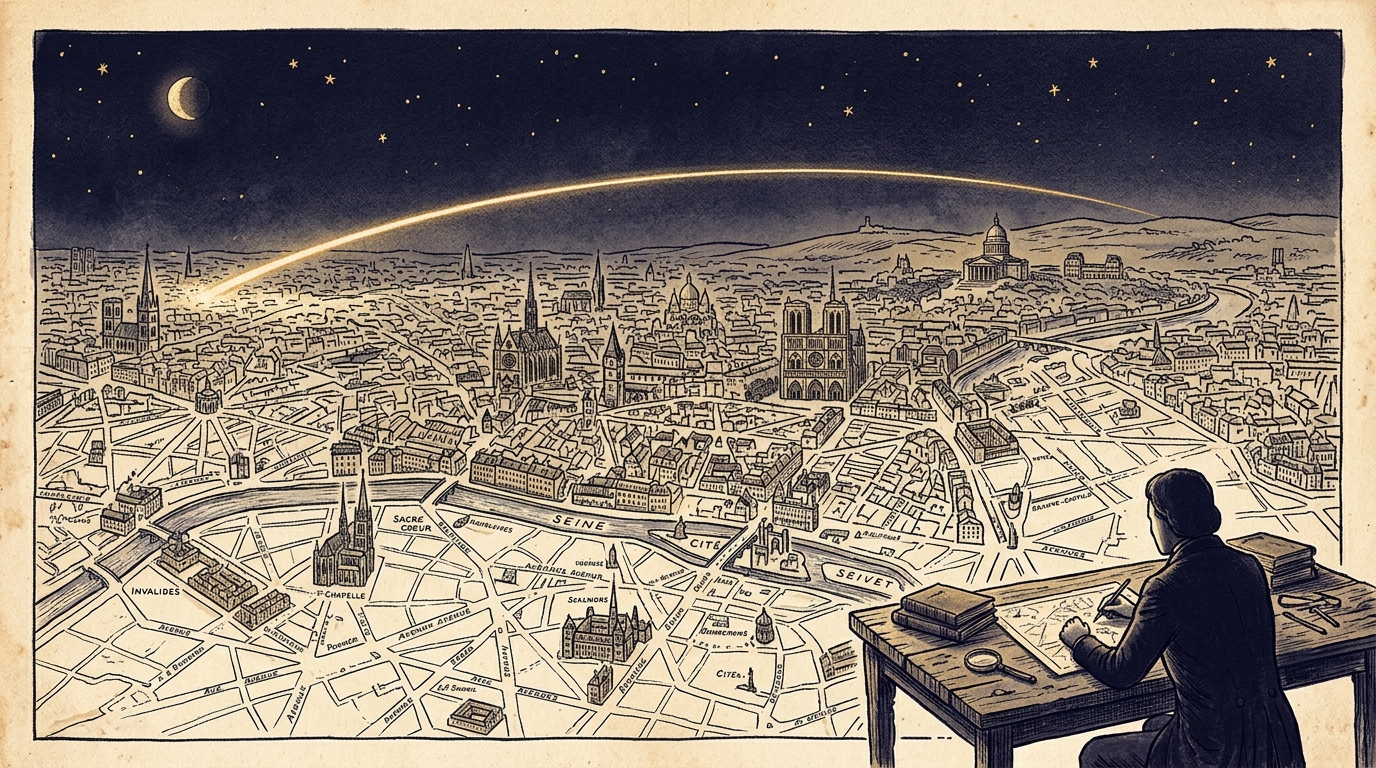
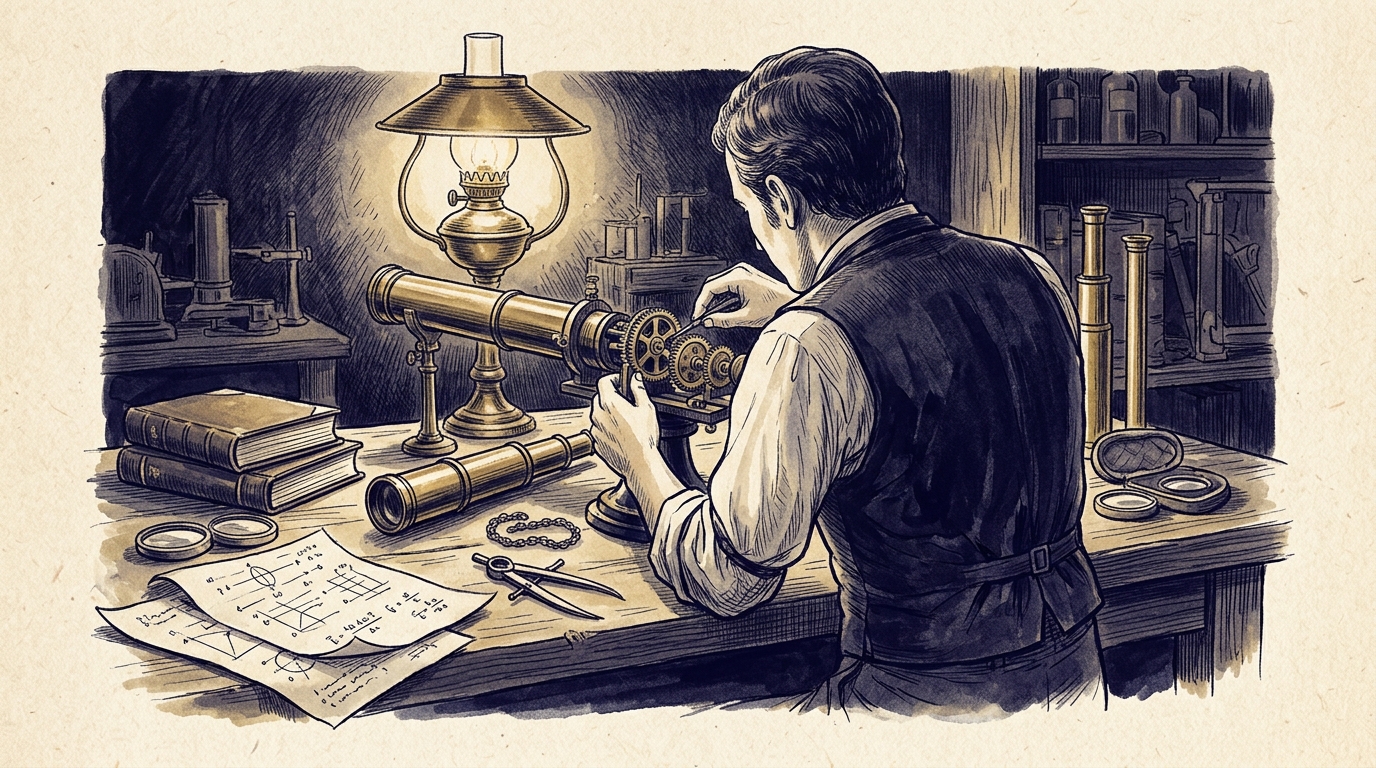
His answer was a wheel. With teeth. Seven hundred and twenty of them, cut around the rim like a comb. Spin it, and the gaps between the teeth become a shutter, opening and closing hundreds of times a second. A lamp is focused through a single gap. The thin beam shoots out from Suresnes, across the rooftops of Paris, to a mirror on the hill of Montmartre, more than eight kilometres away, and reflects straight back. Seventeen kilometres, there and back, aimed to return through the very same wheel. `F4`
05THE DESIGN ② the eclipse
Now, watch. Turn the wheel slowly, and the light leaves through a gap and comes back through the same gap. You see it. Bright. But speed the wheel up. While the beam is away on its long flight, the wheel keeps turning. Spin fast enough, and by the time the light returns, the gap is gone. A tooth has swung into its place. The returning beam strikes the tooth. And vanishes. `F5`
06THE DESIGN ③ reading the wheel
That blackout is the measurement. At the instant the light first vanished, the wheel had turned just far enough to trade a gap for a tooth, while the beam flew its seventeen kilometres. Fizeau knew the teeth: seven hundred and twenty. He knew the speed of the wheel at the eclipse: about twelve and a half turns a second. And he knew the distance. That was everything he needed. The round trip had taken a few hundred-thousandths of a second. And a spinning wheel had measured it. `F6`
07THE RESULT
So divide the distance by that flicker of time. Out comes the number: about three hundred and thirteen thousand kilometres per second. The true value, we now know, is just under three hundred thousand. Fizeau, with gears, a mirror, and a lamp, had landed within a few percent. On his first attempt. On the ground. `F7`
08WHAT WE LEARNED
A constant of the universe had come down from the sky. Within a year, Léon Foucault refined the method with a spinning mirror, and turned it on a harder question: is light faster in air, or in water? Light ran slower in water. Decisive evidence that light travels as a wave. From there the speed of light only grew more fundamental. Until, in nineteen eighty-three, it was fixed by definition, and the metre itself was redefined in terms of it. `F8`
09WHY IT'S BEAUTIFUL
The interval was too short for any clock on Earth to catch. So Fizeau stopped trying to measure time, and measured teeth and gaps instead. He traded an instant he couldn't see for a wheel he could count. A machine that made an invisible flash into something you could watch appear. And vanish.
10SIGN-OFF
A spinning wheel, a distant mirror — and light, at last, caught in the act. — Beautiful Experiments.
The write-up
In one line: In 1849 Hippolyte Fizeau sent a beam of lamplight through the gaps of a wheel with 720 teeth, out to a mirror ~8.6 km away on Montmartre and back — and by spinning the wheel fast enough that a returning flash was eclipsed by a tooth, he traded an unmeasurable interval of time for a countable number of teeth, and clocked the speed of light on Earth for the first time.
The world then
By the mid-nineteenth century the speed of light was known to be finite and enormous. Two centuries earlier Ole Rømer had caught it lagging — the eclipses of Jupiter's moons ran early or late as the Earth swung nearer to or farther from Jupiter, so light plainly took time to cross the gap. (Rømer showed the finitude and gave a travel time; Huygens was the first to turn it into a numerical speed. Bradley's stellar aberration later sharpened the astronomical value.) But every estimate lived in the heavens. On the ground, light seemed to arrive the instant it left — it crosses a kilometre in a few millionths of a second, faster than any clock, shutter, or reflex of the era could resolve.
The question
Could the speed of light be measured entirely on Earth — over a known stretch of countryside you could pace out yourself — with no appeal to astronomical distances?
The design
Fizeau's shutter was a wheel with 720 teeth, spun so its gaps opened and closed hundreds of times a second. A lamp was focused through a single gap; the thin beam ran from Suresnes to a mirror on Montmartre — about 8.6 km each way, ~17 km round trip — and back through the same wheel. The trick: turned slowly, the light leaves and returns through the same gap and you see it, bright. Spin the wheel faster and, while the beam is away on its long flight, the wheel turns just enough that a tooth swings into the gap's place — the returning beam strikes the tooth and vanishes. That first blackout is the measurement: at it, the wheel advanced by one gap→tooth step during the round trip. The first eclipse came at ~12.6 turns per second.
The result
Three numbers — 720 teeth, ~12.6 rev/s at the eclipse, and the ~17 km round trip — fix the flight time at a few hundred-thousandths of a second, an interval no clock of the day could catch. Distance divided by that flicker of time gives ≈ 313,000 km/s (his figure, reported in old French lieues; conversions run 313,000–315,000). The modern value is 299,792.458 km/s — so Fizeau, with gears, a mirror, and a lamp, landed within about 4.5% on the first terrestrial try.
What we learned, and why it's beautiful
A fundamental constant had come down from the sky to the surface of the Earth. Within a year Léon Foucault refined the method with a rotating mirror and used it to compare light in air against light in water; light proved slower in water — decisive evidence for the wave theory over the corpuscular one. (The water test is Foucault's, 1850; Fizeau repeated it independently weeks later.) The speed of light only grew more fundamental from there, until in 1983 it was fixed by definition and the metre itself was redefined in terms of it. The beauty is a reframing: the interval was impossibly short, so Fizeau stopped trying to measure time and measured teeth and gaps instead — letting mechanical rotation do what no clock could, and making an invisible flash into something you could watch appear and vanish.
Sources
Full claim-by-claim evidence is in references.md. Primary anchors:
- H. Fizeau, Sur une expérience relative à la vitesse de propagation de la lumière, Comptes Rendus 29 (1849) 90–92 (original-paper translation + figures via Skulls in the Stars).
- Wikipedia: Fizeau's measurement of the speed of light in air · Foucault's measurements of the speed of light · Rømer's determination of the speed of light · Speed of light (1983 CGPM). Linda Hall Library · Britannica.
Accuracy note: Rømer showed light's speed is finite (a travel time); Huygens first computed a number — the script never puts a km/s figure on Rømer. Fizeau's result is quoted qualitatively ("about 313,000," "within a few percent") because his original lieue figure converts to anywhere from 313,000 to 315,000 km/s. The air-vs-water / wave-theory test is Foucault's rotating-mirror work (1850), not the 1849 toothed wheel — the episode credits Foucault, not Fizeau, and does not conflate it with Fizeau's separate 1851 aether-drag interferometer.
The evidence
Every claim, sourced
Each [F#] you hear in the film links to the source it came from. Nothing gets narrated until every one is checked and signed off.
Sign-off
- PhD sign-off — facts above are correct; the ⚠️ traps are stated correctly in
script.md. (Physics/history-of-science review, 2026-07-08.) - Key numbers verified against the primary 1849 note / authoritative sources: 720 teeth, 8,633 m one way (~17 km round trip), ~12.6 rev/s at first eclipse, result ≈ 313,000 km/s (from lieues) vs modern 299,792.458, ~4.5% high. Narration keeps them rounded ("about", "more than", "a few percent").
- Attribution correct: toothed wheel (Fizeau 1849, terrestrial first) vs. rotating mirror + water/wave test (Foucault priority 1850); Rømer showed finite (Huygens first computed the number — no Rømer km/s in script); the water test is credited to Foucault, not Fizeau.
Gate OPEN → narration + render may proceed.
- F1
In 1849 Fizeau aimed a beam through a spinning toothed wheel to a distant mirror and back, clocking light's speed — the first measurement of the speed of light made entirely on Earth (terrestrial, not astronomical); more than 300,000 km/s.
Confirmed across authoritative sources: the first terrestrial / non-astronomical determination of c (all earlier values — Rømer, Bradley — were astronomical). Result ≈ 313,000 km/s (F7).
- F2⚠ commonly confused
By 1849 light's speed was known to be finite and enormous — Ole Rømer (1670s) caught it lagging in the timing of Jupiter's moons (early/late as Earth's distance changed); the sky agreed (moons, eclipses, wheeling stars). But every measurement was astronomical. Light crosses a km in a few millionths of a second — too fast for any clock/shutter/reflex. ⚠️
Rømer (1676) showed light's travel time is finite, expressed as a time (~22 min across Earth's orbit's diameter). ⚠️ TRAP: Rømer did not publish a km/s figure — Huygens (1678) first computed a numerical speed (~220,000 km/s); Bradley's stellar aberration (1728) later gave the best pre-terrestrial value (~295,000 km/s). Script says only that Rømer "caught it lagging" / "light took time to cross the gap" — no Rømer number claimed.
- F3
Fizeau's question: could the speed of light be measured entirely on Earth, over a known terrestrial distance you could pace out, with no appeal to astronomy?
The stated aim of the 1849 note — a terrestrial determination of c independent of celestial distances.
- F4
The apparatus: a wheel with 720 teeth as an ultrafast shutter; a lamp focused through a gap; the beam ran from Suresnes (his father's house) to a mirror on Montmartre, ≈ 8.6 km one way (8,633 m) → ≈ 17.3 km round trip, and back through the same wheel.
720 teeth and the 8,633 m one-way baseline both confirmed in the original paper (translation) and Wikipedia. ⚠️ TRAP: some retellings quote the ~17 km round trip as the one-way figure — one way is ~8.6 km.
- F5
The trick: turned slowly the beam returns through the same gap (bright); sped up, the wheel turns enough during the round trip that a tooth eclipses the returning beam (dark). First eclipse at ≈ 12.6 turns/second.
First disappearance when the wheel advances by one gap→tooth step during the light's round trip; 12.6 rev/s at first eclipse confirmed in the original paper (translation) + Wikipedia.
- F6
Three knowns — teeth (720), wheel speed at eclipse (~12.6 rev/s), round-trip distance (~17 km) — fix the round-trip time (a few hundred-thousandths of a second); the wheel measured an interval no clock could.
Round-trip time = 1 / (2 × 720 × 12.6) s ≈ 5.5 × 10⁻⁵ s ≈ 55 µs — "a few hundred-thousandths of a second." Kept qualitative on screen (the payoff is Fizeau's published result, not a producer-computed µs figure — [[dont-show-your-own-computation]]).
- F7⚠ commonly confused
Result ≈ 313,000 km/s; modern value 299,792.458 km/s; Fizeau landed within a few percent (~4.5% high) on his first terrestrial attempt. ⚠️
Fizeau's 1849 paper gives the result in old French lieues; conversions in the literature land at 313,274 km/s (Wikipedia) up to 315,000 km/s (some texts) — all from the same figure. Error vs modern c consistently ~4.5% too high. ⚠️ TRAP: narration keeps it to "about 313,000" / "within a few percent" — never a spurious 4-digit precision; on-screen "≈ 313,000" and "≈ 4.5% high."
- F8⚠ commonly confused
A year later Léon Foucault refined the method with a rotating mirror (1850) and used it to compare light in air vs water: light is slower in water, decisive for the wave theory. The speed of light was later fixed by definition and the metre redefined in terms of it (1983). ⚠️
⚠️ TRAP (attribution): the water/wave test used the rotating-mirror method — Foucault has priority (27 Apr 1850; Fizeau independently repeated it ~7 weeks later, 17 Jun 1850) — not the 1849 toothed wheel. Script credits Foucault's rotating mirror, never Fizeau, for the water test. c fixed at 299,792,458 m/s exactly, metre redefined, 17th CGPM, 1983. (Distinct from Fizeau's separate 1851 interferometric aether-drag experiment — not mentioned here to avoid conflation.)