
Eratosthenes · c. 240 BCE
The Whole Earth from a Shadow
Around 240 BCE, a scholar measured the size of the whole planet without leaving the ground — with a stick, its shadow, and a single day of the year. He came startlingly close.
The walkthrough
Beat by beat
THE HOOK
0:18
01THE HOOK
Around 240 BCE, a scholar in Egypt measured the size of the entire planet — without ever leaving the ground `F1`. His only instruments were a stick, its shadow, and a single day of the year. And he came startlingly close `F1`.
02THE WORLD THEN
By his time, educated Greeks already knew the Earth was a sphere `F2`. Aristotle had seen its round shadow fall across the Moon in an eclipse, and watched new stars climb into view as travelers journeyed south `F2`. What no one knew was how big the sphere was. Its size was pure guesswork — a number no one had ever measured `F2`.
03THE QUESTION
Eratosthenes, chief librarian at Alexandria, asked a daring question: could you measure the whole world from a single stretch of it, without ever leaving the ground `F1`? His insight was that a shadow holds the answer. On a flat Earth, every noon shadow would fall at the same angle. Because the Earth curves, that angle shifts from place to place — and the shift is a measure of the curve itself `F3`.
04THE DESIGN ① Syene, at noon on the solstice
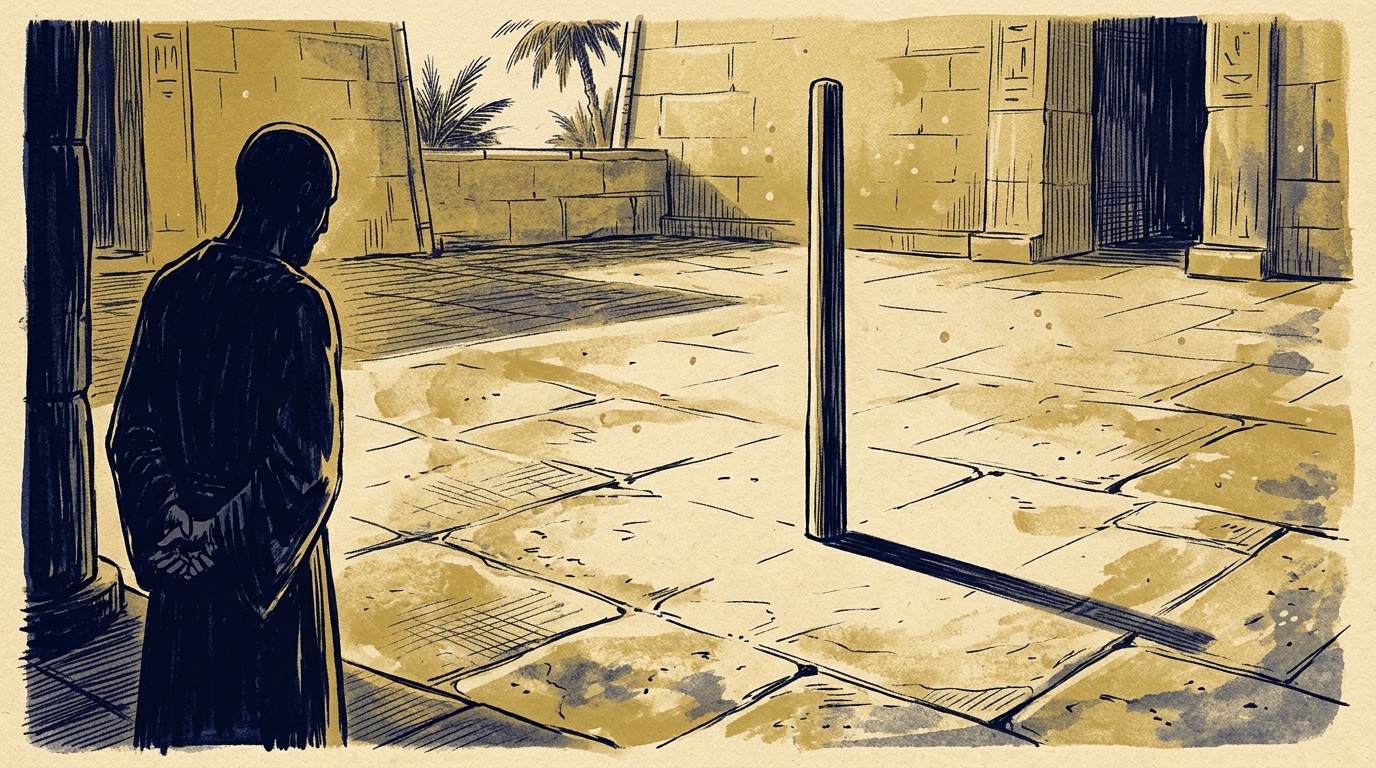
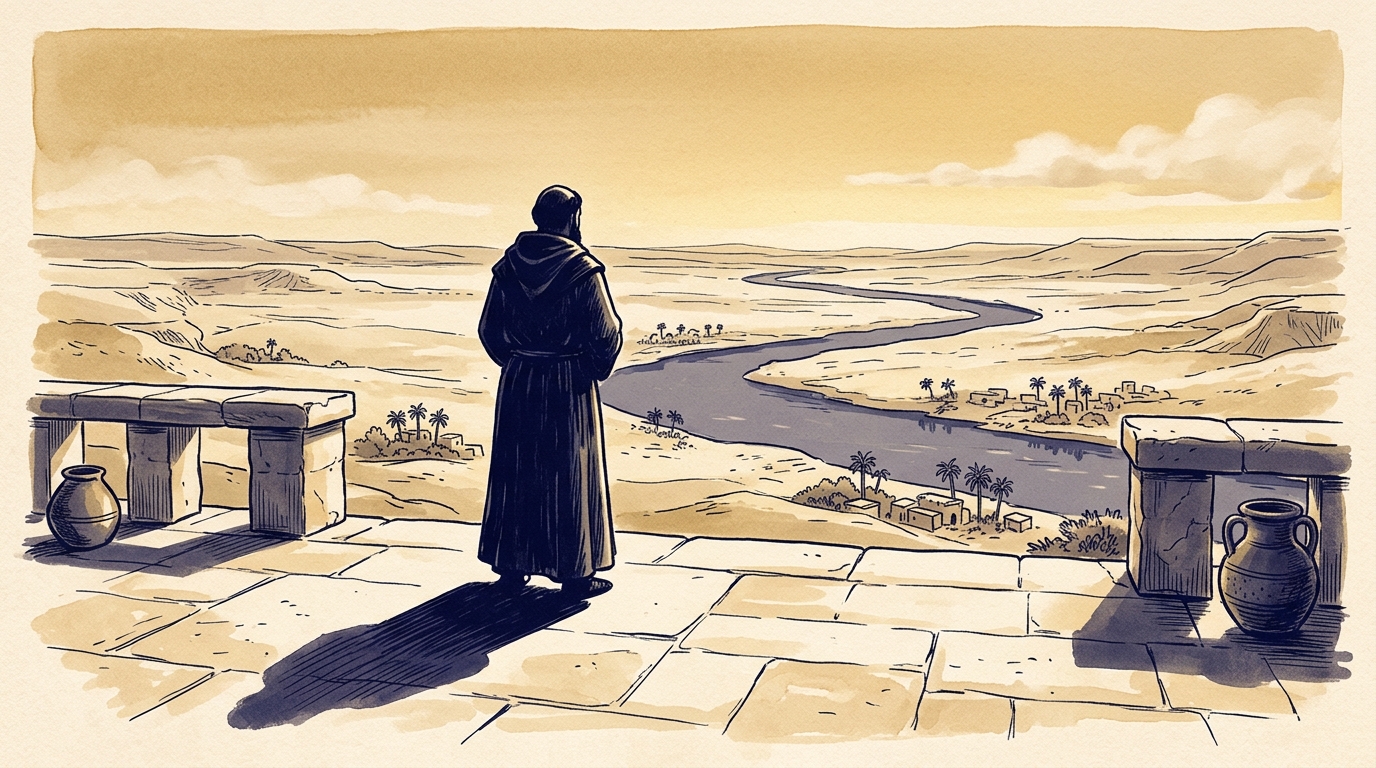
He started with a fact about a town far to the south — Syene, which sits close to the Tropic of Cancer `F4`. There, at noon on the longest day of the year, the Sun climbs almost to the very top of the sky. Upright poles cast almost no shadow — it was even said the noon Sun lit the bottom of the wells `F4`.
05THE DESIGN ② Alexandria, same instant
At that same moment, well to the north in Alexandria, an upright pole did cast a shadow `F5`. Eratosthenes measured it: the shadow leaned by one-fiftieth of a full circle — what we'd call about seven degrees today `F5`. Same Sun, same instant, two cities — yet one cast a shadow and the other almost none `F5`.
06THE DESIGN ③ the crux
Why should that shadow mean anything? Because the Sun is so far away that its rays reach the Earth effectively parallel `F6`. Extend the two upright poles down into the ground, and they meet at the center of the Earth. The angle between them there — the slice of the planet that separates the two cities — is exactly the angle of the Alexandrian shadow: a fiftieth of a circle `F6`. A shadow at your feet had measured the curve of the world `F6`.
07THE RESULT ① the fraction
So the arc from Syene to Alexandria is one-fiftieth of the way around the whole Earth `F7`. Whatever that stretch of ground measured, the entire planet was simply fifty times as far `F7`.
08THE RESULT ② the scale-up
And that stretch of ground was a known figure of the day: about five thousand stadia between Syene and Alexandria `F8`. Fifty times five thousand — two hundred and fifty thousand stadia. The whole circumference of the Earth, reckoned from a shadow `F8`. Some ancient accounts put it at two hundred fifty-two thousand `F8`.
09WHAT WE LEARNED
How close was he? That turns on the length of his stadion — an ancient unit we can no longer pin down `F9`. By the shortest likely value he was off by a percent or two; by others, more like ten `F9`. But the point stands: more than two thousand years ago, with no instrument but a shadow, geometry alone had the size of the whole planet `F9 F10`.
10WHY IT'S BEAUTIFUL
Its beauty is leverage `F11`. A cosmic quantity — the size of the world — pulled down into a schoolroom exercise in proportions `F11`. No fleet, no survey of the globe, no instrument but a stick and the Sun. Only one bold assumption — that the light arrives parallel — and the nerve to trust a chain of reasoning enough to stake a number on it `F11`.
11SIGN-OFF
Two thousand years before anyone could look down and see the Earth whole, a shadow had already measured it. — Beautiful Experiments.
The write-up
In one line: Around 240 BCE Eratosthenes measured the circumference of the whole planet from within a single country — by comparing the length of a noon shadow in two cities and scaling one small arc up to the full circle.
The world then
By the third century BCE, educated Greeks already accepted that the Earth is a sphere. Aristotle had argued it from evidence: the Earth casts a round shadow on the Moon during a lunar eclipse, and new stars rise into view as you travel south. What no one had done was measure the sphere. Its size was an open question, bounded only by guesswork.
The question
Could you measure something cosmic — the size of the entire world — without ever leaving the ground? Eratosthenes, the chief librarian of the Library of Alexandria, saw that a shadow holds the answer. On a flat Earth, a vertical rod would cast an identically angled noon shadow everywhere at once. Because the Earth curves, that angle changes from place to place, and the change is a direct measure of the curvature.
The design
He combined two observations made at the same moment — local noon on the summer solstice. At Syene (modern Aswan), which sits close to the Tropic of Cancer, the Sun stands almost directly overhead: upright objects cast almost no shadow. At Alexandria, well to the north, a vertical gnomon does cast a shadow — one that measured one-fiftieth of a full circle (what we would now call about 7.2°). The key step is a single assumption: the Sun is so distant that its rays arrive effectively parallel. Given parallel rays, the shadow angle at Alexandria equals the angle subtended between the two cities at the Earth's centre (alternate angles). The local shadow is a direct read-out of the planet's curvature.
The result
If the arc between the cities is one-fiftieth of a full turn, then the arc is one-fiftieth of the Earth's circumference. The overland distance Syene→Alexandria was a known figure of roughly 5,000 stadia, so the whole circumference is 50 × 5,000 = 250,000 stadia (Strabo and Pliny report a refined 252,000). From two shadows and one distance, Eratosthenes had reckoned the size of the whole world.
What we learned, and why it's beautiful
How accurate was he? That depends entirely on the length of his stadion, a unit we can no longer pin down: by the shortest plausible value he was within a percent or two of the modern figure (~40,000 km); by others he is more like 10–15% high, and some of any closeness comes from errors that happen to cancel. But precision is not the point. The beauty is leverage — a planetary quantity pulled down into a schoolroom exercise in proportions, using no instrument but a stick and the Sun and one bold assumption about distant light. It was the first known measurement of the planet's size by pure reason: geometry, applied with nerve.
Sources
Full claim-by-claim evidence is in references.md. Primary/authoritative anchors:
- Cleomedes, Caelestia (On the Circular Motions of the Celestial Bodies) — the principal surviving account of the calculation (Eratosthenes' own On the Measurement of the Earth is lost).
- Strabo, Geography, and Pliny, Natural History — secondary witnesses reporting 252,000 stadia.
- Aristotle, On the Heavens (De Caelo) — the empirical arguments for a spherical Earth.
- MacTutor (Univ. of St Andrews), Eratosthenes; Wikipedia, Earth's circumference; MAA Convergence, Eratosthenes and the Mystery of the Stades.
- D. Shcheglov, "The 'Itinerary Stade' and the Accuracy of Eratosthenes' Measurement"; Peter Gainsford, Kiwi Hellenist (on the well legend and the stadion controversy).
Accuracy notes: The dramatized image of Eratosthenes looking down a well is a modern popularization (Carl Sagan's Cosmos); the well was an ancient marker that the Sun stood overhead at Syene (Pliny, Strabo), but no ancient source ties it to his calculation, which used a shadow instrument (a skaphē / gnomon). Syene is near but not exactly on the Tropic, and Alexandria is not exactly on Syene's meridian — idealizations the ancient account already made. "1/50 of a circle" is the ancient figure; "7.2°" is the modern gloss. The method yields the circumference directly (radius and diameter follow by division). The famous "accurate to within 1%" is partly an artifact of choosing the short stadion; the honest statement is a range of roughly 1–15%.
The evidence
Every claim, sourced
Each [F#] you hear in the film links to the source it came from. Nothing gets narrated until every one is checked and signed off.
Sign-off
- Producer fact-check — the method (Syene overhead / Alexandria 1/50 shadow / parallel-ray equal-angles / ×50 scale-up), the sources (Cleomedes primary; Strabo/Pliny for 252,000), and the biography are corroborated across the cited references (Wikipedia Earth's circumference & Eratosthenes, MacTutor, MAA Convergence, Gainsford's Kiwi Hellenist, Shcheglov).
- ⚠️ Traps stated correctly in
script.md: (a) the well is lore, not his instrument, and Syene is near, not on the tropic → "almost overhead / almost no shadow" [F4]; (b) "1/50 of a circle" is the ancient figure; "7.2°" is a modern gloss shown as such [F5]; (c) 250,000 (Cleomedes) and 252,000 (Strabo/Pliny) both stated [F8]; (d) accuracy given as an honest ~1–15% range, never "within a few percent" [F9]; (e) the method yields circumference, not radius [F7,F8]; (f) Alexandria "well to the north," not exactly on Syene's meridian [F5]. - Numbers on screen kept honest: "7.2°" is framed as the modern translation of "1/50"; the crux is labelled not to scale; 250,000 is shown with the 252,000 variant noted; no modern-km equation and no precise "% error" appear on screen (the accuracy range is spoken only).
- Historian / classicist sign-off (recommended before publish) — confirm the Cleomedes attribution, the skaphē-vs-gnomon simplification, and the stadion-accuracy framing with a specialist.
Gate OPEN → narration + render may proceed (prototype). Resolve the historian box before public release.
- F1
Eratosthenes measured the whole Earth's size from a shadow, without leaving the ground, and came startlingly close; he was chief librarian at Alexandria (under Ptolemy III), a polymath
Biography + the achievement as the first geometric measurement of Earth's size
- F2
Educated Greeks already accepted a spherical Earth; Aristotle argued it from the round shadow on the Moon in a lunar eclipse and from new stars appearing as you travel south. Its size was the open question
Aristotle, On the Heavens (De Caelo), gives exactly these two empirical arguments
- F3
Eratosthenes' insight: on a flat Earth noon shadows match everywhere; because it curves, the shadow angle changes with latitude, and that change measures the curvature
The reasoning as reconstructed from Cleomedes' account
- F4⚠ commonly confused
At Syene (Aswan), at noon on the summer solstice, the Sun is almost directly overhead and verticals cast almost no shadow. ⚠️ Syene is near the Tropic of Cancer, not exactly on it (script says "almost"); ⚠️ the well that "lit to the bottom" is an ancient marker of the tropic (Pliny/Strabo) but no ancient source ties it to Eratosthenes' calculation — the "he looked down a well" image is a modern popularization (Sagan). Script frames the well as lore ("it was even said"), not as his instrument
Syene's near-tropic position; the well as tropic-marker, not method
- F5⚠ commonly confused
At Alexandria, well to the north, the same-moment gnomon shadow measured one-fiftieth of a full circle. ⚠️ the ancient figure is the fraction "1/50," not "7.2°" — 7.2° is the modern gloss (1/50 × 360°); ⚠️ Alexandria is taken as north of Syene though it lies ~3° west of its meridian (an idealization Cleomedes made)
Cleomedes: shadow = 1/50 of the circle, measured on a skaphē (bowl gnomon)
- F6
Because the Sun is very distant, its rays arrive effectively parallel, so the shadow angle at Alexandria equals the central angle between the two cities (alternate angles)
Exactly the geometric principle Cleomedes reports (parallel rays ⇒ equal alternate angles)
- F7
1/50 of a circle (7.2° × 50 = 360°) ⇒ the Syene–Alexandria arc is 1/50 of the Earth's circumference
The core proportion of the method
- F8⚠ commonly confused
The road Syene→Alexandria was a known figure of ~5,000 stadia; 50 × 5,000 = 250,000 stadia (the circumference). ⚠️ Strabo and Pliny give 252,000 stadia (= a round 700 stadia/degree; likely Eratosthenes' own later refinement), while Cleomedes uses 250,000 for pedagogical ease — script states both
Cleomedes 250,000; Strabo/Pliny 252,000; 5,000 stadia a pre-existing survey figure
- F9⚠ commonly confused
⚠️ Accuracy is genuinely disputed and hinges on the length of the stadion (candidates ≈157.5 m vs ≈185 m). By the short stadion 250,000 stadia ≈ 39,375 km (~1–2% low); by the Attic stadion ≈ 46,250 km (~15% high). We do not know which he used, and part of any closeness comes from compensating errors. Script says "off by a percent or two … by others, more like ten," never a bare "within 1%"
The stadion controversy and error range
- F10
It was the first known method-based (geometric) measurement of the planet's size by reason — "geometry alone had the size of the whole planet"
The historical significance
- F11
Why it's beautiful — the leverage framing (a cosmic quantity reduced to a schoolroom proportion; one assumption of parallel light). Editorial reflection, consistent with the channel's selection criteria (economy/elegance)
Channel reflection, not a disputed fact