
Crick, Brenner et al. · 1961
A Triplet Code
By adding and deleting single letters from a virus's genes — and watching it live or die — Crick and Brenner proved the genetic code is read three letters at a time.
The walkthrough
Beat by beat
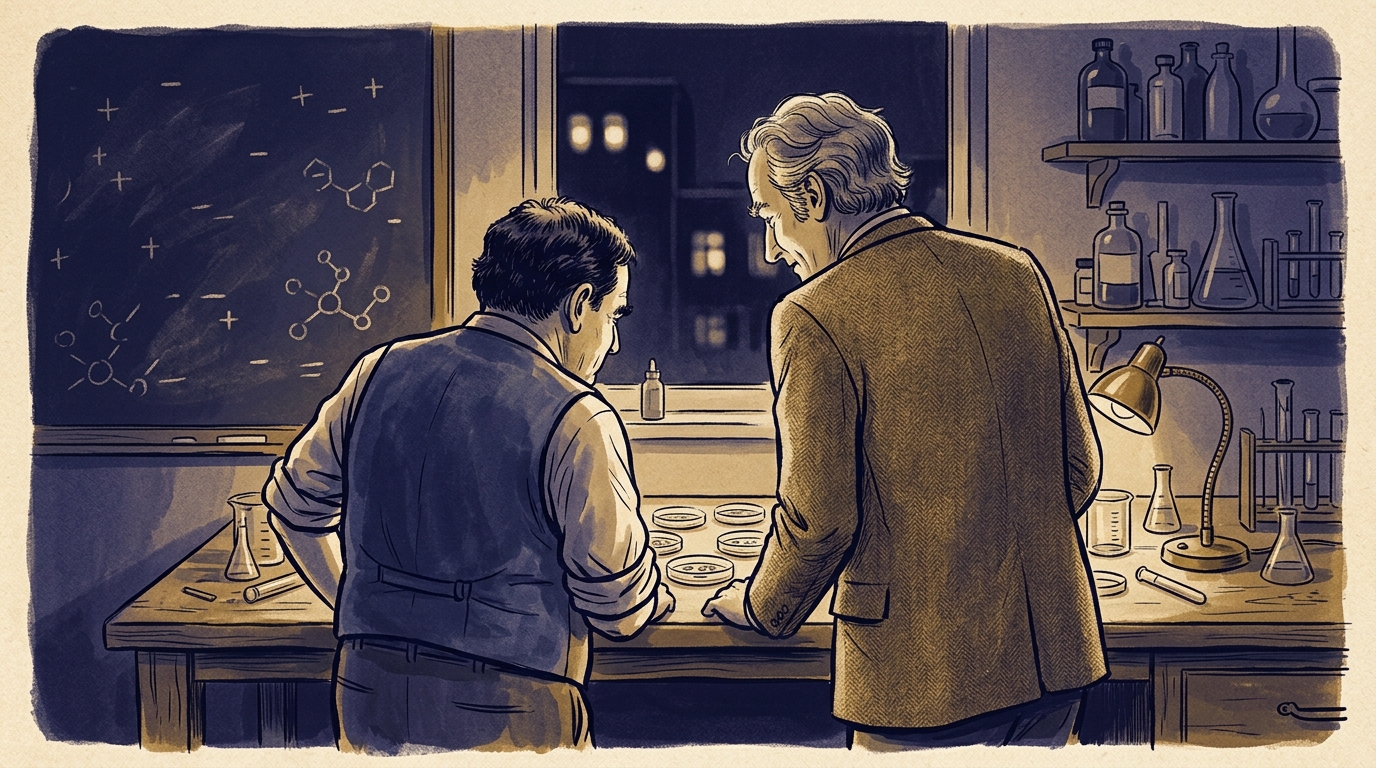
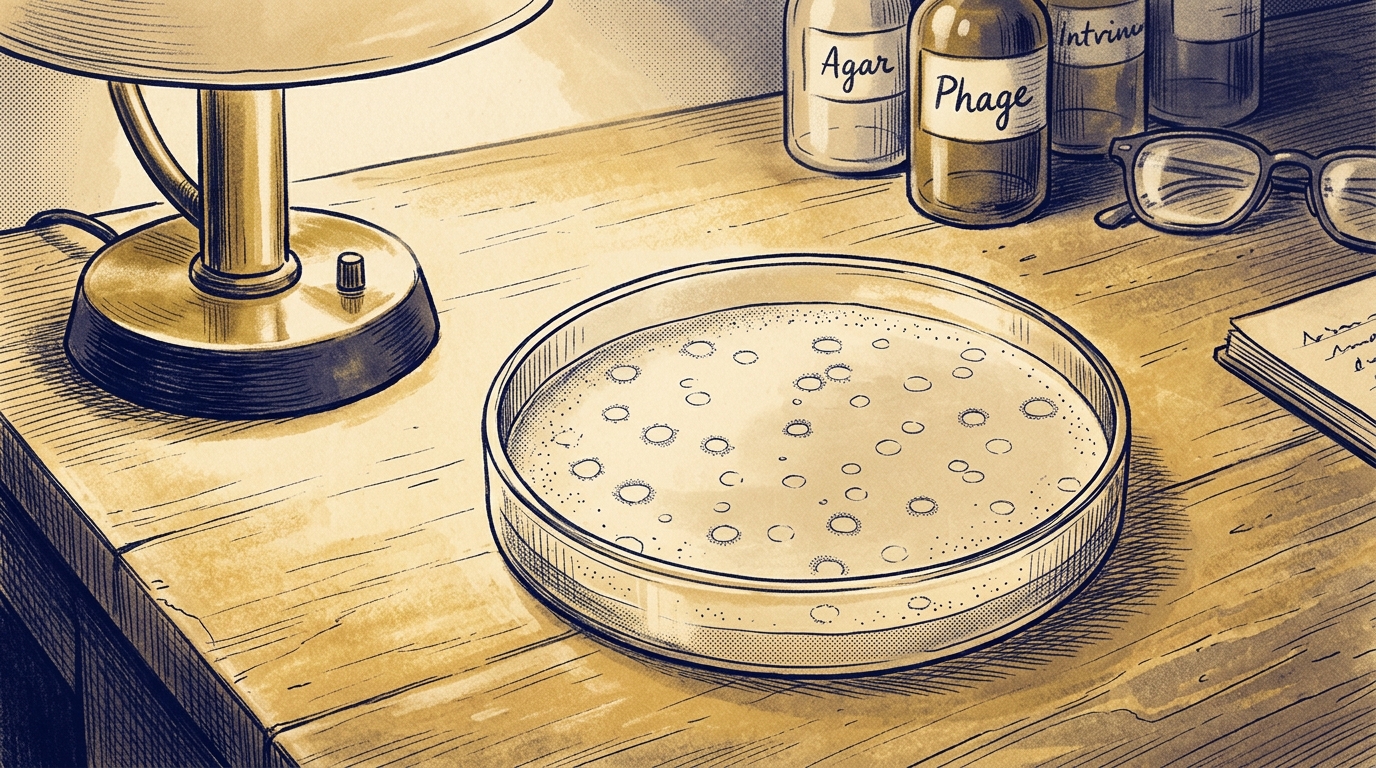
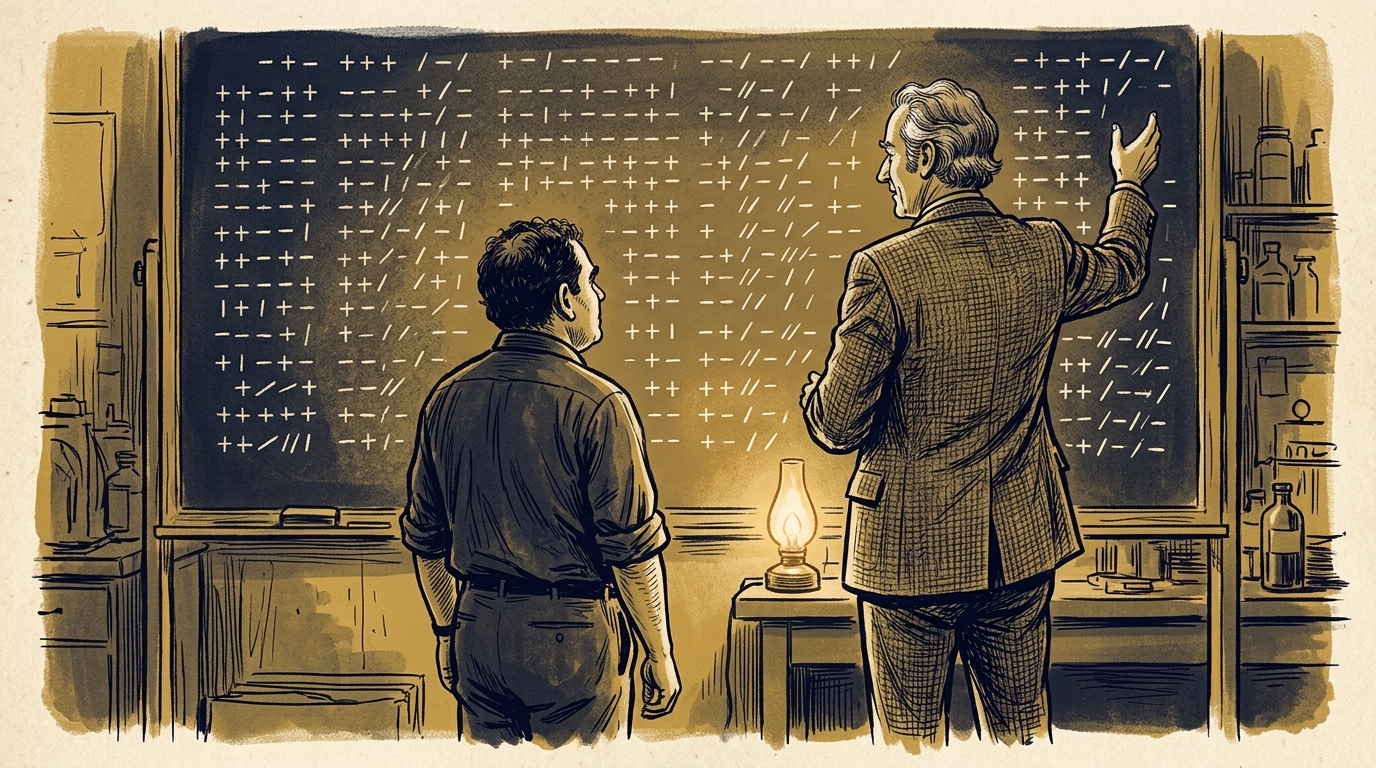
THE HOOK
0:21
01THE HOOK
In 1961, Francis Crick and Sydney Brenner cracked the grammar of life without reading a single letter of it. By adding and deleting single letters from a virus's genes — and watching it live or die — they proved the genetic code is read three letters at a time `F1`.
02THE WORLD THEN
By 1961 everyone agreed on the headline: the order of DNA's four letters somehow spells the order of a protein's twenty amino acids `F2`. But the grammar was a mystery. How many letters make a word? Two give only sixteen combinations — too few. Three give sixty-four — more than enough, perhaps too many `F3`. Were the words read overlapping, or in clean separate blocks? Was there punctuation between them? Nobody knew `F2`.
03THE QUESTION
Crick saw a way in. Imagine the message as a sentence written without spaces, read from a fixed starting point in fixed-size chunks. Delete a single letter, and everything after it slides out of step — pure gibberish `F4`. Could you use those shifts — adding and removing single letters — to count the letters in a word? `F4`
04THE DESIGN ① the system
They needed a gene that would shout when it broke. They chose the rII region of a virus — the T4 bacteriophage — a gene so sensitive that a working copy let the virus grow on a certain strain of bacteria, and a broken copy simply couldn't `F5`. Life or death, read straight off a dish. And they had the perfect tool: a chemical, proflavin, that adds or deletes single letters of DNA — never just swapping one `F6`.
05THE DESIGN ② the reading frame
Here is the whole idea on a sentence you can read. THE CAT ATE THE RAT — take it three letters at a time, and every word lands `F4`. Now delete one letter near the start. The reading frame shifts by one, and from that point on every word is scrambled — the message is destroyed `F7`. A single deletion; a dead gene. Call it a "minus" `F6`.
06THE DESIGN ③ plus meets minus
Now the trick. Downstream of that deletion, add a letter back — a "plus" `F6`. Between the two changes, one short stretch stays garbled. But beyond the second one, the frame clicks back into register, and the words read true again `F8`. A plus and a minus near each other, and the broken gene often heals `F8`.
07THE DESIGN ④ counting to three
So how many letters make a word? Watch what heals and what doesn't. One deletion: dead. Two deletions: still dead — the frame is off by two `F9`. But delete three letters of the same sign, and the frame shifts by a whole word and snaps back into step; the message downstream reads true again `F9`. One or two stay broken. Three heal `F9`.
08THE RESULT
And that is exactly what the dishes showed. A virus carrying one or two changes of the same sign stayed dead — no growth `F10`. Three changes together, and the plaques came back: the virus lived `F10`. The gene could only be mended in steps of three. The reasoning allowed three, or any multiple of it — and three is the answer `F9`.
09WHAT WE LEARNED
From a virus living or dying, they had read off the architecture of the code — without sequencing a thing `F11`. It is a triplet, read from a fixed start, in clean non-overlapping blocks, with no commas between the words `F8`. And because sixty-four words spell only twenty amino acids, the code must be degenerate — several triplets sharing a single meaning `F12`. The shape of the code was fixed by pure genetics, while others were only beginning to read its very first words `F11`.
10WHY IT'S BEAUTIFUL
That is the beauty of it. In 1961 no machine on Earth could read a single base `F13`. Yet by adding and subtracting letters and watching a virus grow, Crick and Brenner reasoned their way to the deep arithmetic of an unseeable molecule — three `F1`. It is inference at its most daring: deducing the shape of the invisible from what it does.
11SIGN-OFF
Life reads itself three letters at a time. — Beautiful Experiments.
The write-up
In one line: By adding and deleting single letters in a virus's genes and watching it live or die, Crick, Barnett, Brenner and Watts-Tobin proved — without reading a single base — that the genetic code is read from a fixed start in non-overlapping groups of three.
The world then
By 1961 the headline was settled: the order of DNA's four bases specifies the order of a protein's twenty amino acids. But the grammar of the code was unknown. How many letters make a word? Two give only sixteen combinations — too few for twenty; three give sixty-four — more than enough, perhaps too many. Were the words read overlapping or in separate blocks? Was there punctuation between them? The code was still a puzzle of pure logic — and Brenner himself had, in 1957, already ruled out overlapping codes with nothing but arithmetic (the subject of our first episode).
The question
Picture the message as a sentence written without spaces, read from a fixed starting point in fixed-size chunks. Delete a single letter and everything after it slides out of step — pure gibberish. Could those shifts — adding and removing single letters — be used to count the letters in a word?
The design
They chose the rII region of bacteriophage T4, a gene with an exquisitely sensitive readout: a working copy lets the phage grow on E. coli strain K12(λ); a broken copy cannot grow there at all — life or death, read straight off a dish. Their tool was proflavin, an acridine that adds or deletes single bases (a "frameshift") rather than swapping one. Starting from a founding mutant, they labelled additions "+" and deletions "−".
- A single + or − shifts the reading frame → the gene is dead.
- A + paired with a − nearby restores function ("pseudo-wild"): the frame is thrown off only between the two sites and clicks back into register beyond — a short garbled stretch, then the message reads true again.
- The clincher: three changes of the same sign (+++ or −−−) restore function, while one or two do not.
Shown on a sentence: THE CAT ATE THE RAT. Delete the C and everything downstream scrambles. Add a letter
back and only one word (XAT) stays garbled — ATE THE RAT is restored. Delete three letters and the frame
shifts by a whole word and snaps back into step.
The result
On the plates, phage carrying one or two same-sign changes stayed dead; three together brought the plaques back — the virus lived. The gene could only be mended in steps of three. The reasoning strictly allowed "three, or a multiple of three"; three is the answer, later confirmed as the code was chemically cracked.
What we learned, and why it's beautiful
The experiment established the architecture of the genetic code — a triplet, read from a fixed start, in non-overlapping blocks, with no commas — and, because sixty-four words spell only twenty amino acids, that the code must be degenerate (several triplets sharing a meaning). All of it deduced by pure genetics, in a year when no machine on Earth could read a single base (DNA sequencing was still sixteen years away). It framed the codon-by-codon decoding that Nirenberg, Khorana and others were beginning in the very same year. Reasoning your way to the arithmetic of an unseeable molecule from whether a virus lives or dies is scientific imagination at its most daring.
Sources
Full claim-by-claim evidence is in references.md. Primary anchor:
- Crick FHC, Barnett L, Brenner S, Watts-Tobin RJ, "General Nature of the Genetic Code for Proteins," Nature 192(4809):1227–1232 (30 Dec 1961). https://www.nature.com/articles/1921227a0
Accuracy note: the four authors are Crick, Barnett, Brenner, Watts-Tobin (the episode uses the popular "Crick & Brenner" shorthand). The paper's stated conclusion is the coding ratio is "3, or a multiple of 3" — the narration keeps that hedge. Nirenberg–Matthaei's first codon (poly-U → phenylalanine, Oct 1961) was contemporaneous, published just before this paper — the episode claims no precedence over it. Degeneracy was inferred ("probably degenerate"), not measured here; and proflavin's ±1-base action and the +/− signs were operational inferences from the genetics, with the physical mechanism confirmed later.
The evidence
Every claim, sourced
Each [F#] you hear in the film links to the source it came from. Nothing gets narrated until every one is checked and signed off.
Sign-off
- Producer fact-check — the argument (reading frame → single frameshift kills → +/− heals → +++ heals, one/two do not → coding unit three), the rII/T4/K12(λ) system, proflavin frameshifts, degeneracy, and all dates are corroborated across the cited sources.
- ⚠️ Traps stated correctly in
script.md: (a) conclusion is "3, or a multiple of 3" — narrated as "three, or any multiple of it — and three is the answer" [F9]; (b) Nirenberg 1961 was contemporaneous, not enabled by the Crick paper — narrated as "others were only beginning to read its very first words," no precedence claimed [F11]; (c) degeneracy inferred ("must be degenerate"), not measured [F12]; (d) proflavin ±1-bp / +/− signs are operational inferences from genetics [F6]; (e) +/− suppression works "often" (barrier must lack a stop) — narrated "often heals" [F8]; (f) full author credit (Crick, Barnett, Brenner, Watts-Tobin) recorded though narration names the famous duo. - Numbers in audio kept robust: only 16 / 64 / 20 stated as exact (arithmetic); the coding-unit result carries the "or a multiple of three" hedge; degeneracy stated as a logical "must."
- "What was shown" vs "what was later confirmed" not overstated: they proved the architecture (triplet, non-overlapping, fixed-start, degenerate) by genetics; the chemical codon meanings were read by others (1961→~1966).
- PhD sign-off (recommended before public release) — confirm the exact "3, or a multiple of 3" and "probably degenerate" wording against the Nature 1961 PDF.
Gate OPEN → narration + render may proceed. Resolve the final PhD box before public release.
- F1⚠ commonly confused
In 1961 Crick & Brenner (with Barnett & Watts-Tobin) proved the code is read in non-overlapping groups of three, by adding/deleting single bases and scoring gene function — without reading a single base. ⚠️ paper's exact conclusion is coding ratio "3, or a multiple of 3" (see F9); no sequencing existed (F13)
The paper's method (frameshift genetics) and central result
- F2
By 1961 base sequence was known to specify amino-acid sequence, but the code's architecture — word length, overlap, punctuation — was unknown (the paper's explicit motivation)
Introduction / motivation of the paper
- F3
Two bases give 16 combinations (too few for 20); three give 64 (more than enough)
4²=16 < 20 ≤ 64 = 4³ (arithmetic)
- F4⚠ commonly confused
The reading-frame idea: the message is read from a fixed starting point in fixed-size chunks, so a single insertion/deletion shifts the frame and garbles everything downstream ⚠️ the concept is the paper's ("fixed start," reading in "phase"); the exact term "reading frame" is a modern paraphrase
Central logical inference of the paper
- F5
They used the rII region of bacteriophage T4; a working (rII⁺) gene lets the phage grow on E. coli strain K12(λ), a mutant cannot → an extremely sensitive selection (one wild-type among millions is detectable)
The rII/T4 selection system
- F6⚠ commonly confused
The mutagen was proflavin (an acridine), which adds or deletes single bases rather than swapping one; additions were labelled "+", deletions "−" ⚠️ the +/− assignment is operational/arbitrary (built from the founding mutant FC0); Crick et al. inferred ±1-bp indels from the genetics — the physical intercalation mechanism was Lerman's separate 1961 model, not demonstrated in this paper
Proflavin frameshift mutagenesis; operational +/− signs
- F7
A single frameshift (one + or one −) destroys gene function
rII mutant fails to grow on K12(λ)
- F8⚠ commonly confused
A "+" paired with a "−" nearby restores function ("pseudo-wild") — the frame is off only between the two sites and restored beyond → read sequentially, from a fixed start, non-overlapping, commaless ⚠️ restoration works "often," not always: the out-of-frame barrier stretch must avoid a chain-terminating ("nonsense") triplet, so position matters
Frameshift suppression → non-overlapping, fixed-start code
- F9⚠ commonly confused
Three mutations of the same sign (+++ or −−−) restore function; one or two do not → coding unit is three ⚠️ paper's stated conclusion is "3, or a multiple of 3"; the script says so ("or any multiple of it — and three is the answer") — exactly-three was confirmed by the later biochemistry
The clinching result
- F10
The readout was viral growth / plaques on E. coli K12(λ): plaques appear (phage lives) only when the reading frame is sufficiently restored
The genetic assay
- F11⚠ commonly confused
The architecture was deduced by pure genetics; the chemical code was read separately. ⚠️ Timing: Nirenberg–Matthaei's first codon (poly-U → phenylalanine) was published Oct 1961, before the Crick paper (30 Dec 1961) — they were contemporaneous & independent; the full 64-codon dictionary came by ~1966. Script says only "others were only beginning to read its very first words" — no false precedence
Contemporaneous 1961 work; full code ~1966
- F12⚠ commonly confused
The code is degenerate — several triplets sharing one meaning ⚠️ the paper stated this as "probably degenerate," an inference from 64 ≫ 20 and pseudo-wild viability, not a direct codon-assignment measurement; script says "must be degenerate" (a logical inference)
Degeneracy inferred as probable
- F13
In 1961 no method existed to read/sequence DNA bases — practical DNA sequencing (Sanger dideoxy) arrived in 1977
No sequencing in 1961