
Clayton & Dickinson · 1998
Other Minds in Birds
Episodic memory — recalling the what, where, and when of a single past event — was thought to be ours alone. Then a scrub jay remembered all three.
The walkthrough
Beat by beat
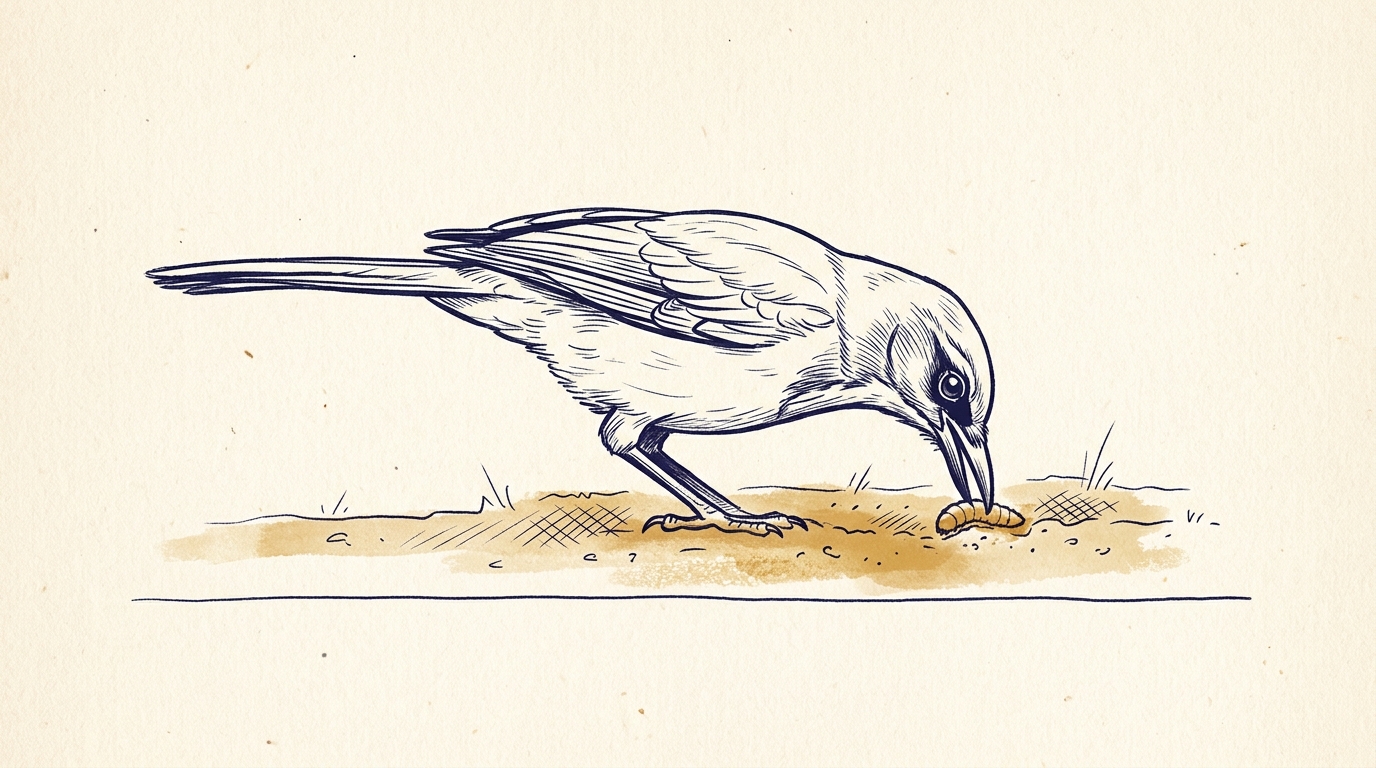
THE HOOK
0:25
01THE HOOK
For most of a century, one kind of memory was thought to be ours alone — the power to travel back to a single past event and recall its what, its where, and its when `F1`. Then a Cambridge scientist with a dancer's eye for movement watched a jay hide its food `F11` — and proved the bird remembered all three `F1`.
02THE WORLD THEN
The reigning view had a name behind it. Endel Tulving argued that reliving a specific episode — mental time travel — depends on human self-awareness `F2`. Animals, the thinking went, were stuck in an eternal present: they could learn, but they could not remember a particular past `F2`. Corvids — the crows and jays — had begun to unsettle that assumption. And the scrub-jay, which hides thousands of meals and finds them again, was the perfect place to test it `F3`.
03THE QUESTION
Here is the sharp version of the question. When a jay recovers a cache, is it just following a learned rule — food is buried here `F3`? Or can it recall one specific event: not only what it hid and where, but how long ago — and act on it `F1`?
04THE DESIGN ① the two foods
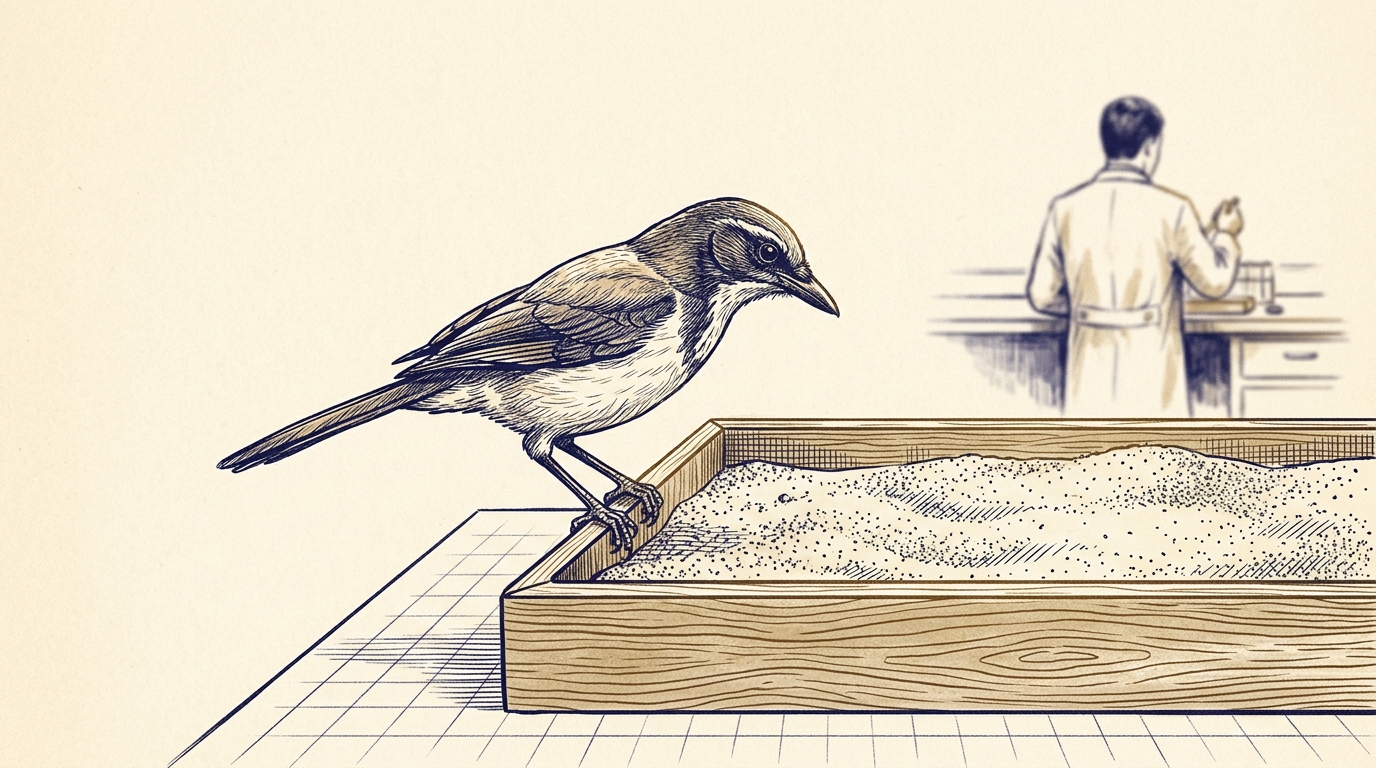
The design turns on a conflict the jays feel themselves. Given the choice, a scrub-jay loves a wax-moth larva — a fat, wriggling grub — far more than a peanut `F4`. But grubs rot, and peanuts keep `F4`. So the experimenters let a jay cache both, in sand-filled trays made unmistakably distinct — each ringed with coloured building blocks, so every hiding place was its own `F4`.
05THE DESIGN ② the clever timeline
Then they played the grub's freshness against the clock. In a single trial the jay caches one food, waits days, caches the other, then recovers `F5`. So at the moment of choice the two caches have different ages: one hidden four hours ago, the other a hundred and twenty-four `F5`. After four hours the grub is still delicious. After a hundred and twenty-four, it has rotted to something no jay will touch `F5`. To choose well, the bird must know not just what and where, but when.
06THE DESIGN ③ the trap for smell
And here is the move that makes it a proof. On the test, before the jay is let back in, every cache is quietly removed and the sand smoothed flat `F6`. Now there is nothing to see and nothing to smell — the trays are empty `F6`. Wherever the bird chooses to dig, it is digging on memory alone `F6`.
07THE RESULT
And the jays chose exactly as memory predicts. After the short delay, they went straight for the grub tray — the prize, still fresh `F7`. After the long delay, the same birds turned away from the grubs and searched for peanuts instead — declining to dig for a treat they knew by now was spoiled `F7`. Crucially, only jays who had learned that grubs rot made the switch `F7`. Their choice depended jointly on what, where, and how long ago — integrated in a single memory `F7`.
08WHAT WE LEARNED
Clayton and Dickinson called it episodic-like memory — "like," deliberately, because we can measure a bird's choices but never its inner experience `F8`. It was the first rigorous, behavioural test of remembering a specific past in any animal — and it opened a field `F8`. Soon jays were shown re-hiding food when a rival had watched them cache `F9`, and stashing breakfast where they expected to wake up hungry `F10` — memory of the past, and planning for the future.
09WHY IT'S BEAUTIFUL
What makes it beautiful is that the cleverness is logical, not technological. No scanner, no probe — just a grub, a peanut, and a clock, arranged so that behaviour alone could reveal whether a bird remembers when `F5`. Designing a situation in which an animal has no way to succeed except by real memory — that is the whole art `F6`.
10SIGN-OFF
A worm, a nut, and a week's patience — enough to find another mind. — Beautiful Experiments.
The write-up
In one line: By pitting a jay's love of a perishable grub against the passage of time — and emptying the trays so no smell could help — Nicola Clayton and Anthony Dickinson showed a bird recalling what it had hidden, where, and how long ago: the first rigorous evidence of episodic-like memory in an animal.
The world then
For most of the twentieth century, one kind of memory was thought to be uniquely human: the ability to travel back in the mind to a specific past event — its what, its where, and its when. Endel Tulving had named this "episodic" memory and tied it to human self-awareness — "mental time travel." Animals, the reigning view held, were stuck in an eternal present: they could learn, but they could not re-live a particular episode. Corvids — crows and jays — were beginning to unsettle that assumption, and the food-caching scrub-jay, which hides thousands of meals and finds them again, was the perfect place to test it.
The question
When a jay recovers a cache, is it merely following a learned rule — food is buried here — or can it recall one specific caching event: not only what it hid and where, but how long ago, and act on that?
The design
The design turns on a conflict the jays feel themselves. Given the choice, a scrub-jay much prefers a wax-moth larva (a "waxworm") to a peanut — but larvae rot while peanuts keep. Clayton and Dickinson let a jay cache both, in sand-filled ice-cube trays made visuospatially unique with coloured Lego Duplo blocks, so every hiding place was its own.
Then they played the grub's freshness against the clock. In a single trial the jay caches one food, waits about 120 hours, caches the other, waits a final 4 hours, then recovers — so at the moment of choice the two caches have different ages: one 4 hours old, the other 124 hours old. After 4 hours the grub is still delicious; after 124 hours it has rotted to something no jay will touch.
The move that makes it a proof is the control: on the test the caches were removed and the sand smoothed flat before the bird returned ("tested in extinction"). With the trays empty there is nothing to see and nothing to smell — so wherever the jay digs, it is digging on memory alone.
The result
The jays chose exactly as memory predicts. After the short delay they searched where they had hidden the still-fresh grubs; after the long delay the same birds turned away from the grubs and searched for peanuts instead, declining to dig for a treat they knew by then was spoiled. Crucially, only jays that had experienced grubs rotting made the switch. Their choice depended jointly on what, where, and how long ago — integrated in a single memory.
What we learned, and why it's beautiful
Clayton and Dickinson called it episodic-like memory — "like," deliberately, because we can measure a bird's choices but never its inner experience; the behavioural what–where–when criteria are what a non-verbal animal can be held to. It was the first rigorous demonstration of remembering a specific past in any animal, and it opened a field: jays were later shown re-caching food when a rival had watched them (Emery & Clayton, 2001) and caching where they anticipated being hungry the next morning (Raby et al., 2007) — memory of the past, and planning for the future.
The elegance is logical, not technological. No scanner, no probe — just a grub, a peanut, and a clock, arranged so that behaviour alone could reveal whether a bird remembers when. Designing a situation in which an animal has no way to succeed except by real memory is the whole art.
Sources
Full claim-by-claim evidence is in references.md. Primary anchors:
- Clayton, N. S. & Dickinson, A. "Episodic-like memory during cache recovery by scrub jays." Nature 395, 272–274 (1998). doi:10.1038/26216 — the what-where-when experiment.
- Emery, N. J. & Clayton, N. S. "Effects of experience and social context on prospective caching strategies by scrub jays." Nature 414, 443–446 (2001). doi:10.1038/35106560 — re-caching when watched.
- Raby, C. R., Alexis, D. M., Dickinson, A. & Clayton, N. S. "Planning for the future by western scrub-jays." Nature 445, 919–921 (2007). doi:10.1038/nature05575 — future planning.
- Original method quoted in Worsfold, Clayton & Cheke, "Revisiting episodic-like memory in scrub jays," Learning & Behavior (2025), PMC11880068.
Accuracy note: The headline what-where-when result is the 1998 paper — not the 2001 re-caching study, which is a later follow-up. The delays are 4 h and 124 h within one trial (the caches differ in age at a single recovery), not two separate groups. And it is episodic-like: the experiment establishes the behavioural criteria of a recalled past, without claiming to read the bird's conscious experience.
The evidence
Every claim, sourced
Each [F#] you hear in the film links to the source it came from. Nothing gets narrated until every one is checked and signed off.
Sign-off
- Producer fact-check — design (preference-vs-perishability, sequential 4 h/124 h caching, extinction control), result (short→worms, long→peanuts, only for degrade-experienced birds), and the episodic-like framing are verified against a Clayton-co-authored review that quotes the 1998 method in full.
- Key numbers verified against the primary design as quoted: 4 h and 124 h stated as exact; the "century of belief" kept qualitative; species/food kept to the 1998 original (peanuts + waxworms), not the 2025 replication (pine nuts, 76 h).
- ⚠️ Traps stated correctly in
script.md: (a) 1998 for the what-where-when result; 2001/2007 flagged as later work [F9,F10]; (b) sequential single-trial ages, not parallel groups [F5]; (c) episodic-like, no claim of conscious recollection [F8]; (d) "stuck in time" attributed to the view, not quoted from Tulving [F2]; (e) Clayton a scientist who is also a dancer [F11]. - "What was shown" vs "what was later confirmed" not overstated — the 1998 result is the integrated what-where-when memory; social re-caching [F9] and future-planning [F10] are named as subsequent studies.
- PhD sign-off (recommended before public release) — confirm the exact 1998 wording of the retention intervals and the group structure against the Nature primary PDF (behind paywall; not retrievable in-session).
Gate OPEN → narration + render may proceed. Resolve the final PhD box before public release.
- F1⚠ commonly confused
For ~a century, recalling a specific past event — its what, where, and when — was thought uniquely human; Clayton & Dickinson showed a jay remembered all three ⚠️ shown behaviourally (episodic-like), see F8
The 1998 paper's thesis: search shifts prove integrated what-where-when memory
- F2⚠ commonly confused
Endel Tulving framed episodic memory / "mental time travel" as depending on human self-awareness; animals were widely held to be "stuck in time," able to learn but not to recall a particular past ⚠️ "stuck in time" is Roberts 2002's crisp phrasing of the Tulvingian view, not a verbatim Tulving quote
Tulving: episodic memory as a uniquely human neurocognitive system; Roberts crystallised "are animals stuck in time?"
- F3
Scrub-jays hide thousands of caches and recover them — a natural lab for asking whether recovery is a learned rule or recall of a specific event
Food-caching ecology of scrub-jays; the motivating question of the paper
- F4
Jays prefer wax-moth larvae ("waxworms") to peanuts, but larvae perish and peanuts keep; both cached in sand-filled ice-cube trays made visuospatially unique with coloured Lego Duplo blocks
Preferred-but-perishable vs less-preferred-but-durable; distinctive trays
- F5⚠ commonly confused
Sequential design: cache one food → ~120 h delay → cache the other → final 4 h delay → recover, so caches are 4 h and 124 h old; after 4 h the grub is fresh, after 124 h it has rotted to an unpalatable state ⚠️ single trial, staggered ages — not parallel groups
"120-h delay… final 4-h delay… after a 124-h delay the waxworms were rotten"
- F6
The extinction control: on the test, caches were removed and the substrate smoothed before recovery — the trays are empty, so searching cannot use sight or smell of food and reflects memory alone
"caches were removed and not replaced prior to recovery to assess reliance on memory and to control for olfactory cues"; substrate "smoothed over to remove visual cues"; "tested in extinction"
- F7
Result: short delay → searched the waxworm tray; long delay → switched to the peanut tray, avoiding the now-degraded grubs; only birds that had experienced worms degrading made the switch → choice depended jointly on what, where, and when
"searched in the waxworm tray after the short delay, but in the peanut tray following the long delay… this… only applied to birds who had had the experience of food degrading"
- F8⚠ commonly confused
They named it "episodic-like" — deliberately "like," because the subjective/autonoetic side of episodic memory cannot be verified in a non-verbal animal; behavioural what-where-when criteria are what's tested. First rigorous demonstration in an animal ⚠️ do not overclaim conscious recollection
Operational episodic-like criteria; the "-like" caveat
- F9⚠ commonly confused
The field it opened — jays re-cache food when they had been watched by a potential thief (and only birds that had themselves pilfered did so) ⚠️ this is the 2001 follow-up, not the 1998 primary
Prospective/social caching; perspective-taking
- F10
Jays cache where they anticipate being hungry the next morning — evidence of planning for the future, independent of current need
"Planning for the future by western scrub-jays"
- F11⚠ commonly confused
Nicola Clayton — Professor of Comparative Cognition, University of Cambridge; an accomplished dancer, later Scientist in Residence with Rambert; her sense of movement sharpened her eye for behaviour ⚠️ "dancer-with-a-scientist's-eye," not "left dance for science"
Cambridge chair in comparative cognition; dancer / Rambert residency