
Sydney Brenner · 1957
The Experiment That Killed a Beautiful Idea
A young biologist killed an entire family of theories about the genetic code — with a pencil, a page of arithmetic, and data everyone already had.
The walkthrough
Beat by beat
THE HOOK
0:18
01THE HOOK
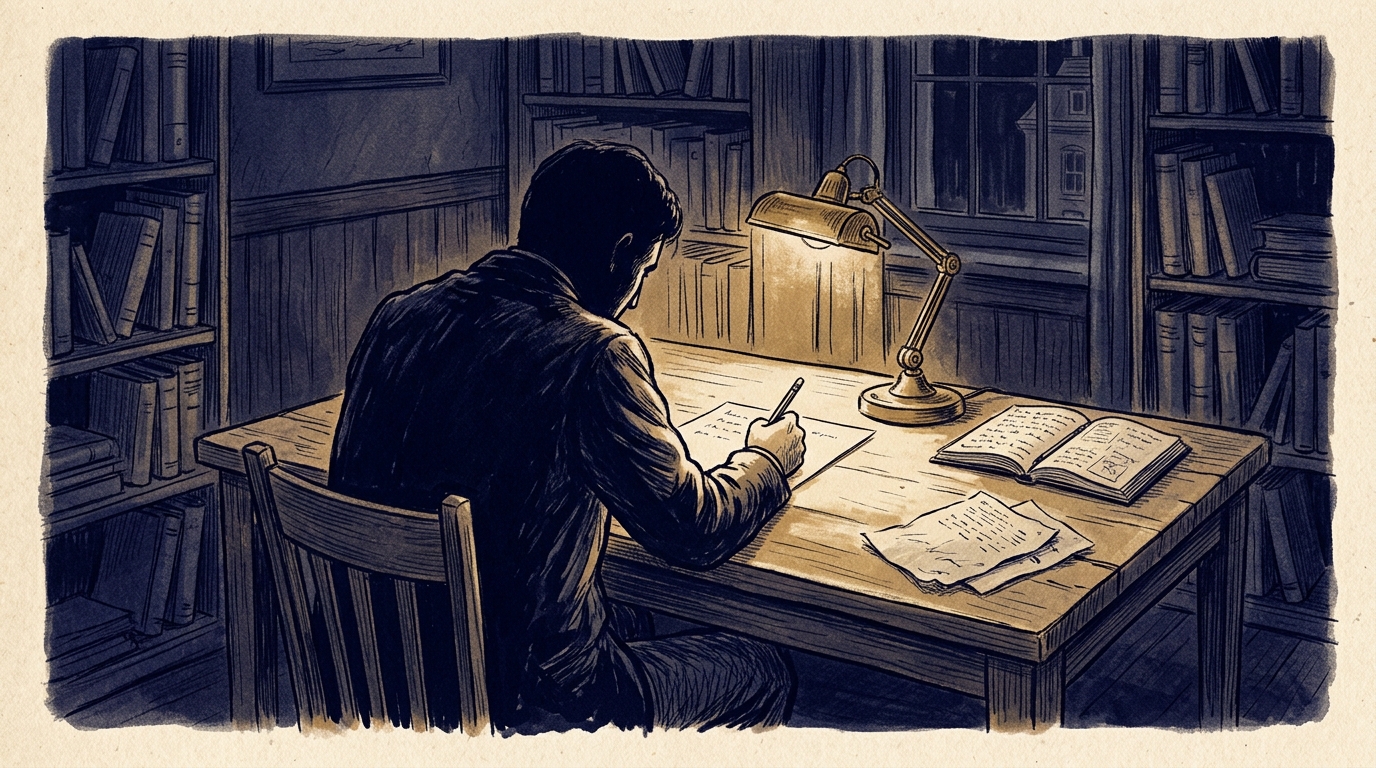
In 1957, a young biologist killed an entire family of theories about the genetic code `F1`. He didn't run an experiment. He never touched a test tube. He used a pencil — and a handful of facts everyone already had `F12`.
02THE WORLD THEN
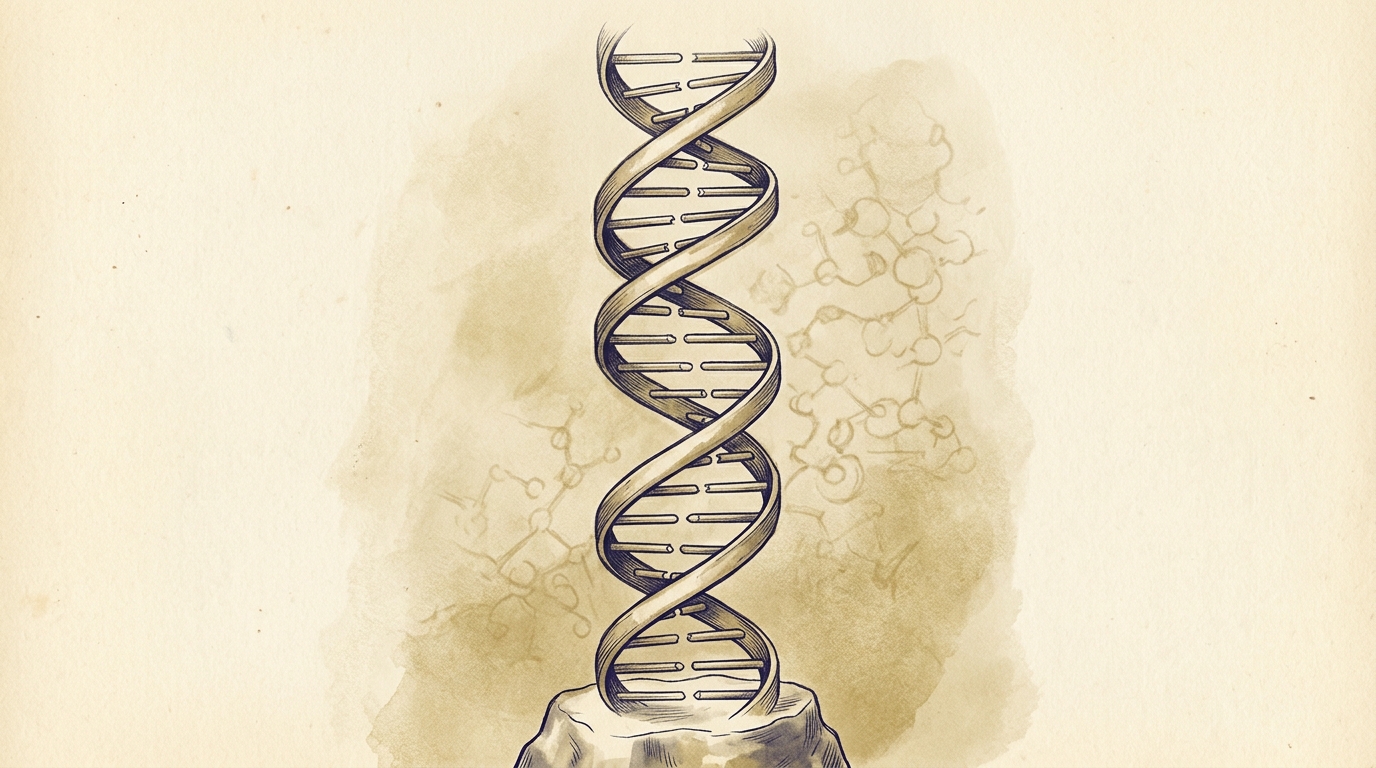
The double helix was brand new — Watson and Crick, 1953 `F2`. But the real mystery was still wide open: how do just four letters of DNA spell out the twenty amino acids that build a protein? `F2` Letters in pairs give only sixteen combinations — too few. In threes, sixty-four — more than enough `F3`. So the message had to be read in triplets.
03THE QUESTION
That left one tantalising question: do the triplets overlap? The most elegant idea of the day said yes — George Gamow's "diamond code," where each triplet shares letters with its neighbours, packing the message tight `F4`. It was beautiful. The only question was whether it could be true.
04THE DESIGN ① reading the code
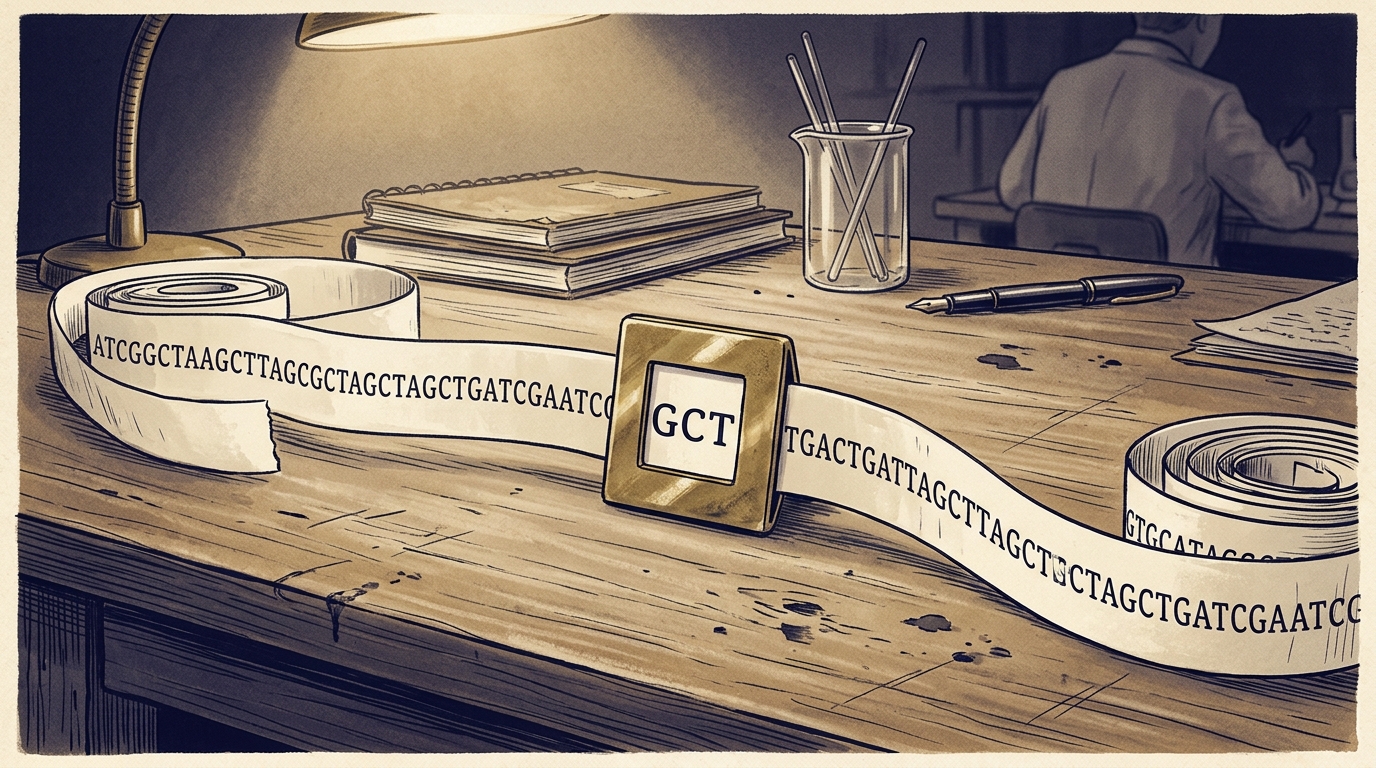
So picture the DNA as a long tape of letters. A non-overlapping code would read it in separate blocks of three. An overlapping code is greedier — it slides along just one letter at a time. Letters one to three are the first amino acid; two to four, the next; three to five, the next. Read that way, every amino acid shares two of its three letters with the one beside it `F5`.
05THE DESIGN ② the catch
And that sharing is a trap you can spring with arithmetic. Fix one amino acid — its three letters are set. Its neighbour keeps the last two and adds only one new letter. One free letter means just four possibilities. So in any overlapping code, an amino acid can sit beside at most four others `F6`.
06THE DESIGN ③ the test
Here is where the real proteins come in. Brenner went through the sequences already known `F7` and asked, for each amino acid, how many different neighbours it actually has. Again and again, the answer was more than four. And every neighbour beyond the fourth forces the code to spend another triplet — another of its sixty-four words `F6`.
07THE RESULT
Add up all the triplets those neighbours demand, and the total runs past seventy `F8`. But a three-letter code has only sixty-four words in all `F9`. Seventy cannot fit inside sixty-four. The overlapping code was impossible `F9`.
08WHAT WE LEARNED
And not only Gamow's. The paper's title is its result: the impossibility of all overlapping triplet codes — a whole class of theories, ruled out by a single count `F10`. The code had to be non-overlapping, read in clean separate blocks of three, exactly as a famous experiment would confirm in 1961 `F11`.
09WHY IT'S BEAUTIFUL
What makes it beautiful is how little it took. No apparatus, no new measurement `F12` — just a sharp question, other people's data, and arithmetic. Brenner didn't find the code. He cleared the board of everything it could not be `F11` — which is very often how the largest questions get answered.
10SIGN-OFF
Sometimes the most powerful instrument in the lab is a pencil. — Beautiful Experiments.
The write-up
In one line: In 1957 Sydney Brenner disproved an entire class of genetic-code theories — every overlapping triplet code — with nothing but arithmetic and protein sequences other people had already read.
The world then
By the mid-1950s the structure of DNA was known — Watson and Crick's double helix (1953). The next great problem was the code: how do four bases (A, C, G, T) specify the twenty amino acids of a protein? Pairs of bases give only 4² = 16 combinations — too few. Triplets give 4³ = 64 — comfortably enough. So the message had to be read in groups of (at least) three.
The question
Did the triplets overlap? The most elegant proposal of the day was George Gamow's 1954 "diamond code," an overlapping code in which each base is shared between neighbouring codons — compact, physically motivated, and beautiful. The question was whether nature actually used it.
The design
Brenner's insight was that an overlapping code makes a checkable prediction. If consecutive amino acids share two of their three bases, then any given amino acid can be immediately followed by only a handful of others — at most four, because just one base is free to vary. He didn't run a new experiment: he took the protein sequences chemists had already determined (Fred Sanger had recently sequenced insulin, the first fully-read protein) and tabulated which amino acids actually neighbour which.
The result
He then counted the distinct base-triplets those observed neighbours would require. The sequences demanded more than seventy different triplets — but a three-letter code provides only 64. Seventy cannot fit inside sixty-four. The overlapping code was impossible.
What we learned, and why it's beautiful
The paper's title is its result: the impossibility of all overlapping triplet codes — not just Gamow's specific scheme, but the entire class, eliminated by a single count. The genetic code had to be non-overlapping, read in clean, separate triplets — exactly what Crick, Barnett, Brenner and Watts-Tobin would confirm with their frameshift experiments in 1961. The beauty is in the economy: no apparatus, no new measurement, just a sharp question put to data that already existed. Brenner didn't discover the code; he cleared away everything it could not be — which is often how the biggest questions get answered.
Sources
Full claim-by-claim evidence is in references.md. Primary anchors:
- Brenner, S. "On the Impossibility of All Overlapping Triplet Codes in Information Transfer from Nucleic Acid to Proteins." PNAS 43(8), 687–694 (1957).
- Gamow, G. "Possible Relation between Deoxyribonucleic Acid and Protein Structures." Nature 173, 318 (1954).
- Crick, F. H. C., Barnett, L., Brenner, S., Watts-Tobin, R. J. "General Nature of the Genetic Code for Proteins." Nature 192, 1227–1232 (1961).
Accuracy note: Brenner disproved overlapping codes; he did not prove the actual code (that came later).
The headline figure is stated as "more than seventy" triplets versus 64; the exact count of proteins Brenner
compiled is left qualitative, as secondary retellings differ — see the sourcing note in references.md.
The evidence
Every claim, sourced
Each [F#] you hear in the film links to the source it came from. Nothing gets narrated until every one is checked and signed off.
Sign-off
- Producer fact-check — the argument (overlap → ≤4 neighbours → >70 triplets needed > 64 → impossible), the framing (Gamow's diamond code; all overlapping codes), and the dates are corroborated across the cited sources.
- ⚠️ Traps stated correctly in
script.md: (a) all overlapping triplet codes, not just Gamow's [F10]; (b) Brenner disproved overlap, did not prove the real code — confirmed later in 1961 [F11]; (c) protein count kept qualitative; "70" narrated as "more than seventy" [F7,F8]. - Numbers used in audio kept robust: only 64 is stated as exact (4³); the rest qualitative / "more than seventy".
- PhD sign-off (recommended before publish) — confirm the exact "70" and the protein count against the PNAS/PMC primary PDF.
Gate OPEN → narration + render may proceed (prototype). Resolve the final PhD box before public release.
- F1
In 1957 Brenner showed no overlapping triplet code can carry the genetic message — with arithmetic and sequences others had already read
The paper's title and thesis
- F2
By the mid-1950s the helix was known and DNA carried the message, but the mechanism of protein synthesis was unknown — no messenger RNA (1961), no adaptor/tRNA yet; many assumed amino acids fit directly against the template. The code was a theorists' problem (Gamow, the RNA Tie Club).
Watson–Crick helix; pre-mRNA state of the field; mRNA found 1961
- F3
Two bases give only 16 combinations (too few for 20); three give 64 — so the code had to be (at least) triplets
4²=16 < 20 ≤ 64 = 4³ (arithmetic)
- F4⚠ commonly confused
Gamow's 1954 "diamond code": with no messenger known, protein assembled directly on the DNA, each amino acid in a diamond pocket of the double helix. It is an overlapping triplet code — the diamond has 4 corners, but two are a complementary base pair (A–T/G–C) = one letter → 3 informational letters; the diamonds gave ~20 shapes for 20 amino acids ⚠️ "4 bases" geometry vs "3-letter" information
Gamow's overlapping diamond code; complementary-pair redundancy → triplet
- F5
In an overlapping triplet code, neighbouring amino acids share two of their three bases
Definition of an overlapping triplet code
- F6
So any amino acid can be followed (or preceded) by at most four others — the single free base has only four choices
Brenner's combinatorial constraint on neighbours
- F7⚠ commonly confused
Brenner used the protein sequences already read — Sanger had just spelled out insulin — no new experiment ⚠️ count kept qualitative
Insulin = first fully sequenced protein (Sanger, 1951–1955)
- F8⚠ commonly confused
The neighbours actually observed demanded more than seventy distinct triplets ⚠️ "70" corroborated via secondary accounts, not the primary PDF here
Brenner's count of required triplets exceeds the limit
- F9
But a triplet code offers only 64. 70 > 64 → no overlapping triplet code is possible
The paper's central contradiction & conclusion
- F10⚠ commonly confused
The title says it: all overlapping triplet codes — not just Gamow's — a whole class of theories, gone ⚠️ generality, not one code
Paper refutes the entire class
- F11⚠ commonly confused
The code had to be non-overlapping — later confirmed by the 1961 frameshift experiment ⚠️ Brenner disproved overlap; he did not prove the real code
Crick, Barnett, Brenner & Watts-Tobin frameshift work
- F12
A purely theoretical "armchair" experiment — no apparatus — settled a major question
The paper is a combinatorial argument over existing data