
Binnig & Rohrer · 1981–1983
Seeing Atoms
For a century, atoms were the surest thing in science that no one had ever seen. Then two physicists at IBM Zurich held a metal needle a breath above a surface, read the ghostly quantum current leaking across the gap — and finally let us see, and even move, individual atoms.
The walkthrough
Beat by beat
THE HOOK
0:33
01THE HOOK
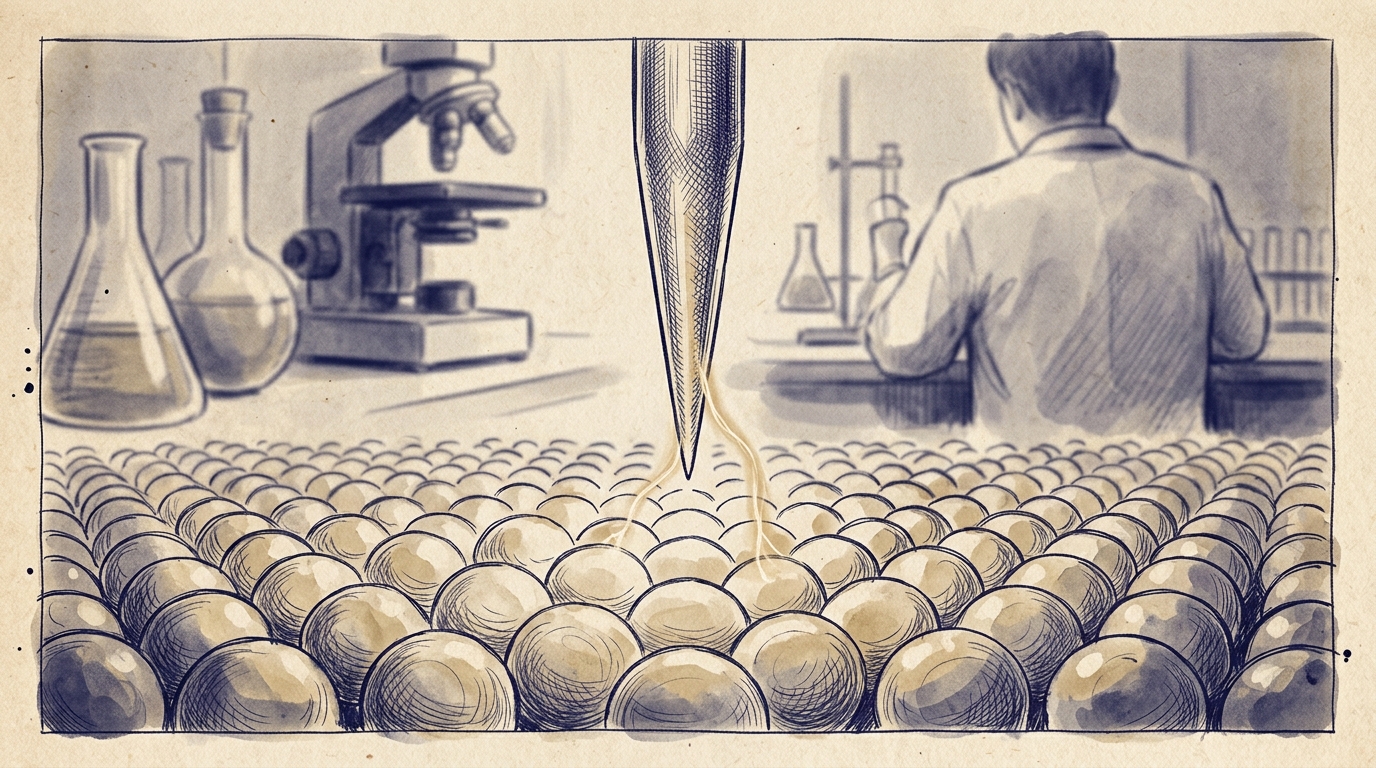
For a hundred years, atoms were the surest thing in science that no one had ever seen. Real beyond doubt. And, on any ordinary surface, utterly invisible `F3`. Then, in a Zurich lab, two physicists held a metal needle a breath above a surface — never touching it — and read a faint electric whisper leaking across the gap `F1`. That whisper drew a map. Individual atoms, in plain view `F1`. And soon, the same needle would nudge them about, one at a time, like beads `F10`.
02THE WORLD THEN
By 1980, no one doubted atoms were real `F3`. But real and seen are different things. Everything we knew of them came sideways — from how they scatter X-rays, from the light they give off, from the equations `F3`. Always an average over billions. Never one atom, fixed to one spot on a real surface `F3`. And the reason is simple. To resolve a thing, your wave must be finer than it is. Visible light ripples in waves thousands of atoms wide `F3`. Far too coarse. So the field was starving for a way to stop inferring, and start seeing.
03THE QUESTION
So here is the question they set themselves. Not the average. Not the diffraction pattern. Could you map real atoms, one at a time, exactly where they sit — a picture you could point at? `F3`
04THE DESIGN ① the quantum gap
Their answer began with a quantum trick. Bring a sharp metal tip within a nanometre of a conducting surface `F4`. Close — but never touching. In our world, no current can cross that empty gap. In the quantum world, it can. An electron can simply appear on the far side of a wall it hasn't the energy to climb `F4`. Physicists call it tunneling `F12`. Across the vacuum, a tiny current flows `F4`.
05THE DESIGN ② the exponential ruler
But this current answers to just one thing: the width of the gap. Draw the tip closer by a single ångström — a ten-billionth of a metre, less than the width of an atom — and it leaps roughly tenfold `F5`. So think what that means for the very end of the needle. Whichever atom pokes out closest carries almost the entire current `F5`. You are not reading with the needle. You are reading with its one frontmost atom `F5`. One atom, feeling for another.
06THE DESIGN ③ scan & feedback
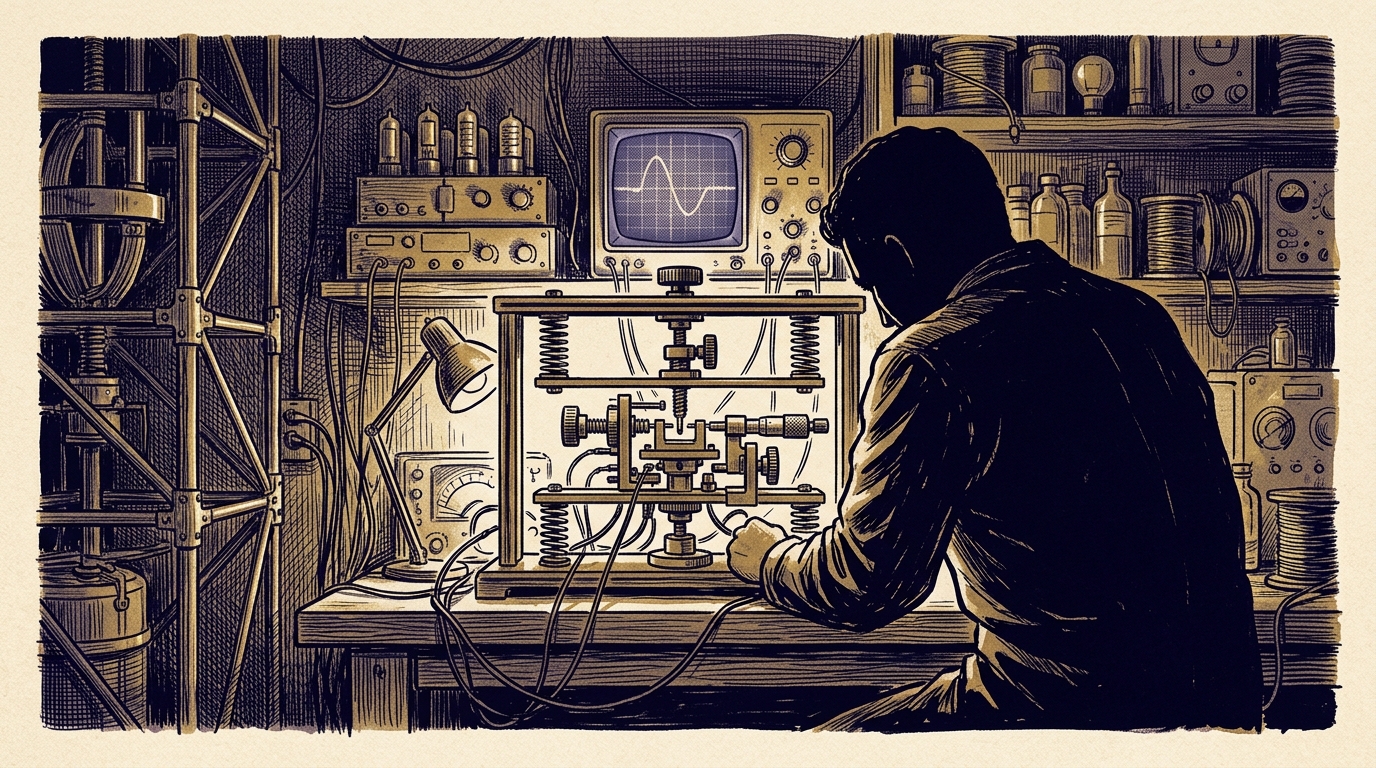
Now you have to move this atom-sized feeler without a single stumble. The tip rides on crystals that stretch when you apply a voltage — by fractions of an atom, smooth as breath `F6`. It rasters, back and forth. A feedback loop watches the current every instant and lifts or drops the tip to hold it dead constant `F6`. Trace those tiny height corrections across the surface, and you have drawn the landscape — atom by atom `F6`. One catch. A passing truck, a footstep, a voice would drown it. So the first machine floated free, hung on a magnet, in near silence `F7`.
07THE RESULT
Then, in 1982, silicon `F8`. They aimed the tip at a clean silicon surface and scanned. And out of the noise rose row upon row of individual atoms — locked in a pattern of sevens, the famous seven-by-seven `F8`. A reconstruction people had argued over for years, read only from blurry diffraction. Here it was, in the open `F8`. The first time anyone had looked at a surface and seen its atoms, one by one `F1`.
08WHAT WE LEARNED
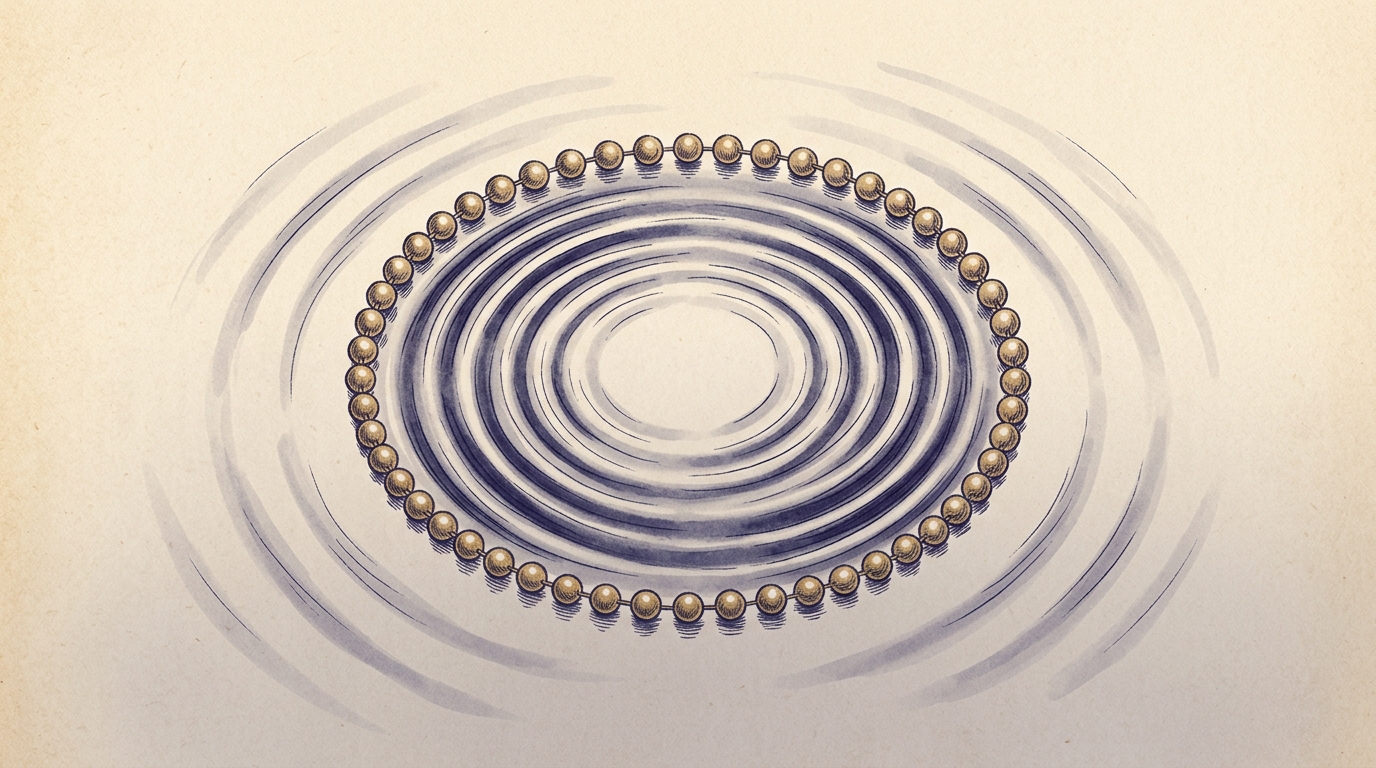
The nanoscale was open, to sight and then to the hand. The idea threw off a whole family of probes. Its closest cousin, the atomic force microscope, gave up the current entirely `F9`. It feels the faint forces between atoms instead `F13`. And so it reads what the tunnelling tip never could: insulators, plastics, even living cells `F13`. Then, in 1989, the astonishment: researchers slid thirty-five xenon atoms into place, one by one, and spelled three letters — I, B, M `F10`. Later, they fenced electrons inside rings of atoms and watched them ripple into standing waves `F11`. In 1986, Binnig and Rohrer took the Nobel Prize — sharing it with Ernst Ruska, father of the electron microscope `F1`.
09WHY IT'S BEAUTIFUL
What makes it beautiful is where the power came from. Tunneling was a ghost from the 1920s — a paradox on a chalkboard, electrons passing through walls, of no use to anyone `F12`. Binnig and Rohrer took that paradox and made it a ruler `F5`. They did not build a better lens. They gave up on light entirely, and chose to feel the surface instead — with a current, and a single atom `F5`.
10SIGN-OFF
To see the smallest things, they stopped trying to look — and reached out to touch. — Beautiful Experiments.
The write-up
In one line: By dragging an atomically fine metal needle a nanometre above a surface and reading the ghostly quantum current that tunnels across the gap, Gerd Binnig and Heinrich Rohrer let humanity see — and later move — individual atoms.
The world then
By 1980 atoms were beyond doubt as physical entities, but they remained abstractions inferred from indirect evidence — X-ray and electron diffraction, spectra, and equations. No microscope could resolve individual atoms sitting on a surface in real space: visible light's wavelength is thousands of times too coarse, and even electron microscopes struggled to image single atoms cleanly on a solid. Surface science — which governs chemistry, catalysis, and the transistors then transforming the world — was hungry for a tool that could stop inferring and start seeing.
The question
Could you map the exact position of individual atoms on a surface, one at a time, in real space — not a statistical average, but a picture you could point at?
The design
The scanning tunneling microscope (STM) exploits quantum-mechanical tunneling. Bring an atomically sharp metal tip within a nanometre of a conducting surface — without touching — and electrons tunnel across the vacuum gap, producing a tiny current. That current is exquisitely sensitive to distance: it changes by roughly an order of magnitude for every ångström (0.1 nm) of gap. That steep dependence is the secret of atomic resolution — the single closest atom on the tip carries almost all the current, so the instrument effectively reads the surface with one atom. The tip is mounted on piezoelectric crystals that expand and contract by fractions of an atom under applied voltage, letting it scan with sub-atomic precision. A feedback loop constantly adjusts the tip's height to hold the tunneling current constant as it rasters; the record of those height adjustments traces the surface topography atom by atom. The whole assembly had to be isolated from every stray vibration — the earliest apparatus floated on superconducting magnetic levitation.
The result
In 1982 the tip resolved the atomic terraces and the famous 7×7 reconstruction of a silicon (111) surface — an intricate lattice that had been argued over from diffraction data but never seen directly (Binnig, Rohrer, Gerber & Weibel, Phys. Rev. Lett. 50, 120, 1983). It was the first time anyone had looked at a surface and seen its atoms, one by one.
What we learned, and why it's beautiful
The STM opened the nanoscale to direct human vision and, ultimately, to manipulation. It spawned an entire family of scanning-probe microscopes — the atomic force microscope (1986) chief among them — now standard across physics, chemistry, biology and semiconductor manufacturing. Most astonishingly, the tip could not only see atoms but move them: in 1989 Don Eigler and Erhard Schweizer positioned 35 xenon atoms to spell "IBM," and in 1993 "quantum corrals" trapped surface electrons into visible standing waves. Binnig and Rohrer shared the 1986 Nobel Prize in Physics with Ernst Ruska. The beauty is in the leap: tunneling was a purely counterintuitive prediction of 1920s quantum mechanics, and they turned that abstract paradox into a practical ruler — giving up on light entirely and choosing instead to feel the surface, with a current and a single atom.
Sources
Full claim-by-claim evidence is in references.md. Primary anchors:
- Binnig, Rohrer, Gerber & Weibel, "7×7 Reconstruction on Si(111) Resolved in Real Space," Phys. Rev. Lett. 50, 120 (1983).
- Binnig & Rohrer, Nobel Lecture, "Scanning Tunneling Microscopy — from Birth to Adolescence" (1986).
- Eigler & Schweizer, "Positioning single atoms with a scanning tunnelling microscope," Nature 344, 524 (1990).
Accuracy note: the episode is careful that (a) the STM produced the first real-space image of the Si(111)-7×7, but the complete structural model was settled later; (b) seeing atoms (1982) and moving atoms (Eigler, 1989) are separate milestones on related instruments; (c) atomic resolution does not require a deliberately perfect single-atom tip — the exponential current makes the frontmost atom dominate.
The evidence
Every claim, sourced
Each [F#] you hear in the film links to the source it came from. Nothing gets narrated until every one is checked and signed off.
Sign-off
- Producer fact-check — invention/first-images (1981 tunneling → 1983 Si 7×7 atoms), tunneling principle, order-of-magnitude-per-ångström sensitivity, piezo + constant-current feedback, magnetic-levitation isolation, the 7×7 result, AFM 1986 (force-sensing, images non-conductors — F13), Eigler's 35 Xe/Ni(110)/4 K (1989–90), quantum corrals (1993), tunneling as a 1928 prediction, and Nobel 1986 (shared with Ruska) are all corroborated against the sources above.
- ⚠️ Traps stated correctly in
script.md: (a) individual atoms tied to the 1983 Si(111)-7×7, not the 1982 steps paper [F1,F8]; (b) novelty is atoms on a flat surface in real space — FIM (1955) had imaged atoms on tips [F3]; (c) STM visualized the 7×7 directly but did not alone solve the DAS structure (Takayanagi 1985) [F8]; (d) seeing (1982) vs moving (Eigler 1989) atoms kept distinct [F10]; (e) atomic resolution does not require a perfect single-atom tip — the exponential current makes the frontmost atom dominate [F5]. - Numbers used in audio kept robust: only ×10 per ångström, 35 xenon atoms, and the years are stated as exact; the gap is "within a nanometre" (honest upper bound on ~4–7 Å) and the light/atom ratio is "thousands of atoms wide" (qualitative).
- PhD sign-off (recommended before public release) — a surface-physicist read confirming the 7×7/DAS framing and the ×10-per-Å figure against the primary PDFs would fully close the gate; the claims are otherwise sourced.
Gate OPEN → narration + render may proceed.
- F1⚠ commonly confused
The STM was invented by Binnig & Rohrer at IBM Zurich; it gave the first real-space images of a surface's individual atoms; they shared the 1986 Nobel Prize in Physics with Ernst Ruska (electron microscope). ⚠️ 1982 paper shows atomic steps/terraces; individually resolved atoms first appear in the Jan 1983 Si(111)-7×7 image — the script ties "seeing atoms" to the 7×7.
First vacuum tunneling 16 Mar 1981; PRL 49,57 (1982, steps); PRL 50,120 (1983, 7×7 atoms); Nobel 1986 ½ Ruska, ½ Binnig+Rohrer
- F3⚠ commonly confused
By 1980 atoms were established but could not be imaged individually on an ordinary flat surface in real space; positions came indirectly (X-ray/electron diffraction, spectra) as averages. To resolve a thing your wave must be finer than it: visible light (~400–700 nm) is thousands of times larger than an atom (~0.1–0.3 nm / 1–3 Å). ⚠️ Field-ion microscopy (Müller, 1955) had imaged atoms at the apex of a sharp tip — the STM's novelty is atoms on a flat surface in the device-relevant geometry; the script says "on a surface / on any ordinary surface."
Optics diffraction limit (Abbe ~λ/2); atomic diameters 1–3 Å; ratio 10³–10⁴×
- F4⚠ commonly confused
STM principle: a sharp metal tip is brought within a nanometre of a conducting surface without touching; electrons tunnel across the vacuum gap, giving a small tunneling current (~0.1–10 nA). ⚠️ the operating set-point gap is really ~4–7 Å (well under 1 nm); "within a nanometre" is the honest upper bound the script uses.
Vacuum tunneling gap a few Å; current in nA range
- F5
The tunneling current is exponential in the gap: ≈ one order of magnitude (×10) per 1 Å. So the single frontmost atom of the tip carries almost all the current (~90% from an atom just ~1 Å closer) → atomic resolution without a deliberately perfect single-atom tip.
Exponential decay of tunneling probability; Tersoff–Hamann; frontmost-atom domination
- F6
The tip rides on piezoelectric actuators moving it in sub-ångström steps; a feedback loop holds the tunneling current constant as it rasters (constant-current mode), and the recorded height corrections map the topography atom by atom.
Tripod/tube piezo scanner; constant-current z-feedback = image
- F7
The instrument needed extreme vibration isolation; the first STM floated on superconducting magnetic levitation (a lead bowl), also giving eddy-current damping — later abandoned for spring suspension.
Original apparatus: superconducting maglev over lead; confirmed in Nobel account
- F8⚠ commonly confused
In 1982 the tip resolved the silicon (111) 7×7 reconstruction in real space — a lattice long argued over from diffraction, never seen directly (pub. Phys. Rev. Lett. 50, 120, 10 Jan 1983). ⚠️ The STM showed the 7×7 periodicity/corrugation directly; the complete atomic (DAS) structure was worked out later (Takayanagi et al., 1985, using electron diffraction) — the script claims direct visualization, not that STM alone solved the structure.
Binnig, Rohrer, Gerber, Weibel, "7×7 Reconstruction on Si(111) Resolved in Real Space"
- F9⚠ commonly confused
The STM spawned a family of scanning-probe microscopes; chief is the atomic force microscope (AFM) — Binnig, Quate & Gerber, 1986. ⚠️ AFM inventors are Binnig/Quate/Gerber (not Rohrer).
G. Binnig, C. F. Quate, Ch. Gerber, "Atomic Force Microscope," PRL 56, 930 (1986)
- F10⚠ commonly confused
In 1989, Eigler & Schweizer (IBM Almaden) used an STM to position 35 xenon atoms to spell "IBM" on a nickel (110) surface at ~4 K (pub. Nature 344, 524, 5 Apr 1990). ⚠️ done Nov 1989 / published 1990; seeing atoms (1982) and moving atoms (1989) are distinct milestones.
D. M. Eigler & E. K. Schweizer, "Positioning single atoms with a scanning tunnelling microscope"
- F11⚠ commonly confused
Quantum corrals — rings of atoms confining surface electrons into visible standing waves — Crommie, Lutz & Eigler, 1993 (48 iron atoms on Cu(111)). ⚠️ 1993, distinct from and later than the 1989 "IBM" atoms.
Crommie, Lutz, Eigler, "Confinement of Electrons to Quantum Corrals on a Metal Surface," Science 262, 218 (1993)
- F12
Quantum tunneling (barrier penetration) was a counterintuitive 1920s prediction (Gamow's α-decay, 1928; Fowler–Nordheim field emission, 1928); the STM turned that abstract effect into a practical instrument.
Tunneling firmly identified 1928 (Gamow; Gurney–Condon; Fowler–Nordheim)
- F13⚠ commonly confused
The AFM senses interatomic forces, not a tunnelling current (a sharp tip on a flexible cantilever), so — unlike the STM, which requires a conducting sample — it images non-conductors: insulators, polymers/plastics, and biological samples (even living cells). ⚠️ this force-vs-current distinction is the whole reason AFM was invented — the STM's blind spot.
AFM's founding motivation was imaging insulators the STM could not; force sensing via cantilever